Constraint-Aware Proximal Policy Optimization for Band-Gap Prediction in Inorganic Crystal Datasets
DOI:
https://doi.org/10.64972/dea.2023.v2i1.3506d:71-85Keywords:
Proximal Policy Optimization, Band-Gap Prediction, Constraint-Aware Learning, Uncertainty Quantification, Materials InformaticsAbstract
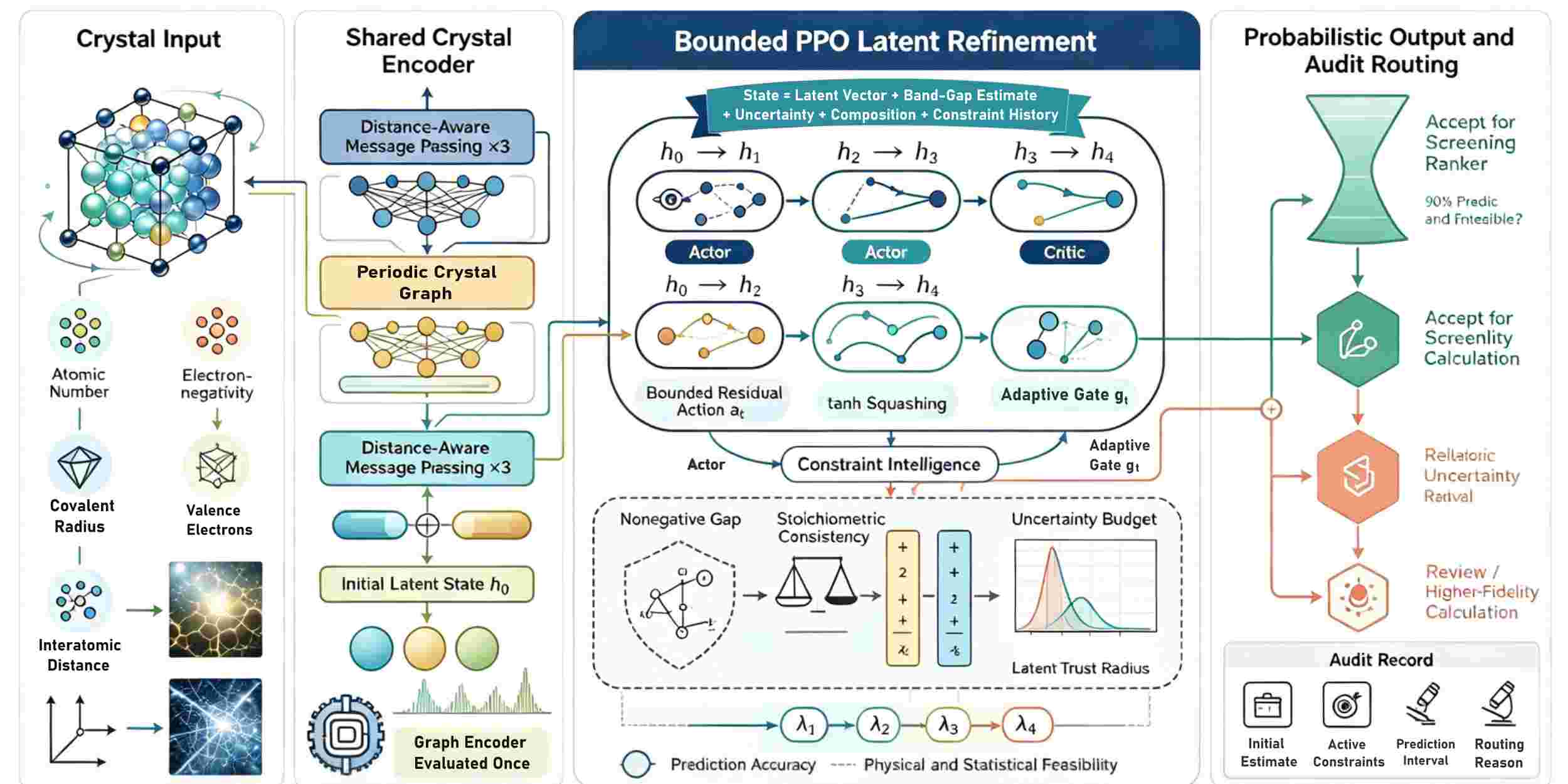
A small search space can be obtained for the functional inorganic crystal by a good band-gap prediction; however, traditional regressors may produce chemically inconsistent or poorly calibrated estimates outside the training distribution. This paper introduces a constraint-aware proximal policy optimization algorithm. The algorithm treats predictions as a series of brief potential state-refined actions. A crystal graph encoder initializes the state; a clipped policy selects bounded residual updates; and a supervised value head estimates the band gap along with heteroscedastic uncertainty. Four constraints are imposed via adaptive Lagrange multipliers instead of a fixed penalty: non-negative output, stoichiometric consistency, bounded latent displacement, and uncertainty control. On composition-disjoint benchmark splits with 42,318 crystals, the proposed model achieved a mean absolute error of 0.274 eV and a coefficient of determination of 0.892. It reduced the violation rate from 6.8% for an unconstrained policy to 1.3% and increased the 90% prediction-interval coverage from 82.4% to 89.1%. Under element-holdout transfer, the increase in error was only 18.6%, and it was lower than that for the strongest graph-regression baseline at 31.7%. Ablation results attribute the most reliable gain to adaptive dual updates and uncertainty-aware rewards. Routing of reviews also included difficult predictions and did not discard their estimates for practical two-stage screening. Therefore, by explicitly incorporating physical and statistical constraints during the optimization process, policy-based optimization can enhance the numerical accuracy of the results and the reliability of deployment.
Downloads
Published
How to Cite
Issue
Section
License
Copyright (c) 2023 Serkan Bozkurt, Zeynep Demir, Lokman Öpçin

This work is licensed under a Creative Commons Attribution-NonCommercial-ShareAlike 4.0 International License.