Improved Vessel Trajectory Prediction from AIS Data Streams by Integrating Explainable Temporal Fusion Transformer
DOI:
https://doi.org/10.64972/dea.2022.v1i1.3174d:44-56Keywords:
AIS Data Stream, Vessel Trajectory Prediction, Temporal Fusion Transformer, Explainable Artificial Intelligence, Maritime Traffic MonitoringAbstract
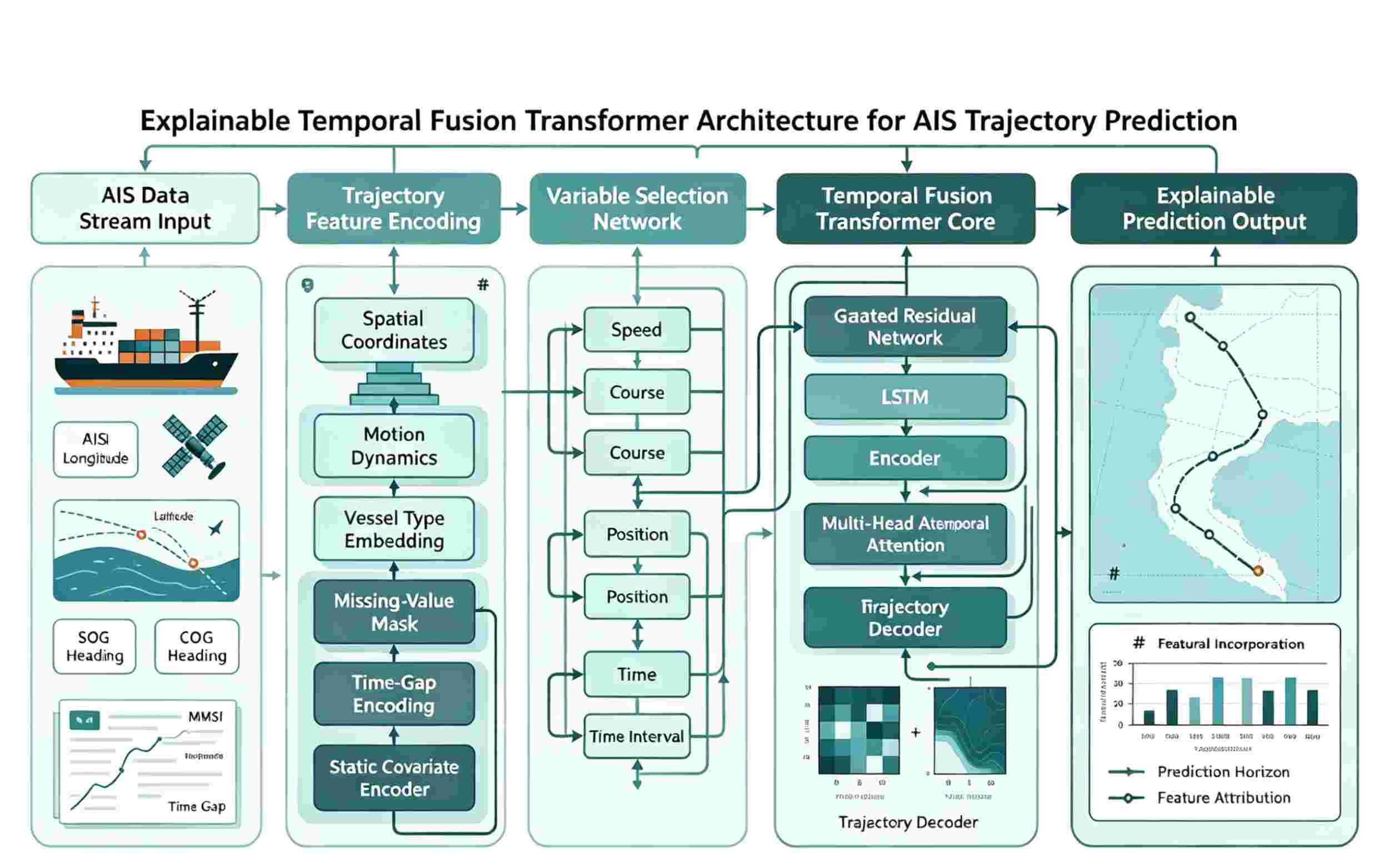
For intelligent navigation supervision, port scheduling, collision risk warning, and marine traffic management, real-time vessel trajectory prediction based on AIS data streams is required. AIS sample irregularities, missing reports, non-linear maneuvering behavior, and poor interpretability are some of the shortcomings of the existing prediction model. In this research, we propose an enhanced vessel trajectory prediction approach that combines AIS stream modeling with an explainable Temporal Fusion Transformer. Stream-level cleaning, temporal feature building, gated variable selection, attention-based temporal fusion, and multi-horizon trajectory forecasting have all been introduced to the framework. Predict the ship's future location, speed, and direction while giving it varying degrees of significance and temporal focus. Create experiments using different vessel kinds, navigation situations, missing-message rates, and forecast horizons based on coastal AIS feeds. By lowering the 30-minute mean position error from 0.84 nautical miles to 0.57 nautical miles, increasing the heading prediction accuracy by 7.6%, and maintaining the inference latency below 42 ms per trajectory window, the suggested method has greatly outperformed LSTM, GRU, Transformer, Informer, and the original TFT baseline. As a consequence, explainable temporal fusion has demonstrated high performance in correctly and interpretable ship trajectory prediction in a real-time AIS stream.
Downloads
Published
How to Cite
Issue
Section
License
Copyright (c) 2022 Mouza Al-Qasimi, Hind Al-Habsi, Tahani Al-Ghafli

This work is licensed under a Creative Commons Attribution-NonCommercial-ShareAlike 4.0 International License.