Path Planning Optimization of Urban Traffic Systems Based on Big Data
DOI:
https://doi.org/10.64972/dea.2023.v2i1.2953d:28-41Keywords:
Big Data Analytics, Path Planning Optimization, Dynamic Routing, Spatiotemporal Traffic PredictionAbstract
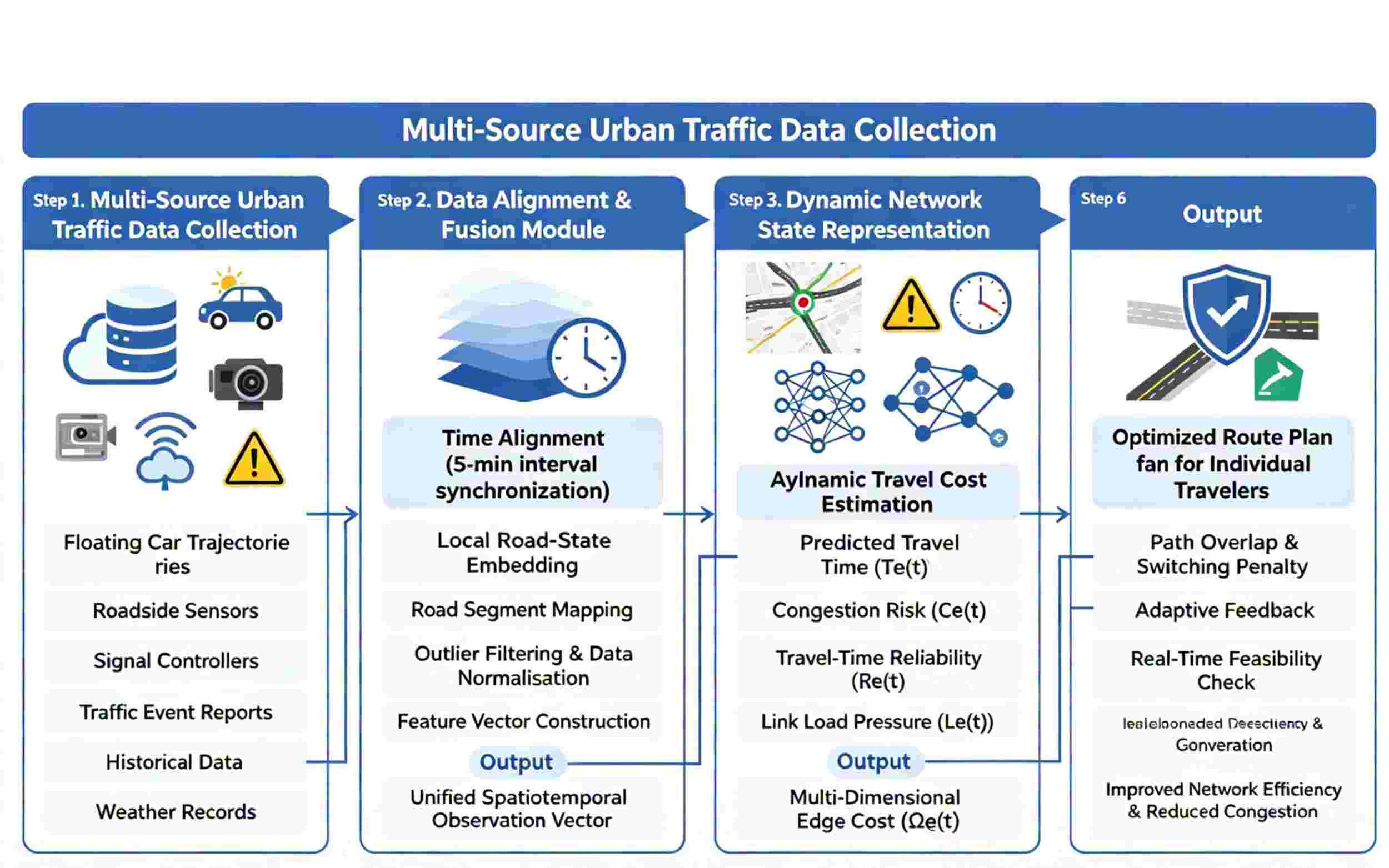
The urban traffic system's route planning approach must take into account the spread of congestion, the variety of the road network, and the time-varying travel demand. This study proposes a path planning optimization paradigm for urban traffic systems based on big data. A dynamic road-network model is constructed from a variety of traffic data sources, including floating-car trajectories, road-segment speeds, signal timing, traffic-flow records, and incident information. The travel time of a link, congestion risk, route reliability, and network load will then be calculated using a spatiotemporal cost model. An adaptive route-selection method will be developed based on the model to increase individual travel efficiency and more equitably distribute system traffic. Test a large-scale metropolitan road network during periods of high demand, frequent traffic jams, and incident disruptions. The suggested approach has reduced average trip time by 13.8%, route delay variation by 18.6%, and bottleneck-link load by 16.9% when compared to the conventional static shortest-path routing, historical-average routing, and other dynamic routing techniques. The study can be used to enhance route selection stability and encourage the real-world implementation of intelligent transportation management.
Downloads
Published
How to Cite
Issue
Section
License
Copyright (c) 2023 Themis Giannakis, Panagiotis Sarris, Haris Triantafyllou

This work is licensed under a Creative Commons Attribution-NonCommercial-ShareAlike 4.0 International License.