State-Space Refinement Kalman Filter Model for Roadway Roof Deformation Detection in Underground LiDAR Scanning
DOI:
https://doi.org/10.64972/dea.2023.v2i1.2942d:16-27Keywords:
Kalman Filtering, State-Space Modeling, Roof Deformation, LiDAR Point Clouds, Adaptive CovarianceAbstract
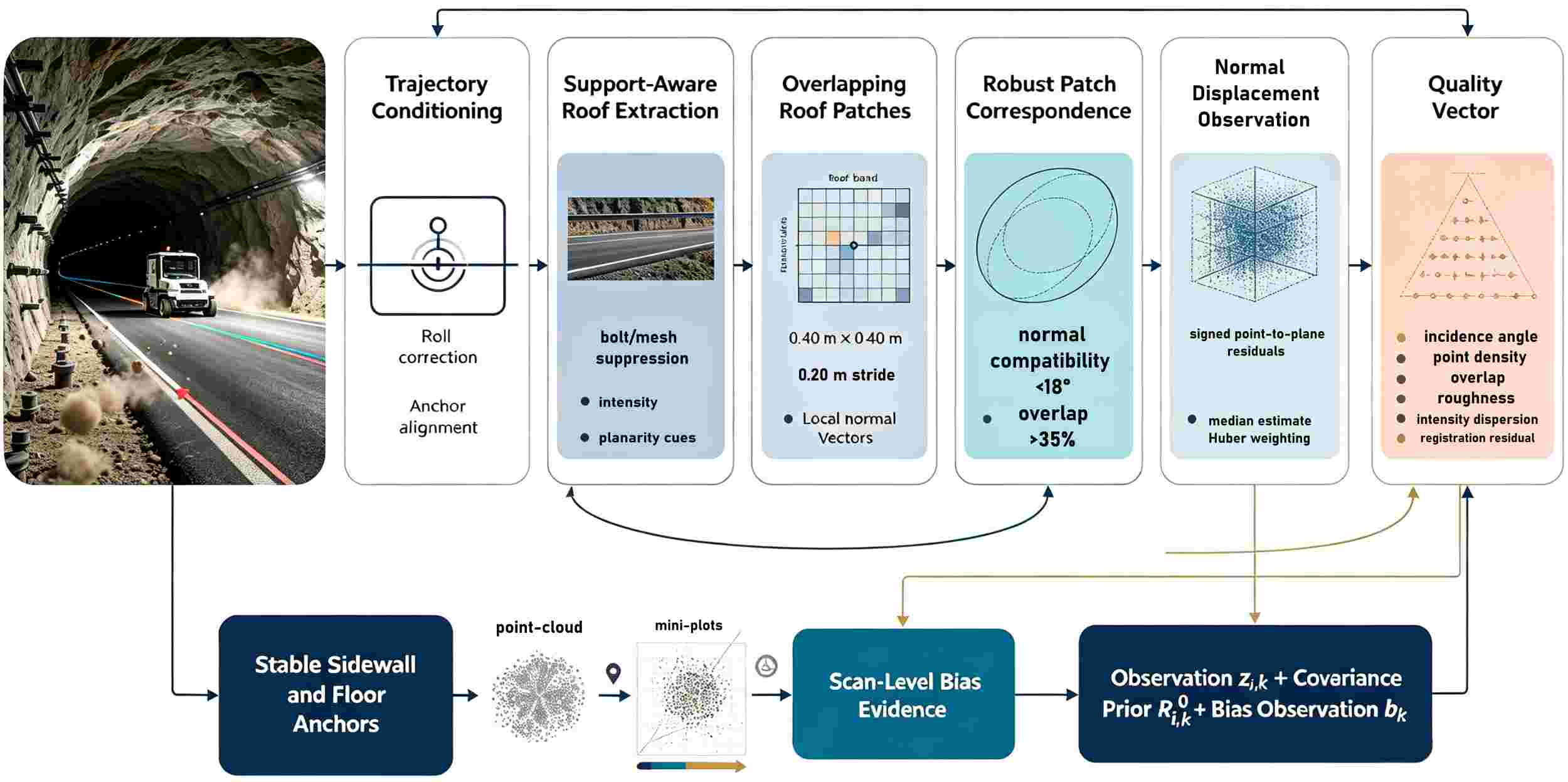
In repeated underground laser scanning, road-roof deformation can be reliably determined through irregular sampling, support occlusion, registration drift, oblique incidence, and dust backscattering. In this paper, a state-space refined Kalman filter is developed, which integrates the following components: normal displacement, deformation rate, acceleration trend, registration bias, and local shape persistence. Without affecting field deployability, innovative statistics refined the delay estimation, fixed-lag backward smoothing refined the delay estimation, and robust patch correspondences generated roof-aligned observations. The experiment was conducted 18 times on a 2.4-kilometer-long road, including natural deformations and controlled roof offsets. Among the 36,720 roof patches evaluated, the proposed model reduced the root mean square error of the direct point-to-plane differential displacement from 8.7 mm to 3.4 mm, while the root mean square error of the traditional Kalman filter was reduced from 6.1 mm to Under a 10mm alarm threshold, the accuracy is 94.1%, the recall rate is 92.6%, and the false alarm rate is 2.8%. The processing time for each 20-meter segment at the standard workstation is 0.43 seconds, and the 95% uncertainty interval covers 94.7% of the reference observations. The ablation results indicate that innovative conditional covariance adaptation and bias state separation are the main contributors under dusty and low-overlap scanning conditions. Therefore, this model provides an interpretable and computationally feasible basis for the deformation screening of underground road operations.
Downloads
Published
How to Cite
Issue
Section
License
Copyright (c) 2023 Zainab Al-Zaabi, Hamdan Al-Suwaidi, Amal Al-Hashimi, Mishaala Al-Tunaiji

This work is licensed under a Creative Commons Attribution-NonCommercial-ShareAlike 4.0 International License.