Gait-Adaptive Neural Operator for Snake Robots Using Proprioceptive Signals in Confined Spaces
DOI:
https://doi.org/10.64972/jaat.2026v4.389p34e:458-470Keywords:
Proprioceptive Sensing, Snake Robot, Neural Operator, Impedance Adaptation, Confined-Space LocomotionAbstract
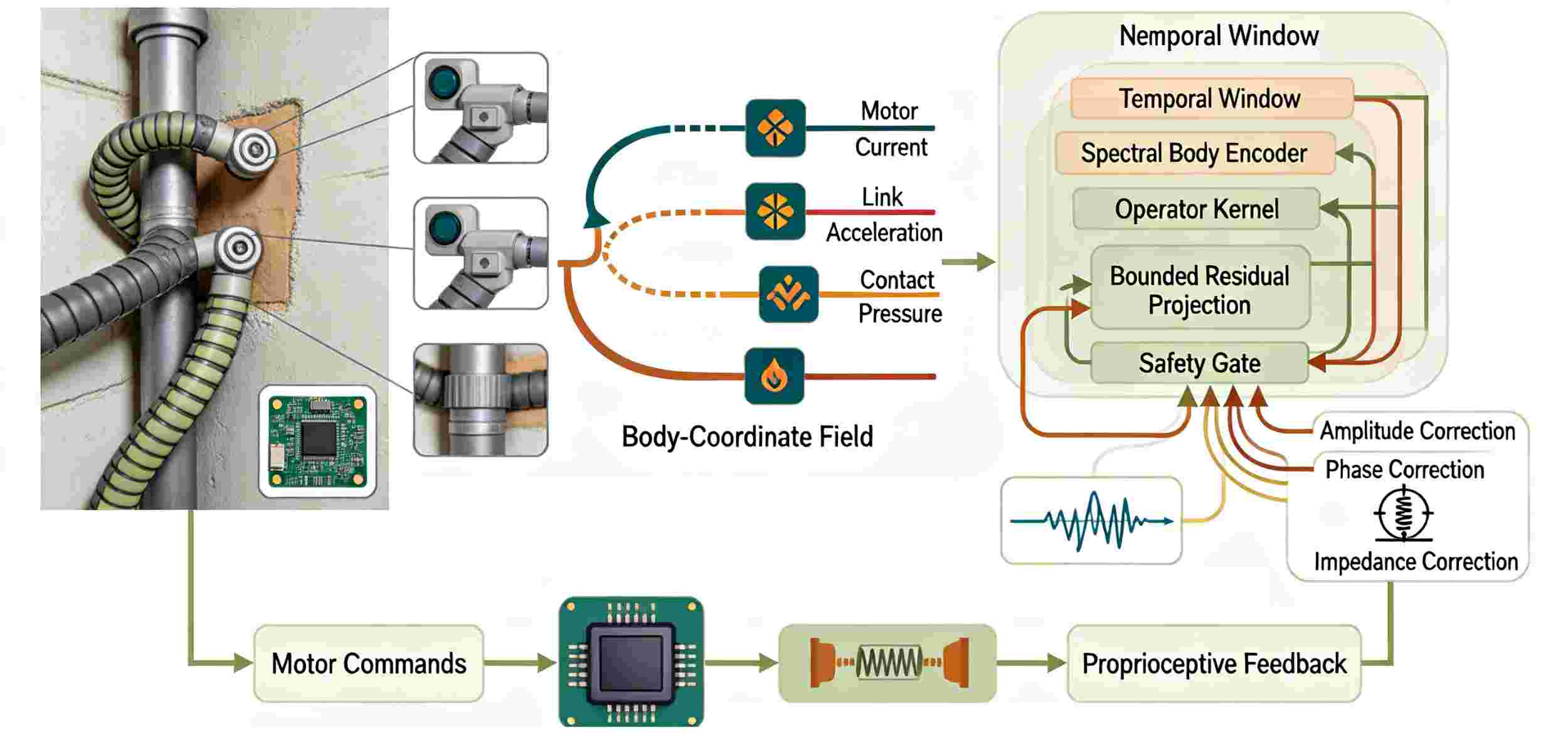
Confined industrial passages remain difficult for snake robots because contact forces, wall clearance, and body curvature change faster than vision-based planners can reliably update. This paper presents a gait-adaptive neural operator that converts proprioceptive streams into spatially continuous corrections for serpenoid amplitude, phase, and segmental impedance. Joint angle, motor current, link acceleration, and contact pressure are represented as body-coordinate fields, and the operator learns a corrective gait field without external localization. A bounded residual formulation keeps the learned correction compatible with rhythmic locomotion, actuator limits, and embedded control timing. Experiments were conducted in straight-pipe, elbow-pipe, rubble-slot, and cable-tray scenes with six clearance ratios, five friction levels, payload offsets, and injected sensing disturbances. Compared with fixed serpenoid, impedance-adaptive, and recurrent-policy baselines, the proposed operator increased mean traversal success from 71.4%, 82.6%, and 86.1% to 94.8%, reduced slip events by 39.7%, and lowered normalized transport cost by 18.9%. At a clearance ratio of 1.10, success reached 91.7%, while the strongest baseline reached 81.7%. The embedded GPU inference latency was 7.6 ms, supporting closed-loop updates at 80 Hz with timing margin for safety supervision. These results indicate that proprioceptive operator learning can support robust locomotion when visual sensing is intermittent, contaminated, or geometrically occluded.
Downloads
Published
How to Cite
Issue
Section
License
Copyright (c) 2026 Felicja Głębocka, Lech Cyprian Górski, Grzegorz Chmielewski, Maria Kaczan

This work is licensed under a Creative Commons Attribution-NonCommercial-ShareAlike 4.0 International License.