Feature-Selected Random Forest for Vision-Based Grasp Detection in Industrial Robotic Manipulators
DOI:
https://doi.org/10.64972/jaat.2026v4.387p32e:426-441Keywords:
Industrial Robotics, Visual Grasping, Feature Selection, Random Forest, RGB-D PerceptionAbstract
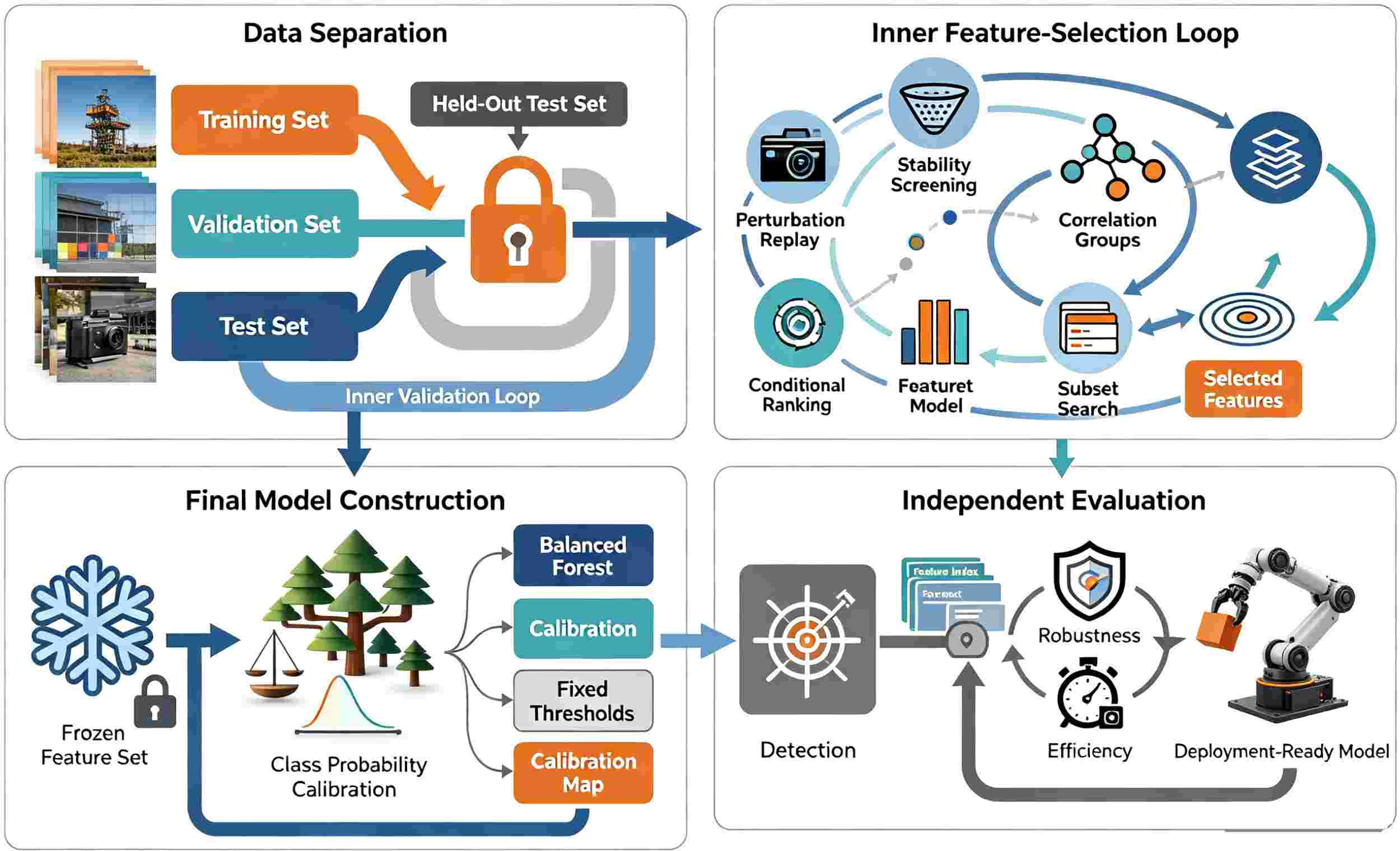
Reliable grasp detection on industrial manipulators is constrained by redundant visual descriptors, domain-dependent illumination, and the latency of evaluating high-dimensional candidates. This study develops a feature-selected Random Forest model that couple’s geometry-aware candidate generation with stability-guided feature screening and uncertainty-calibrated ensemble inference. RGB-D regions are encoded by shape, surface-normal, depth-discontinuity, texture, and manipulator-reachability descriptors. A three-stage selector first removes unstable variables, then ranks conditional permutation relevance, and finally searches compact subsets under accuracy-latency constraints. The selected variables train a class-balanced forest whose leaf votes are calibrated for rejection of ambiguous grasps. Replaceable engineering validation data comprising 18,600 labeled candidates from 3,100 scenes indicate that the 34-feature model attains 94.6% detection accuracy, 92.8% grasp success, and a 0.931 F1 score, compared with 90.7%, 87.9%, and 0.889 for an unselected 126-feature forest. Mean inference time falls from 31.8 to 18.7 ms per scene, while robustness under low illumination improves by 5.4 percentage points. Ablation results associate the largest directional-normal error reduction with stability filtering and the largest latency reduction with redundancy pruning. The model provides an interpretable and deployable route to visual grasp detection when training data, controller cycle time, and computational resources are limited. Its feature traceability also supports cell-level diagnosis and safe confidence-based rejection.
Downloads
Published
How to Cite
Issue
Section
License
Copyright (c) 2026 Saulė Mikalauskaitė, Danutė Gasiūnaitė, Agnė Ramanauskaitė

This work is licensed under a Creative Commons Attribution-NonCommercial-ShareAlike 4.0 International License.