TiDE-GNN: Causal-Guided Fusion Graph Neural Network for Automated Urban Canyon Wind Field Estimation from Sparse Mobile and Fixed Sensing
DOI:
https://doi.org/10.64972/jaat.2026v4.385p30e:398-412Keywords:
Urban Canyon Wind, Causal-Guided Fusion, TiDE-GNN, Temporal Decomposition, Street-Scale Meteorology, Sparse Urban SensingAbstract
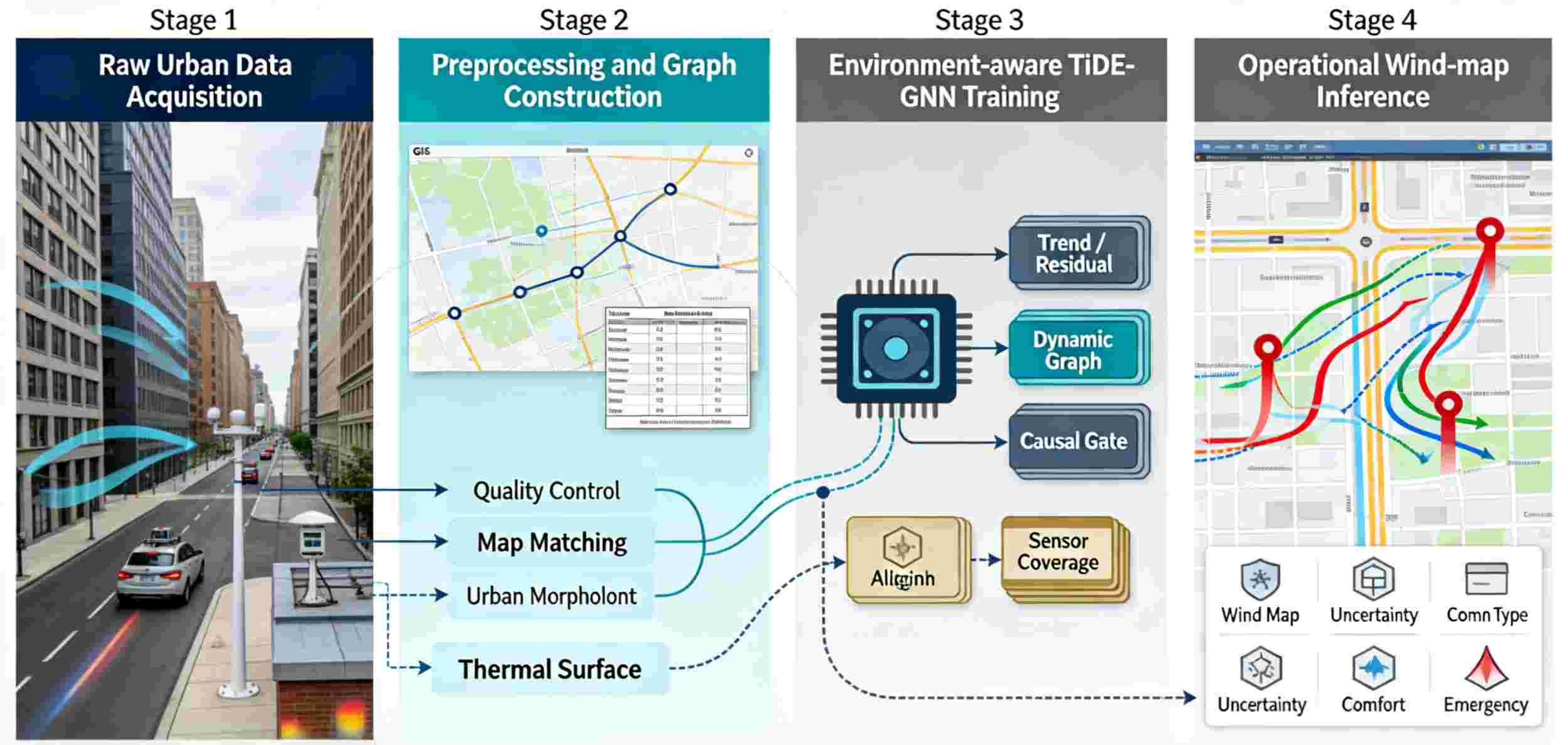
Street-level wind fields in urban canyons are difficult to determine because of building blockage, thermal contrast, vehicle disturbance, and a lack of monitoring; thus, local flow conditions differ from synoptic observations. TiDE-GNN is a temporal decomposition-enhanced graph neural network with causal-guided fusion proposed in this paper for wind speed and direction estimation in dense urban canyons. Decompose each observation sequence into a slowly varying trend and a disturbance component, build a morphology-aware road-segment graph, and fuse meteorological, geometric, thermal and mobile sensing variables using a causal gate that suppresses unstable correlations. A downtown test area covering 5.8 km2, 46 fixed anemometers, 12 mobile sensing traverses, 187 road segments and 62 days of hourly records was selected for the evaluation. TiDE-GNN reduced the MAE of wind speed to 0.39 m s⁻¹ and the MAE of direction to 13.2 degrees compared with the LSTM, DCRNN, STGCN and Graph WaveNet baselines, and increased the vector correlation to 0.87 from 0.78. At less than 30% sensor dropout, the model maintained a wind-speed RMSE of 0.58 m s⁻¹, and the best non-causal graph baseline was 0.70 m s⁻¹. Based on ablation experiments, causal fusion and temporal decomposition reduced the relative MAE by 8.4% and 6.9%, respectively. Based on the above results, Causal Constraint Graphs can be applied to improve street-level wind estimation in areas with sparse observation density and urban structures.
Downloads
Published
How to Cite
Issue
Section
License
Copyright (c) 2026 Zeki Güler, Yunus Erdoğan, Gökhan Jandarma, Halil Kaptan

This work is licensed under a Creative Commons Attribution-NonCommercial-ShareAlike 4.0 International License.