Intelligent Quality Monitoring of Edible Oil Production Using MambaOut-CA-Based Raman Spectral Recognition
DOI:
https://doi.org/10.64972/jaat.2026v4.384p29e:384-397Keywords:
Raman Spectroscopy, Edible Oil Adulteration, MambaOut-CA, Coordinate Attention, Chemometric ClassificationAbstract
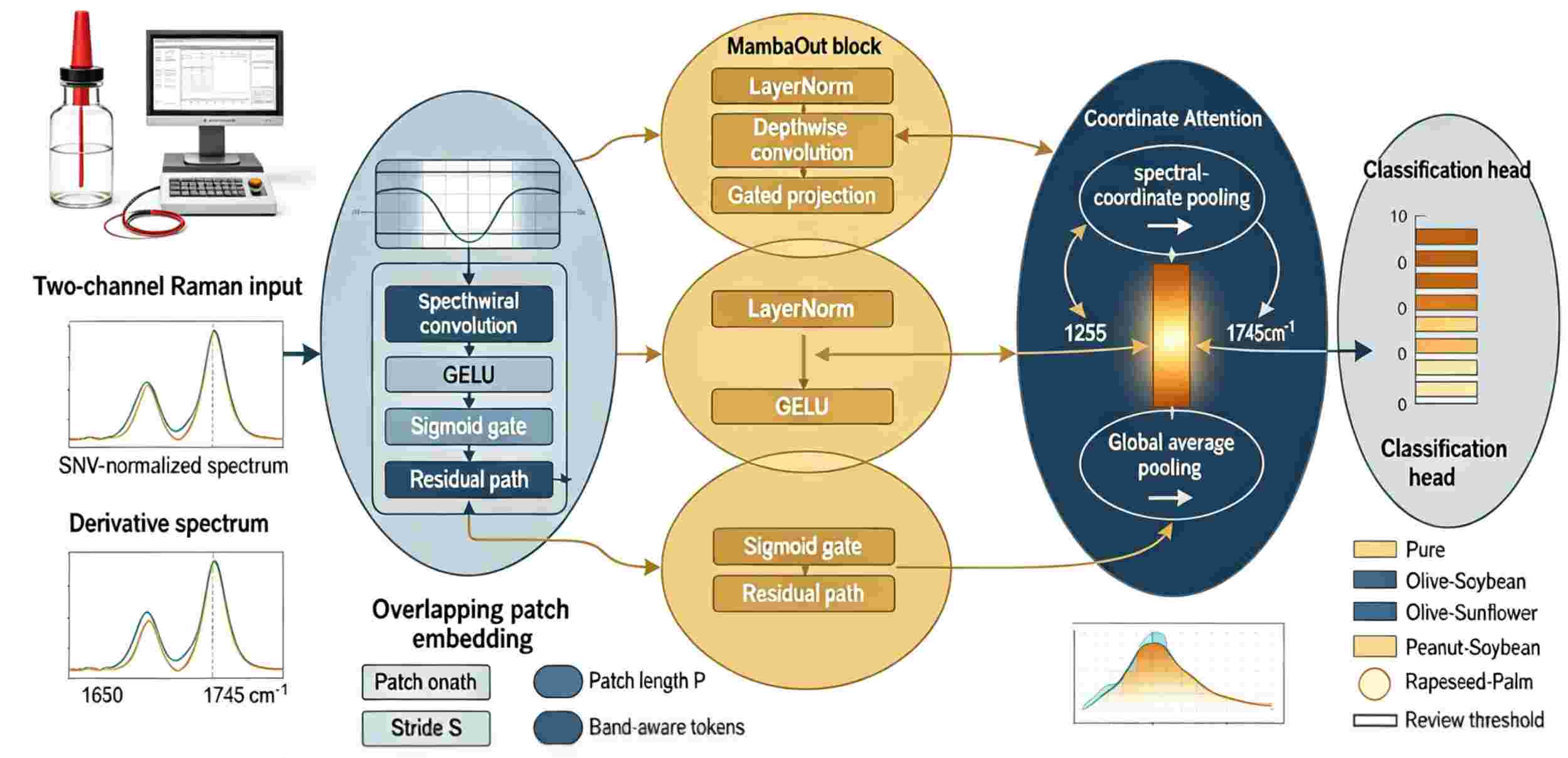
Raman spectroscopy can be used quickly and without damage for edible oil identification; however, precise differentiation of various types of adulteration at a low level and accounting for spectral changes among different production batches are still unresolved issues. MambaOut-CA is a compact neural classifier proposed in this paper that combines MambaOut-style gated spectral mixing with coordinate attention for one-dimensional Raman fingerprints of edible oils. A controlled dataset with five real oils and four adulteration paths was built, including 0, 2, 5, 10, 20, and 40% adulterant ratios across 1,920 spectra. The proposed workflow adds a baseline correction, standard normal variate normalization, first-derivative enhancement and band-aware patch embedding before supervised classification. MambaOut-CA achieved the highest overall accuracy of 98.72% and macro-F1 of 98.41% at the 2% adulteration level among PLS-DA, SVM, ResNet-1D, Transformer-1D and a MambaOut model without attention. Ablation results show that Coordinate attention increased the macro-F1 score by 1.37% and reduced low-level false alarms by 28.6%. The band assignments are concentrated at 1,265, 1,440, 1,650, and 1,745 cm⁻¹, which are consistent with Raman responses related to fatty chain deformation and carbonyl groups. The results show that gated local-global spectral mixing with lightweight attention is suitable for robust edible oil adulteration classification under practical spectral variations.
Downloads
Published
How to Cite
Issue
Section
License
Copyright (c) 2026 Matar Al-Rumaithi, Musab Al-Hammadi, Tawfiq Al-Sibairi

This work is licensed under a Creative Commons Attribution-NonCommercial-ShareAlike 4.0 International License.