Robust Food Freshness Assessment Against Complex Interferences for Cold Chain Monitoring Images
DOI:
https://doi.org/10.64972/jaat.2026v4.346p27e:357-368Keywords:
Cold Chain Images, Freshness Assessment, Multi-Scale Swin Transformer, Visual Quality MonitoringAbstract
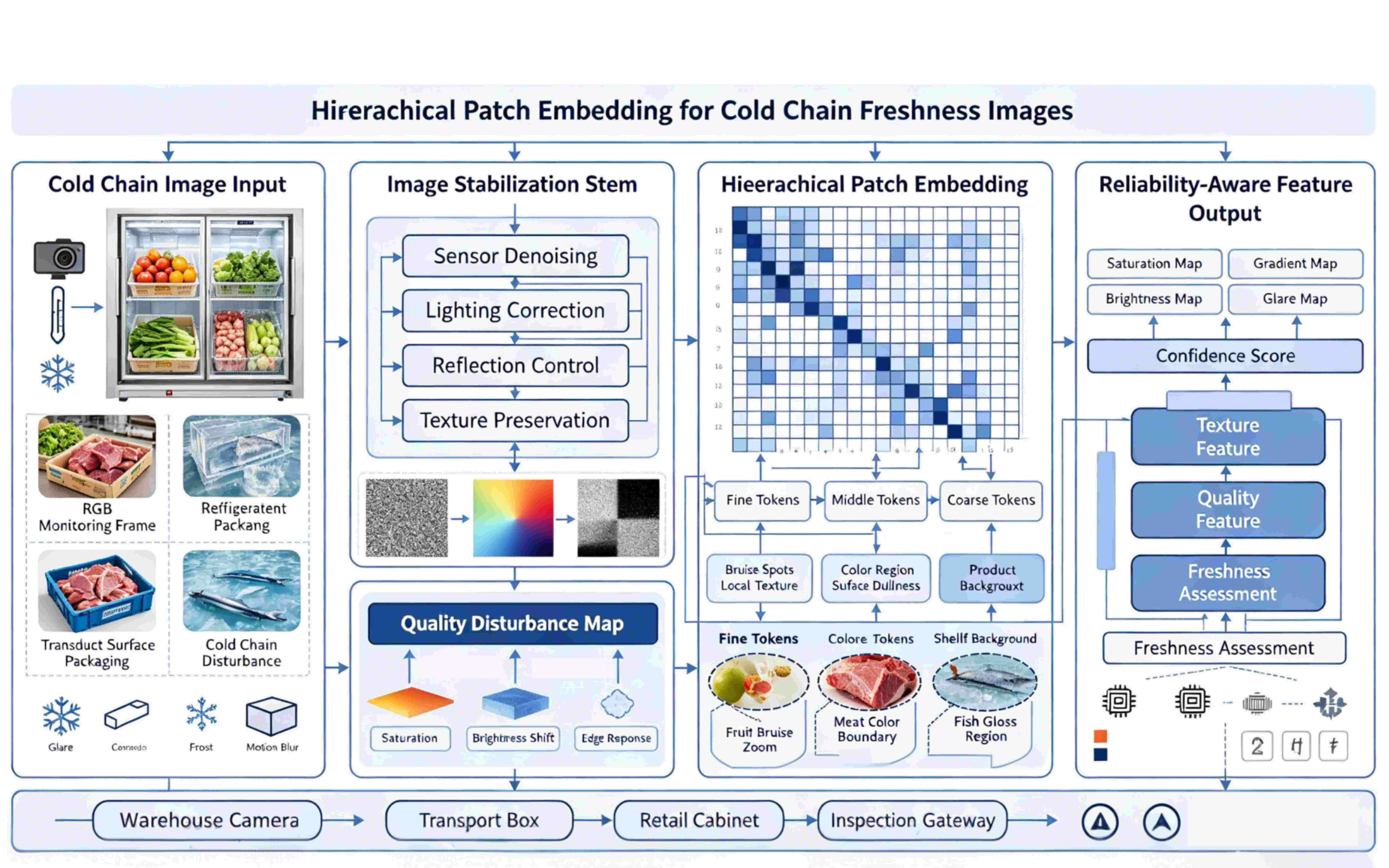
In cold chain logistics, use real-time freshness monitoring to minimize quality loss and postpone the warning. This research proposes a multi-scale Swin Transformer approach to monitor pictures of perishable goods under partial occlusion, condensation, packaging reflections, and variations in light. Method: The suggested system consists of an ordinal freshness choice layer, cross-scale shifted-window attention, hierarchical patch embedding, and reliability-aware token modulation. In a single visual form, the model takes into account product-level context, regional color shift, and local rotting texture. Results: The suggested model achieved 95.7% accuracy, 94.3% macro-F1, and an average inference latency of 19.4ms on a cold chain picture dataset of 21,360 samples for fruit, vegetable, meat, and aquatic product categories. Macro-F1 outperformed EfficientNet-B0 by 4.6 percentage points and conventional Swin Transformer by 2.8 percentage points. In summary, the new method is more accurate in differentiating between fresh and aged foods while still being useful for monitoring and application.
Downloads
Published
How to Cite
Issue
Section
License
Copyright (c) 2026 Maxime Fournier, Antoine Dupuis

This work is licensed under a Creative Commons Attribution-NonCommercial-ShareAlike 4.0 International License.