Ultra-Low-Power Vibration Anomaly Detection Spiking Neural Network Model for IoT Sensors
DOI:
https://doi.org/10.64972/jaat.2023v1.321p30e:404-416Keywords:
IoT Sensor, Spiking Neural Network, Vibration Anomaly Detection, Ultra-Low-Power Computing, Edge IntelligenceAbstract
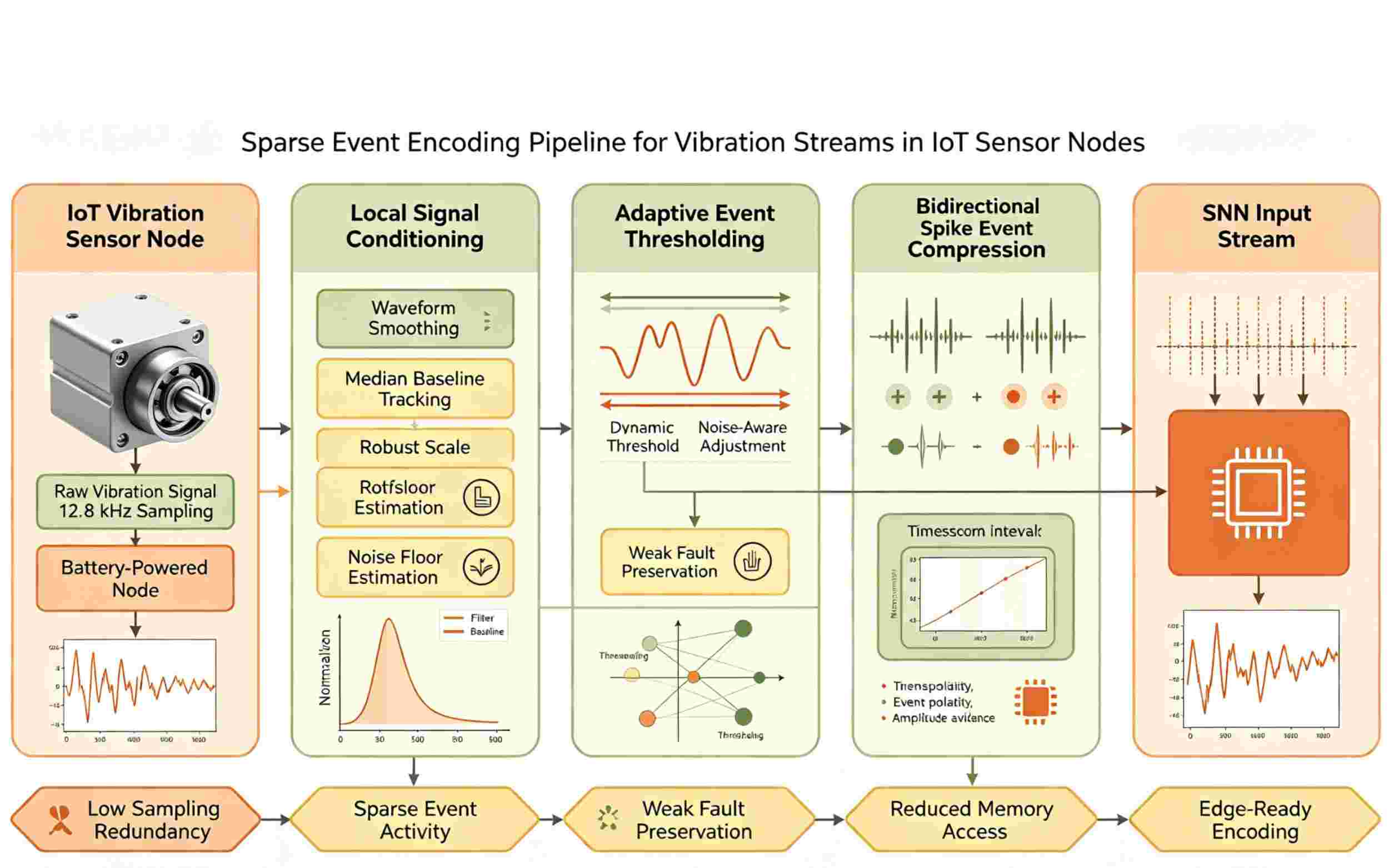
The Internet of Things' (IoT) long-term vibration monitoring will be limited by battery life, local memory, and ongoing sample costs. An ultra-low-power vibration anomaly detection approach based on spiking neural networks is proposed in this research. Create anomaly scores based on membrane potential deviation and spike activity, transform the continuous vibration signal into a sparse event stream, and use adaptive firing control to extract temporal spike characteristics. The detection accuracy, false alarm rate, spike firing rate, latency, memory footprint, and predicted energy consumption are tested using a set of bearing looseness vibration data, impact shock, imbalance, friction, and normal operation. With an accuracy of 96.8%, a macro-F1 of 95.4%, and an anomaly recall of 94.9%, the suggested model lowers estimated inference energy by 51.2% when compared to LSTM autoencoder baselines and by 63.7% when compared to compact CNN. Thus, low-power vibration anomaly detection in embedded IoT sensor modules may be achieved by event-driven spike computation.
Downloads
Published
How to Cite
Issue
Section
License
Copyright (c) 2023 Sylwia Majchrzak, Teresa Nowicka, Wioletta Gajewska

This work is licensed under a Creative Commons Attribution-NonCommercial-ShareAlike 4.0 International License.