Yield Drift Prediction in Wafer Lithography Using a TabTransformer-CatBoost Hybrid Model
DOI:
https://doi.org/10.64972/jaat.2023v1.320p29e:389-403Keywords:
TabTransformer, CatBoost, Wafer Lithography, Yield Drift, Categorical Embedding, Semiconductor ManufacturingAbstract
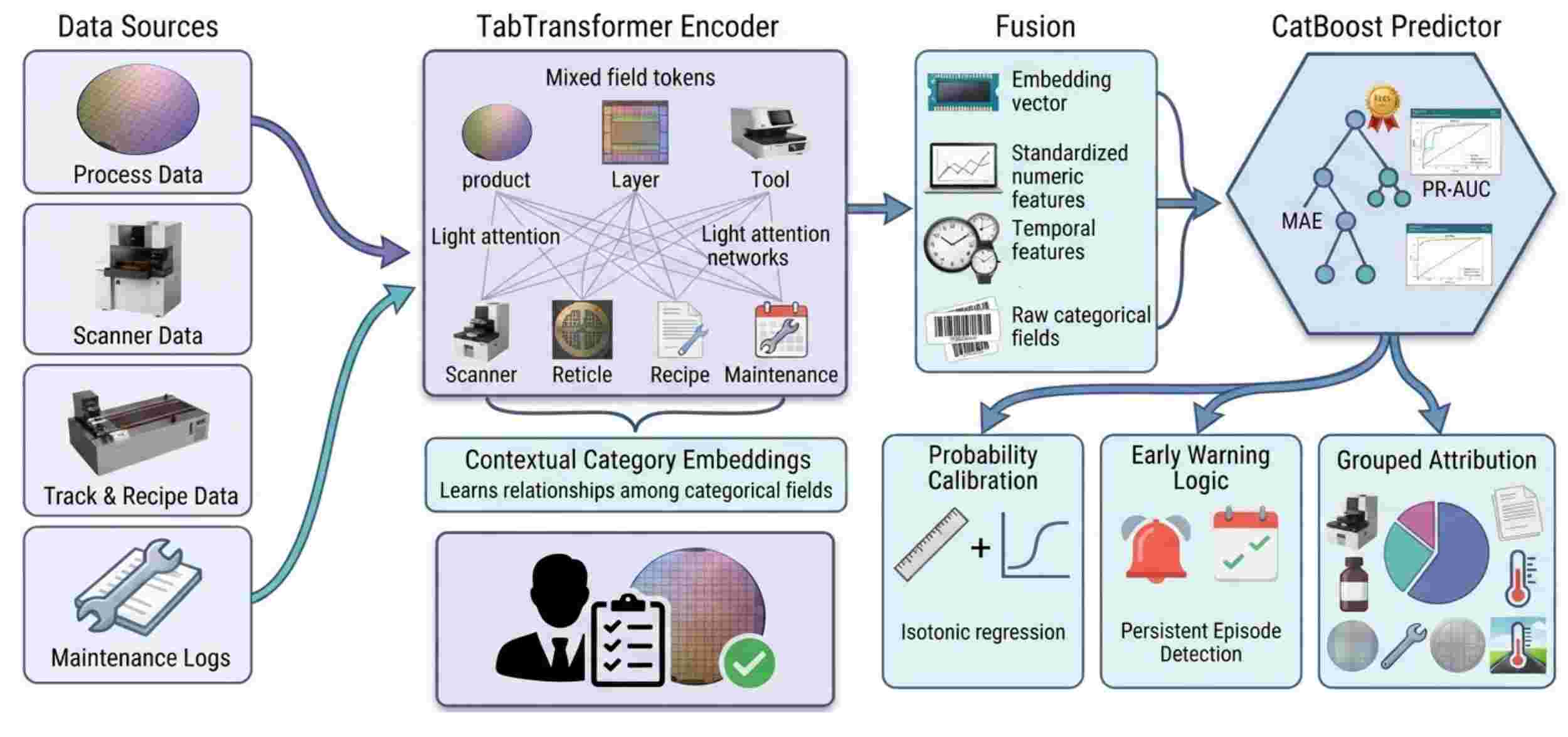
Yield drift in wafer lithography is often caused by weak interactions among tool state, product context, reticle history and metrology response, and fixed-limit monitoring is thus unable to detect early-stage degradation. Develop a TabTransformer-CatBoost hybrid model for lot-level drift prediction based on mixed manufacturing records in this paper. The pipeline has already aligned the collected 186,420 batches, which were gathered over a period of 14 months, encoding product, layer, scanner, track, formula, and maintenance status. It transmitted the learned representations, along with standardized continuous variables and explicit time indicators, to the CatBoost residual learner thru. Chronological rolling-origin validation avoids the leakage of future process states into training. In the held-out three-month interval, the mean absolute error of the hybrid was 0.842 percentage points and its area under the precision-recall curve for detecting a yield loss greater than 2.0 points was 0.913. It improves the error by 18.9% compared to CatBoost and by 24.1% over a standalone TabTransformer. At a fixed false-alarm rate of 5%, 91.6% of the drift episodes are identified and have a median lead time of 7.4 lots. After plasma correction, the calibration error is still 0.021. Ablation and transfer experiments have shown that contextual categorical embeddings and process-age variables are complementary additions, especially for maintenance and product-layer modifications. Based on the above results, attention-based categorical representation can be combined with boosted-tree decision surfaces to achieve accurate, calibrated, and operationally interpretable early warnings for lithography yield control.
Downloads
Published
How to Cite
Issue
Section
License
Copyright (c) 2023 Agnieszka Agata Filipek, Patrycja Homa

This work is licensed under a Creative Commons Attribution-NonCommercial-ShareAlike 4.0 International License.