Boundary-Refined DeepLabV3+ for Short- and Medium-Term Load Forecasting in Regional Power Grids
DOI:
https://doi.org/10.64972/jaat.2023v1.315p28e:375-388Keywords:
DeepLabV3+, Load Forecasting, Spatiotemporal Modeling, Multiscale Features, Energy ManagementAbstract
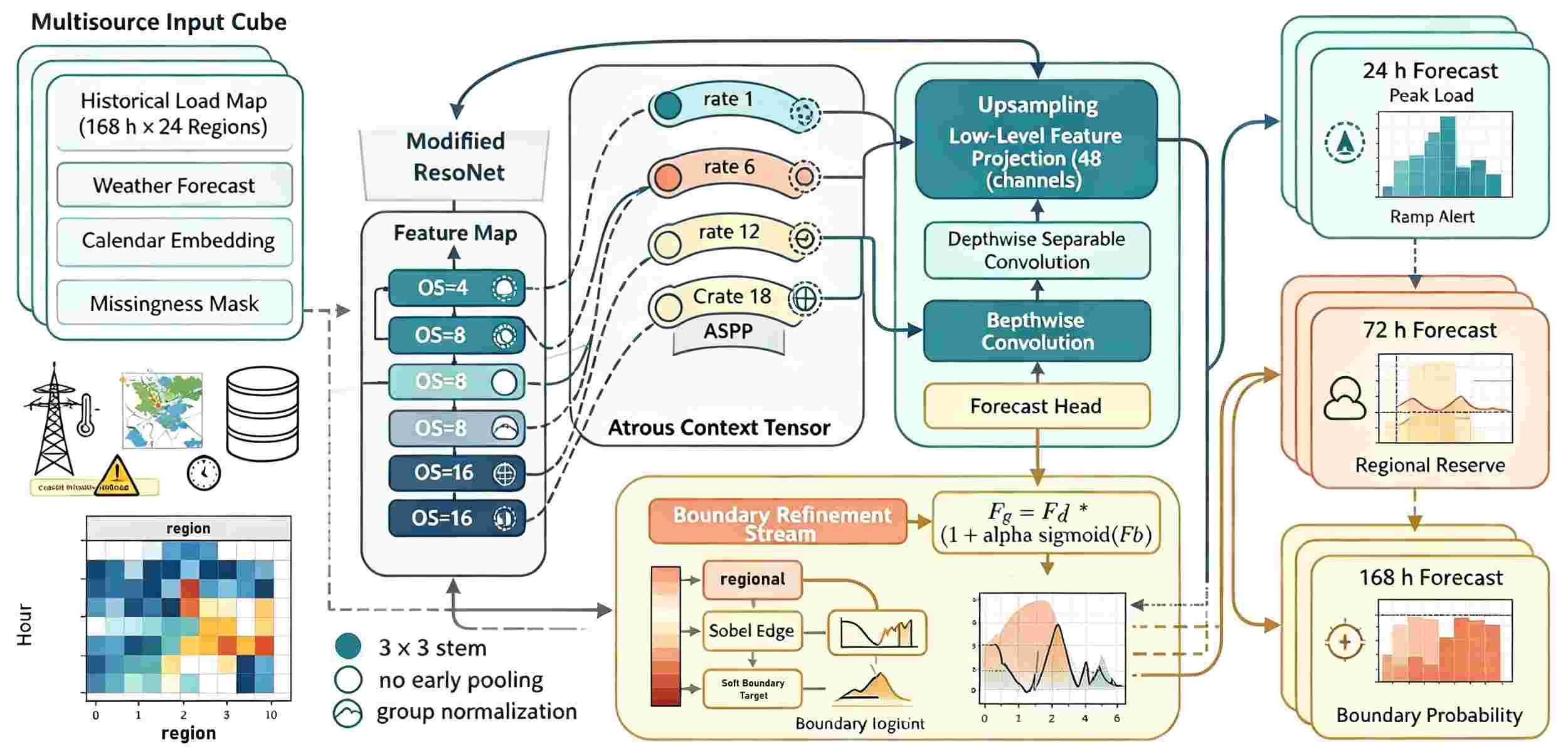
Accurately predicting the electricity demand in a specific area is getting harder and harder because of changes in weather, coordinated demand response and all sorts of urban activities at different times and places. Develop a boundary-refined DeepLabV3+ model in this paper to recast the multi-regional load prediction problem as dense regression of a time-region load map. The encoder uses dilated multi-scale context and employs a particularly refined branch to study slope initiation, peak shoulder, valley bottom recovery, and inter-regional transition zones. By optimizing boundary-weighted regression, gradient consistency, and regional consistency loss, the conditional decoder can provide predictions ranging from 24 to 168 hours. The three years of hourly observations from the 24 regional nodes in the experiment have generated 630,720 load records, as well as synchronous meteorological and calendar variables. On the 24h task, the proposed model has a mean absolute percentage error of 1.86% and a root mean square error of 41.7 MW, and these errors are lower than those of the best baseline by 18.4% and 15.2%, respectively. At 168 h, the mean absolute percentage error is 2.94%. The peak-timing deviation is 1.42 h; under missing-weather and heat-wave tests, the performance degradation is only 0.31 and 0.44 percentage points, respectively. According to the above findings, explicit boundary learning can not only improve overall accuracy but also address specific issues such as ramp-up location, regional consistency, and robustness. Therefore, in the practical application of day-ahead and week-ahead scheduling for regional power grids, explicit boundary learning is of significant importance.
Downloads
Published
How to Cite
Issue
Section
License
Copyright (c) 2023 Lena Majewska, Beata Kubicka

This work is licensed under a Creative Commons Attribution-NonCommercial-ShareAlike 4.0 International License.