Biologically Inspired Edge Detection for Autonomous Driving Based on Improved Canny Algorithm and Human Visual Threshold Modeling
DOI:
https://doi.org/10.64972/jaat.2023v1.313p26e:349-360Keywords:
Computer Graphics, Edge Detection, Autonomous Driving, Biologically Inspired AlgorithmsAbstract
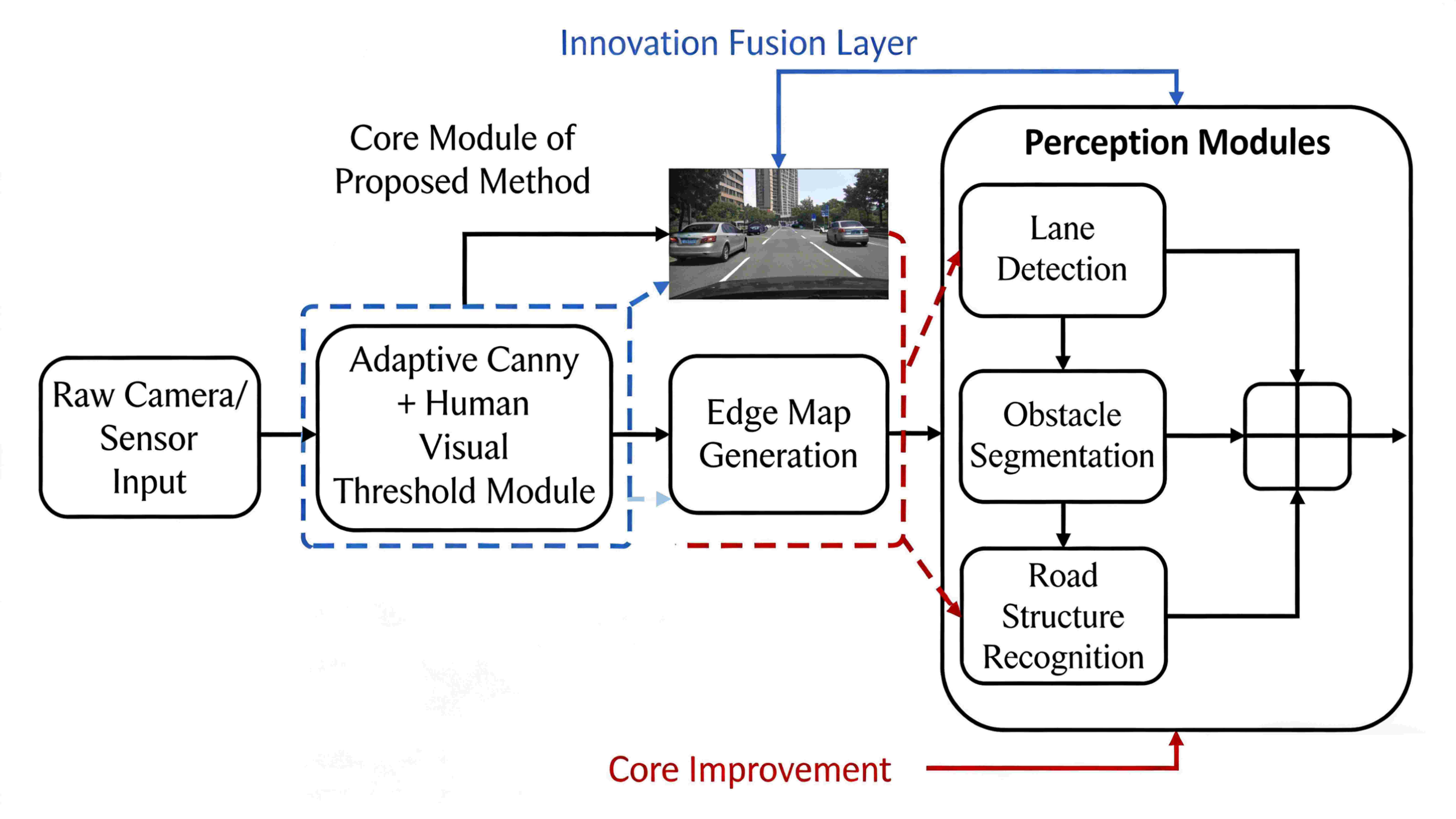
In order to increase the precision of lane identification and obstacle avoidance, autonomous driving systems based on computer vision technology must carry out edge detection. Problems like the inadequate flexibility of traditional algorithms to changes in dynamic light settings and environmental noises remain unanswered when the optimised Canny edge-detector is combined with refined human-defined thresholds. For real-time processing capabilities and explainability, local Gaussian filters, gradient-based edge detection, and biologically inspired threshold—which mimics the human visual system—are integrated with robustness enhancement in complicated situations. evaluating this method's performance in real-world scenarios using accuracy, precision, and latency indicators. These results demonstrate that, in comparison to earlier methods, this one typically has superior accuracy and coverage when there is a lack of contrast or bad weather in outside settings. This system satisfies nearly every criterion for autonomous driving systems and can handle high-quality images. In order to establish a foundation for integration into resource-constrained devices and intelligent driving systems, this article combines algorithm performance with biological adaptation. In terms of enhancing the operational stability and safety of an automated vehicle in the near future.
Downloads
Published
How to Cite
Issue
Section
License
Copyright (c) 2023 Franciszka Gola, Czesława Dmochowska, Katarzyna Gajewska

This work is licensed under a Creative Commons Attribution-NonCommercial-ShareAlike 4.0 International License.