Improved Fault Diagnosis of Legged Robot Actuators Based on Feature Interaction-Aware LightGBM
DOI:
https://doi.org/10.64972/jaat.2023v1.306p20e:269-280Keywords:
Weak Fault Diagnosis, Legged Robot, Actuator Degradation, LightGBM, Feature Interaction, Robust ClassificationAbstract
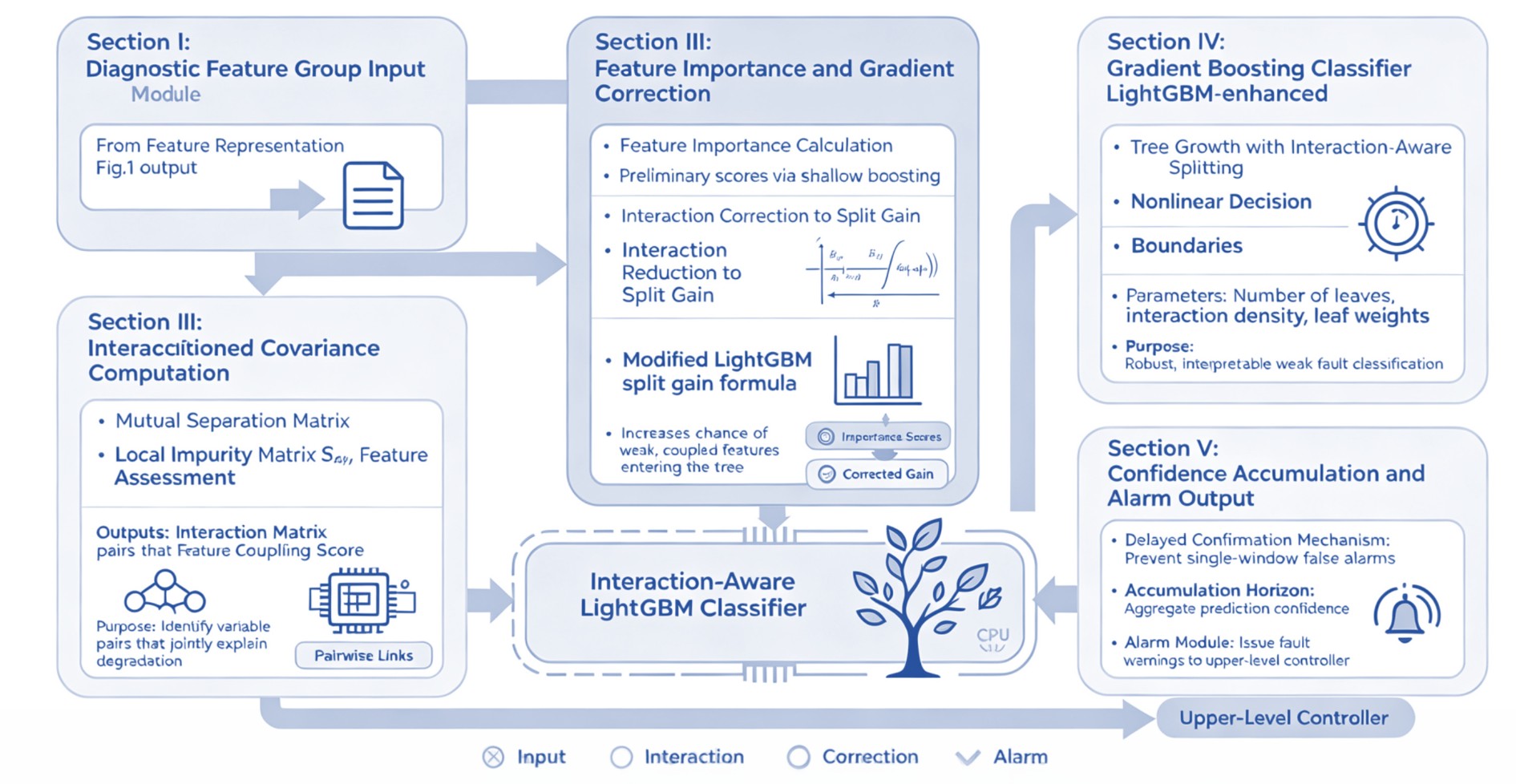
The initial drop in legged robot actuators is often masked by gait transitions, terrain changes, and various sensor noise sources, making it difficult to identify. Most conventional fault diagnosis models assume that input variables are independent, making it difficult to identify the coupled variations between current, torque, vibration, temperature, and joint tracking errors. To enhance actuator fault diagnosis, this paper proposes a LightGBM method based on feature interaction perception. Create a feature set related to gait for the actuators, determine the nonlinear interaction intensity between heterogeneous diagnostic variables, and incorporate this interaction information into the gradient boosting classifier. In the experiment, the actuator fault modes included torque loss, bearing wear, current anomalies, thermal drift, and composite material damage. The average inference time for each diagnostic window is 3.6 milliseconds, with an accuracy of 97.4%, a macro F1 score of 96.8%, and a weak fault recall rate of 94.9%. The above results indicate that feature learning based on interactive perception can enhance the ability to identify minor faults while reducing the computational cost of onboard health monitoring.
Downloads
Published
How to Cite
Issue
Section
License
Copyright (c) 2023 Hanna Natasza Kostecka, Anna Kamila Jaworska, Remigiusz Pajor

This work is licensed under a Creative Commons Attribution-NonCommercial-ShareAlike 4.0 International License.