Quantum Gradient Descent in Neural Network Training Optimization
DOI:
https://doi.org/10.64972/jaat.2023v1.304p18e:242-254Keywords:
Quantum Gradient Descent, Hybrid Quantum-classical Learning, Parameter-shift Rule, Adaptive Shot Scheduling, Noise-resilient OptimizationAbstract
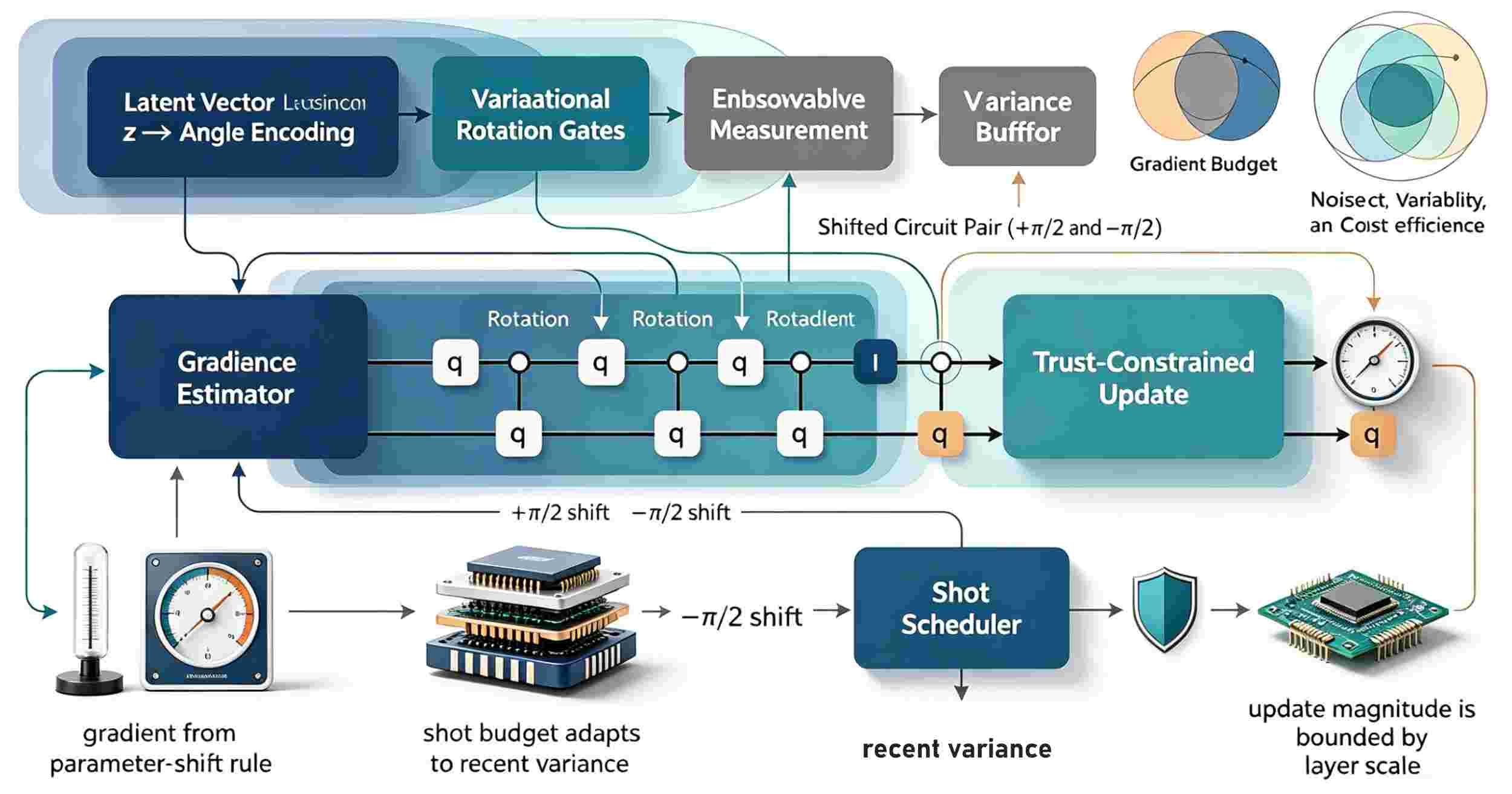
Optimisation of training still faces challenges due to an ill-conditioned loss surface and noisy gradient signals; at the same time, limited computational resources also restrict training options. Quantum Gradient Descent as a Hybrid Optimisation Strategy for Neural Network Training. The proposed noise-resilient quantum gradient descent framework maps selected gradient components to parameterised quantum circuits, estimates directional derivatives via parameter-shift measurements, and returns stable updates to the classical optimizer. It is not directly substituted for backpropagation; instead, it is a type of controllable gradient module that can be added to sensitive layers or low-dimensional projection heads. Add adaptive shot scheduling, damped momentum and layer-wise trust constraints to reduce estimator variance and prevent unstable quantum updates. Representative classification tasks are selected as the subjects of experiments for convergence speed, validation accuracy, gradient fidelity, measurement cost and noise robustness. Based on the above analysis, the new optimizer outperforms standard SGD in terms of final accuracy by 1.6% - 3.2% when using the same number of epochs; at the same time, it reduces the median gradient variance by 28.4% and maintains stable convergence even with an increase in simulated depolarizing noise from 0.001 to 0.015. Based on the above, it can be seen that Quantum Gradient Descent is not an all-purpose optimizer but rather a target-specific training accelerator for gradient-sensitive modules that can trade off sampling cost for more informative descent directions in measurement-aware update design.
Downloads
Published
How to Cite
Issue
Section
License
Copyright (c) 2023 Zacharias Rallis, Kyriakos Vougiouklis

This work is licensed under a Creative Commons Attribution-NonCommercial-ShareAlike 4.0 International License.