Communication Anomaly Behavior Detection Method for Internet of Vehicles Based on Long-Context Mamba
DOI:
https://doi.org/10.64972/jaat.2023v1.303p17e:228-241Keywords:
Long-Context Mamba, Communication Security, Anomaly Behavior Recognition, Selective State SpaceAbstract
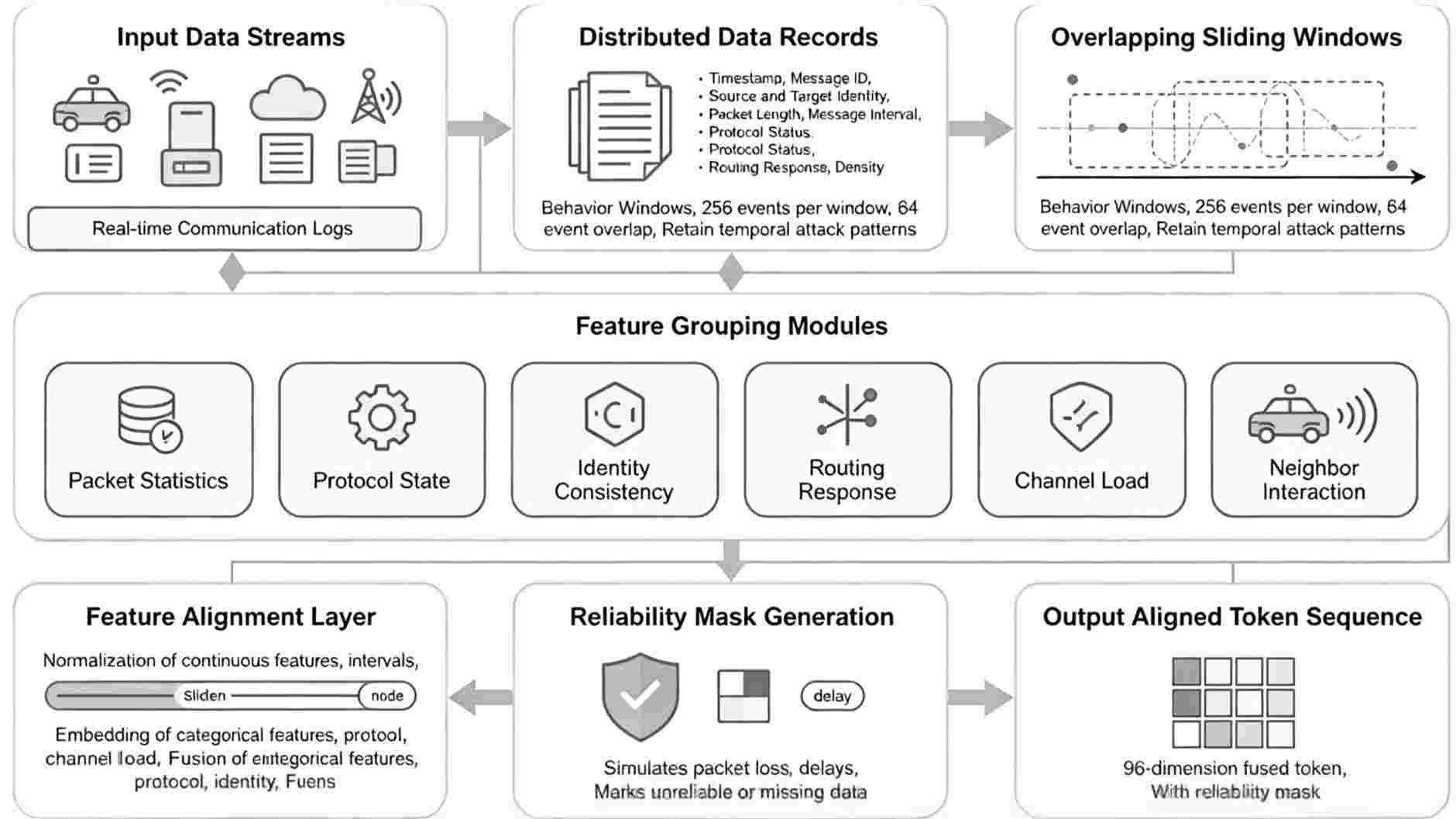
Low-latency anomaly detection models for the Internet of Vehicles need to be developed that can identify malicious communication behaviour in long and noisy traffic sequences. Vehicle messages have various time correlations for identity authentication, packet intervals, neighbor interactions, routing states and channel occupancy; however, these correlations are often reduced due to packet loss, dynamic topologies and bursty traffic. A High-efficiency long-context Mamba detection model for vehicular communication anomaly recognition is proposed in this paper. A behaviour-window construction strategy will be introduced first to align the variables of vehicle-to-vehicle and vehicle-to-infrastructure communication. A long-context Mamba block then selectively updates the state to remember previous abnormal evidence and reduce computational cost. A calibrated detection head has increased the recall rate for minority attacks and reduced false alarms. Experimental results are compared with those of classic machine learning, recurrent neural networks, temporal convolutions and attention-based methods. The model has reached 95.6% anomaly recall, 96.3% macro-F1, and a 5.8ms inference delay in the edge-device simulation. The Framework can perform real-time security monitoring of a dynamic vehicle communication environment.
Downloads
Published
How to Cite
Issue
Section
License
Copyright (c) 2023 Leon Stasiak, Urszula Królowa, Irena Patrycja Kotowska

This work is licensed under a Creative Commons Attribution-NonCommercial-ShareAlike 4.0 International License.