State-Space Refined Kalman Filter Model for Battery State-of-Health Estimation in Energy Storage Power Stations
DOI:
https://doi.org/10.64972/jaat.2023v1.302p16e:213-227Keywords:
Kalman Filtering, State Space Refinement, Battery State of Health, Covariance Inflation, Equivalent Circuit ModelAbstract
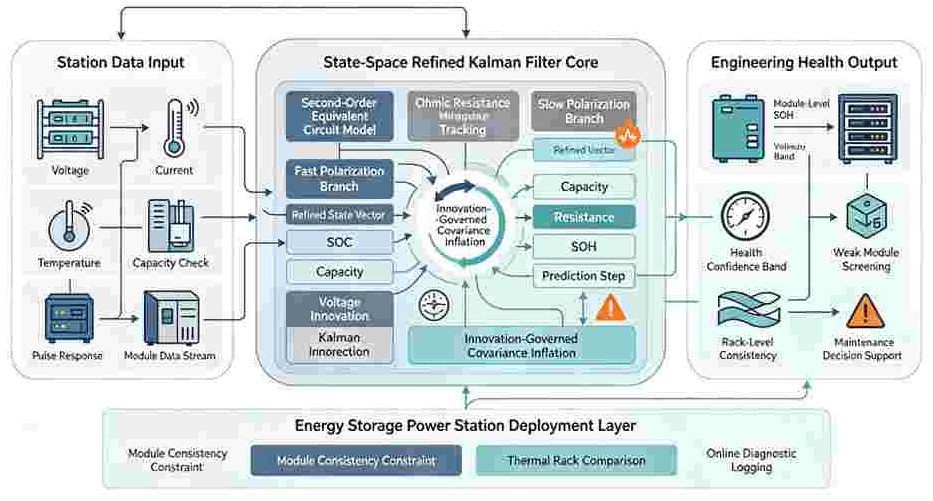
Numerous issues, including partial cycling, current pulses, thermal gradients, and module anomalies, affect battery state-of-health estimation in grid energy storage systems. In this research, develop a state-space refined Kalman filter model that interprets resistance increase and capacity loss as slowly changing states instead of post-processed indications. Temperature-normalized ageing drift, innovation-governed covariance inflation, and a station-level consistency requirement are combined with a second-order equivalent-circuit representation. Twelve integrated sensors gathered temperature data and over 214 operation days of 18,640 charge-discharge fragments from nine-six lithium iron phosphate cells arranged into eight 52 V modules. The state-of-health mean absolute errors were lowered to 1.18%, 1.91%, and 2.78%, respectively, by using a dual Kalman filter and a recursive least squares baseline in place of the traditional extended Kalman filter. The variance in capacity estimation for operation at 0.2C to 1.0C has decreased by 31.7%, and the 95th percentile error has decreased to 2.64%. Additionally, the estimator can identify the high-temperature rack's accelerated degradation 17 days ahead of the baseline alert rule. The findings suggest that, without the use of black-box features, explicit state-space modification can improve the model's accuracy, stability, and engineering interpretability.
Downloads
Published
How to Cite
Issue
Section
License
Copyright (c) 2023 Adam Kacper Dmochowski, Ludwik Kostecki

This work is licensed under a Creative Commons Attribution-NonCommercial-ShareAlike 4.0 International License.