A Dilated Residual TCN Model for Fruit Quality Grading in Hyperspectral Images
DOI:
https://doi.org/10.64972/jaat.2023v1.301p15e:200-212Keywords:
Hyperspectral Imaging, Temporal Convolutional Network, Dilated Convolution, Spectral Attention, Fruit Quality Grading, Nondestructive TestingAbstract
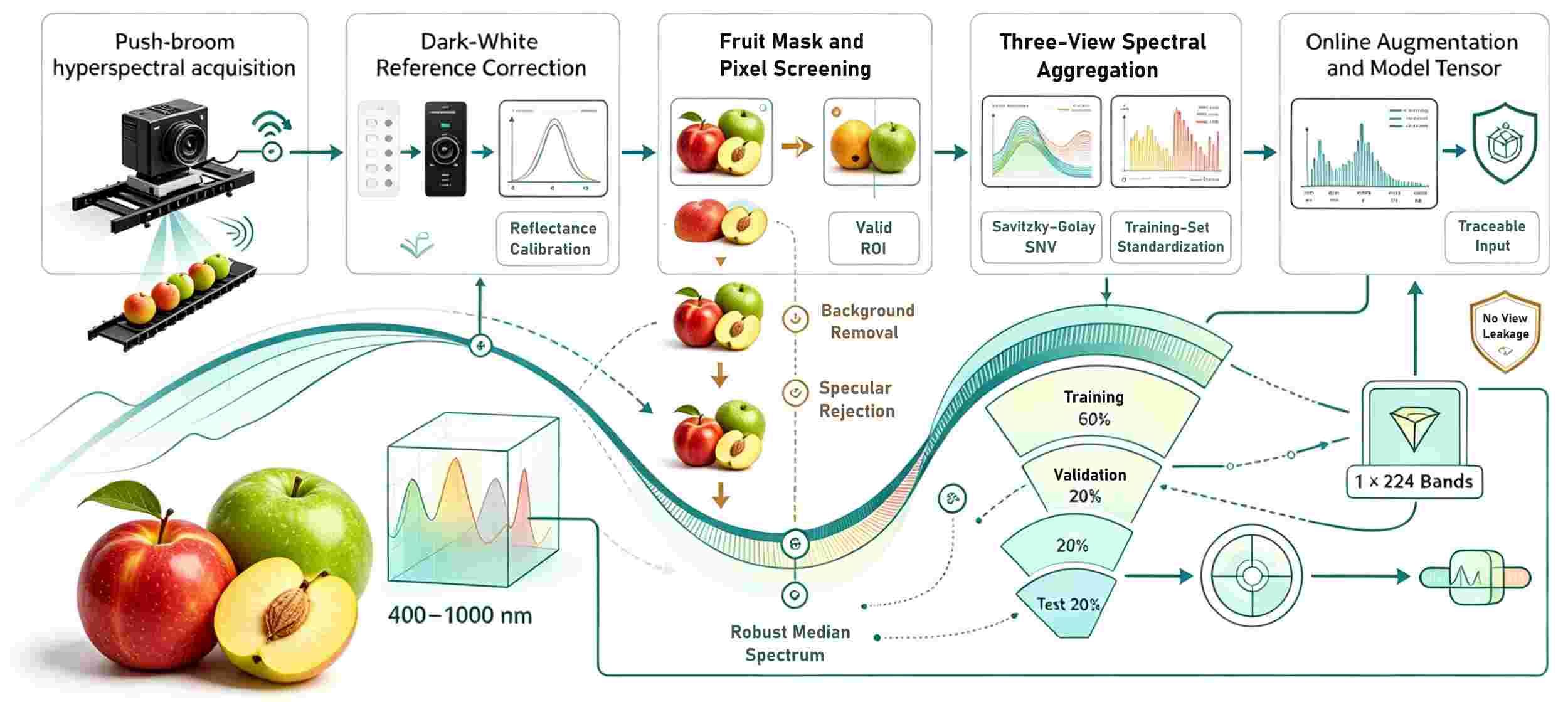
High-speed grading of fruit requires a sensitive internal-chemical measurement device that is also economically feasible for line-side installation. This paper introduces an extended residual temporal convolutional network that treats a hyperspectral signature as an ordered sequence of wavelengths. Savitzky–Golay smoothing, standard-normal-variate correction and training-set normalization are used together with four residual stages that exponentially expand narrow pigment features and broad water-sugar responses. A Gated Spectral-Attention Pooling Layer generates a compact fruit descriptor and learns wavelength importance. Tests on 2,400 fruit samples from the four quality grades showed a 96.8% accuracy and a 96.6% macro-F1 score, with an expected calibration error of 2.7%. The model exceeded a support-vector machine, a one-dimensional convolutional network, a long short-term memory network, and a spectral transformer by 7.4%, 4.6%, 3.5% and 1.7% respectively in terms of support. Removing dilation or the residual paths reduced the macro-F1 by 2.9 and 2.4 points, respectively, and the complete network maintained 92.1% accuracy under a simulated 6 nm wavelength shift. The model has 1.18 million parameters and an inference speed of 2.6ms per fruit; it is accurate and computationally light for non-destructive quality grading. Based on the above experiments, multiscale temporal receptive fields are appropriate for handling local and long-range dependencies in fruit reflectance spectra.
Downloads
Published
How to Cite
Issue
Section
License
Copyright (c) 2023 Tihomir Gojković, Dragiša Petković, Živojin Janković

This work is licensed under a Creative Commons Attribution-NonCommercial-ShareAlike 4.0 International License.