Explainable Artificial Intelligence for Autonomous Driving: A Study on Transparency in Deep Neural Networks
DOI:
https://doi.org/10.64972/jaat.2023v1.300p14e:186-199Keywords:
Autonomous Driving, Deep Neural Networks, Counterfactual Explanation, Uncertainty EstimationAbstract
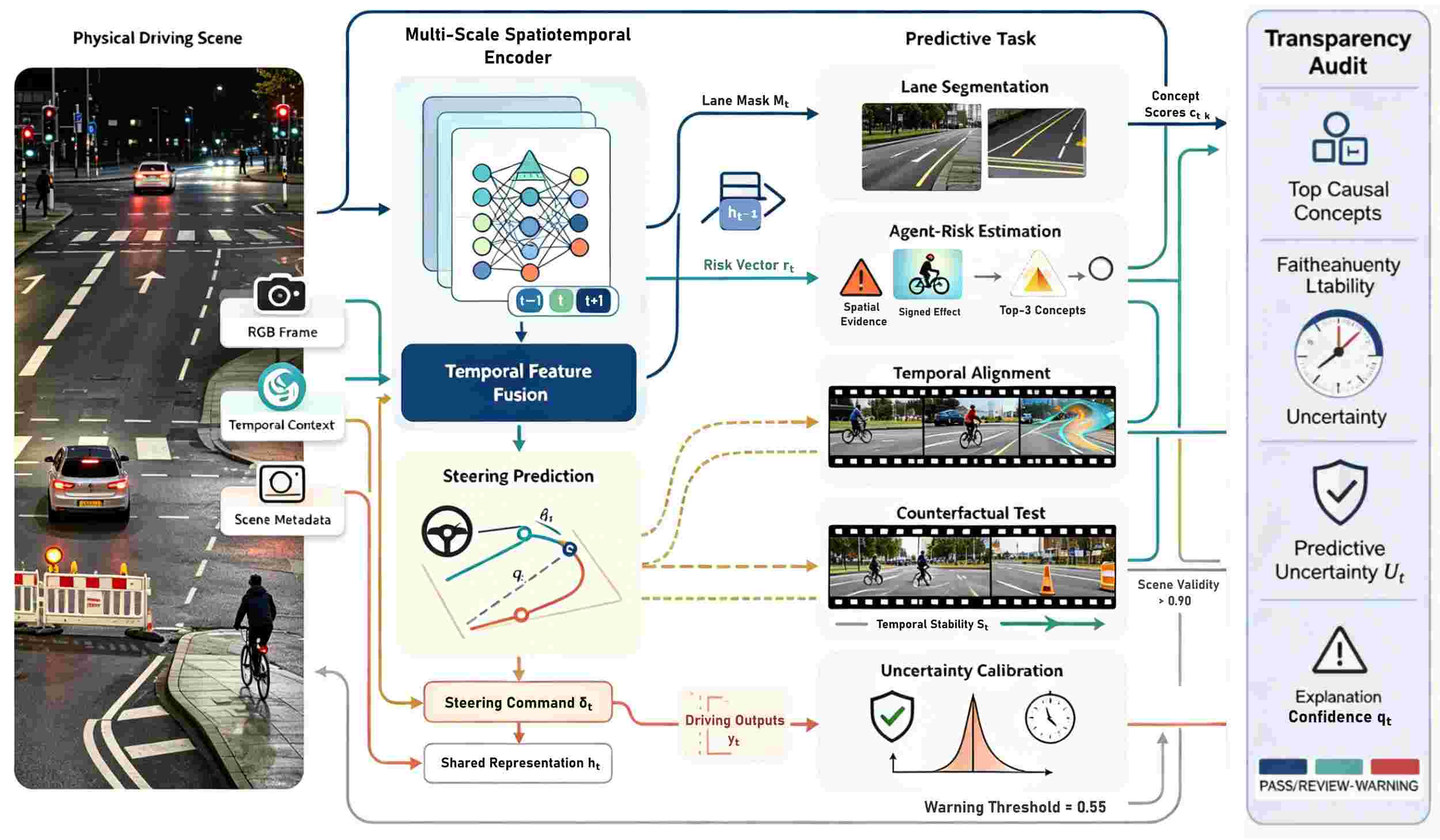
Deep neural networks have strengthened the perception and planning abilities of autonomous vehicles, but as opaque systems, they are difficult to inspect after an accident in bad weather. This paper develops a transparency framework for camera-based driving decisions by integrating concept-aligned feature attribution, temporal counterfactual testing, and uncertainty-aware explanation scoring. A multi-task network was tested on 46,200 annotated urban frames and 8,640 short sequences with clear, rain, night, occlusion and construction conditions. The mean intersection-over-union and steering mean absolute error of the proposed method were 78.6% and 1.84 degrees, respectively, and the generation speed was 21.7ms per frame. The five post-hoc baselines were evaluated, and it was found that among them, the fidelity of the explanations was the lowest, at 0.71, whereas five improvements were made to the other baselines. The human reviewers reduced the localization time for causal road agents by 18.9% with the new explanations, and there was no increase in false intervention decisions. Ablation results show that concept alignment is responsible for most of the semantic faithfulness, and counterfactual consistency is required in cases of occlusion and bad weather. Based on the above research, "openness" can be considered a quantifiable indicator and should not be seen as merely an appearance trait. A system needs to be feasible for driving rules observation and have high accuracy and timeliness in prediction.
Downloads
Published
How to Cite
Issue
Section
License
Copyright (c) 2023 Lidia Kaczmarowa, Oliwia Barbara Budzyńska

This work is licensed under a Creative Commons Attribution-NonCommercial-ShareAlike 4.0 International License.