A Bayesian-Optimized XGBoost Method for Ship Detection in SAR Images
DOI:
https://doi.org/10.64972/jaat.2023v1.297p12e:160-170Keywords:
Synthetic Aperture Radar, Ship Detection, Bayesian Optimization, XGBoost, Feature Engineering, Maritime SurveillanceAbstract
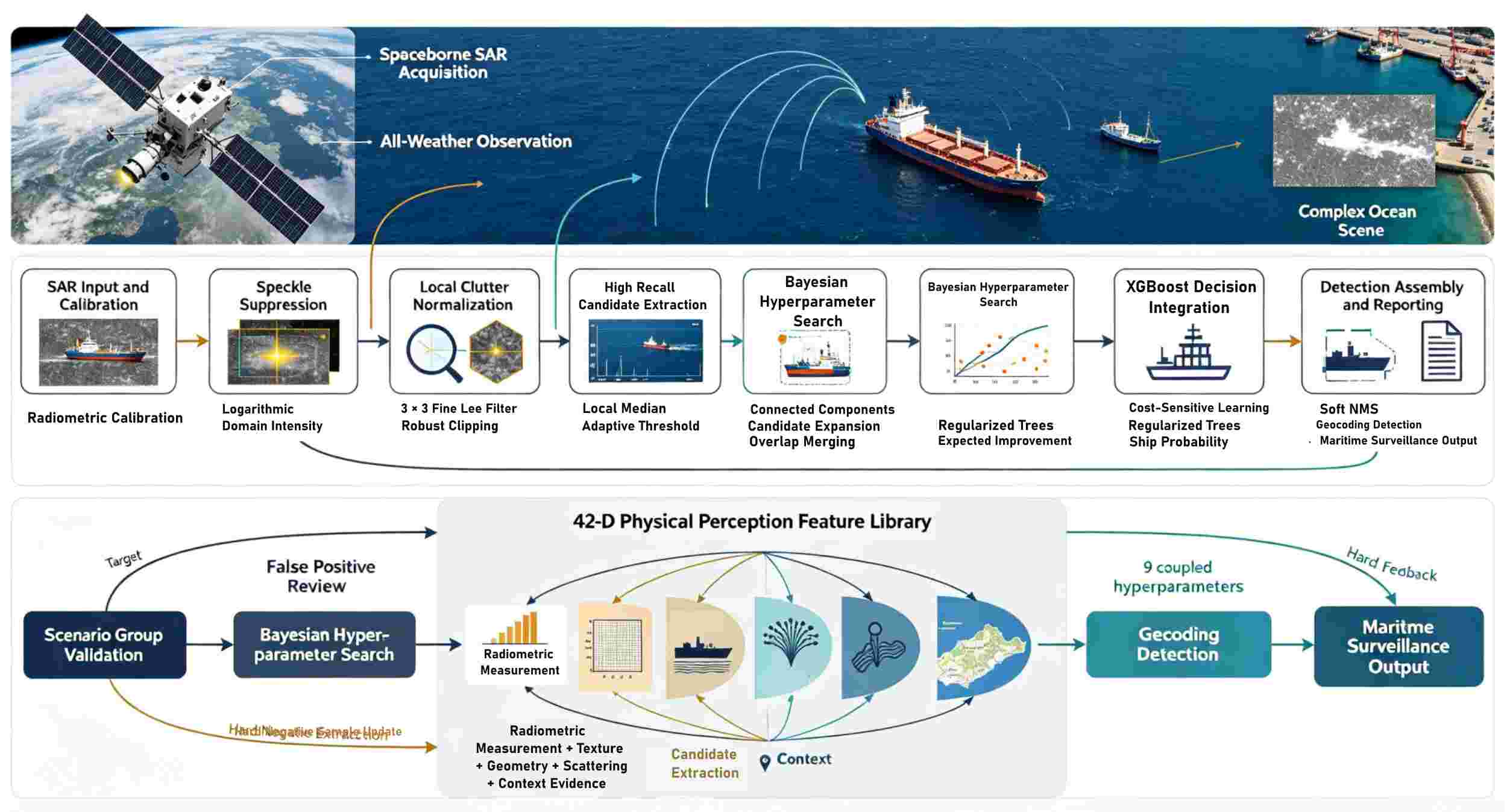
The detection of ship signals in synthetic aperture radar pictures is still difficult because of weak echoes from small vessels and speckle, azimuth ambiguities and bright shoreline structures. This paper introduces a lightweight detector that combines Bayesian optimization of the extreme gradient boosting classifier with physics-aware candidate descriptions. Through log-domain clutter normalization, the candidate regions consist of 42 features related to radiation, texture, geometry, and background. Use Gaussian process surrogate to optimize the nine coupled boosting hyperparameters. By using a validation objective to penalize missed detections of ships, false alarms, and model overcomplexity. Tests on 3,560 image chips containing 8,742 annotated ships achieved a precision of 95.1%, recall of 93.4%, F1 score of 94.2%, and average precision of 95.8% at an intersection-over-union threshold of 0.5. Bayesian optimization reduced the false positive rate per square kilometer from 0.41 to 0.27, and outperformed the manually tuned XGBoost by 2.8 percentage points in the F1 score. The first and largest increase was for ships less than 20 pixels in length; at that time, its recall rate was 85.6%, and then it rose to 90.8%. On a 1024×1024 desktop CPU, inference is completed within 38 milliseconds. Feature attribution shows that normalized local contrast, oriented scattering anisotropy, and coastline distance are the main determining factors. Based on the above results, careful optimization and enhancement can provide an accurate, easy-to-understand, and computable solution for operational maritime surveillance.
Downloads
Published
How to Cite
Issue
Section
License
Copyright (c) 2023 Umberto Pellegrini, Alberto Esposito, Rocco Iannone

This work is licensed under a Creative Commons Attribution-NonCommercial-ShareAlike 4.0 International License.