Illumination-Adaptive Super-Resolution Enhancement for Low-Light Images Based on Vision Transformers and Human Visual Contrast Sensitivity Modeling
DOI:
https://doi.org/10.64972/jaat.2026v4.292p26:346-356Keywords:
Low-Light Image Enhancement, Vision Transformer, Perceptual Modeling, Super-ResolutionAbstract
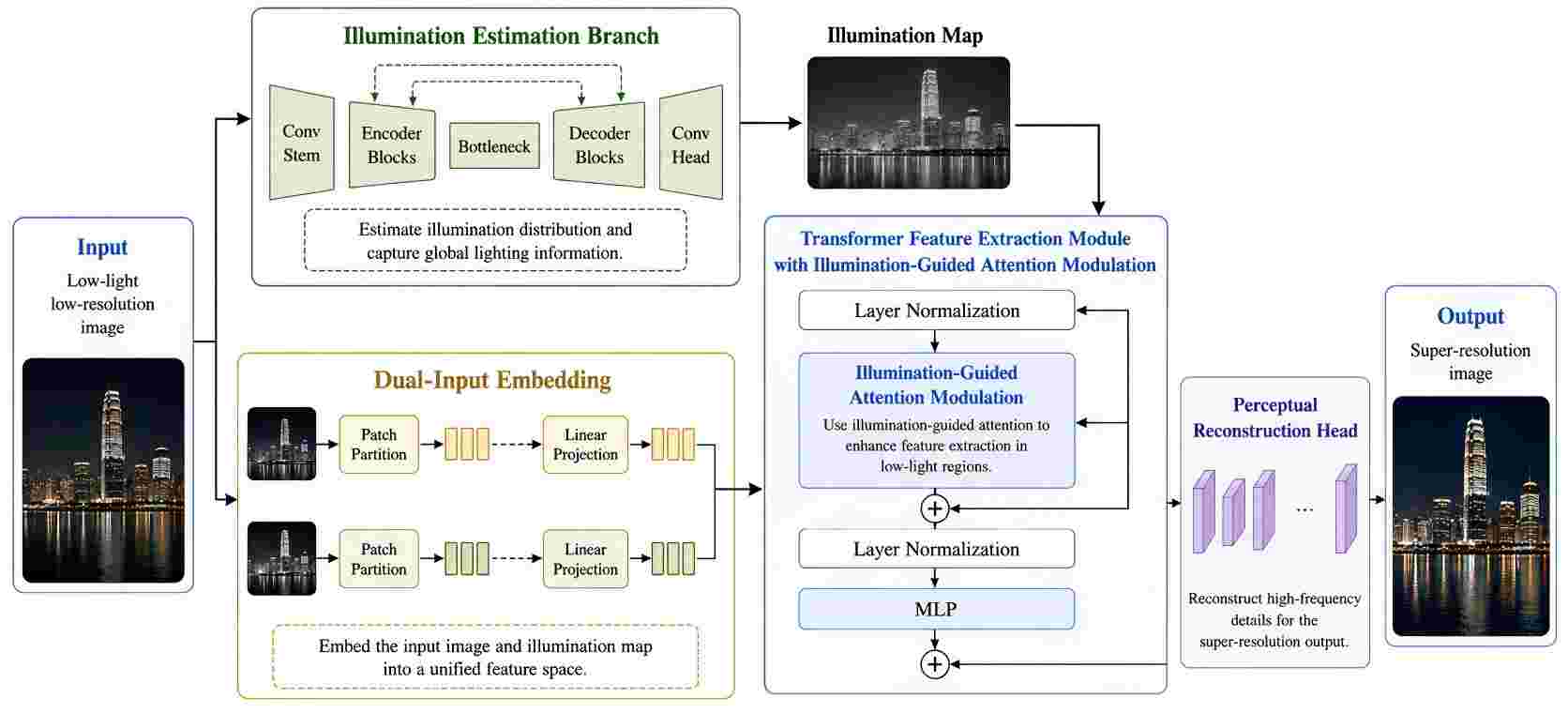
Improving low-light image quality for use in other computer vision applications has been one of the challenges in recent years. This research proposes an illumination-adaptive super-resolution framework to improve the perceived quality and detail of noisy, underexposed images. Signal deterioration and perceptual distortion in low-light conditions are the two issues that need to be resolved. In this way, you may dynamically acquire features that are sensitive to both local and global changes in brightness by adding an illumination estimation module to the Vision Transformer backbone. To restrict the restoration scope to frequency components that are easier for people to perceive, a perceptually guided loss function based on human visual contrast sensitivity is included. The experiment evaluates the method's performance using a few exemplary low-light datasets. According to the aforementioned findings, there has been a general improvement in both the subjective assessments of human raters and the objective measures, such as maximum signal-to-noise ratio, structural similarity, and perceptual distance. In all light circumstances, the suggested system outperforms the conventional convolutional and transformer-based models in terms of fidelity, noise suppression, and visual realism. Additionally, the framework may be applied in a wide range of real-world scenarios and is comparatively insensitive to cross-domain data and other types of degradation. In order to improve low-light photos in the future, this research suggests a strategy that combines human-centered perceptual models with learning-based feature extraction.
Downloads
Published
How to Cite
Issue
Section
License
Copyright (c) 2026 Mohammed Al-Maktoum, Khalid Al-Najjar

This work is licensed under a Creative Commons Attribution-NonCommercial-ShareAlike 4.0 International License.