Long-Sequence Informer Model for Offshore Wind Turbine Fault Diagnosis Using Marine Monitoring Data
DOI:
https://doi.org/10.64972/jaat.2023v1.286p8e:103-117Keywords:
Offshore Wind Turbine, Fault Diagnosis, Marine Monitoring Data, Long-Sequence Informer, ProbSparse Attention, Condition MonitoringAbstract
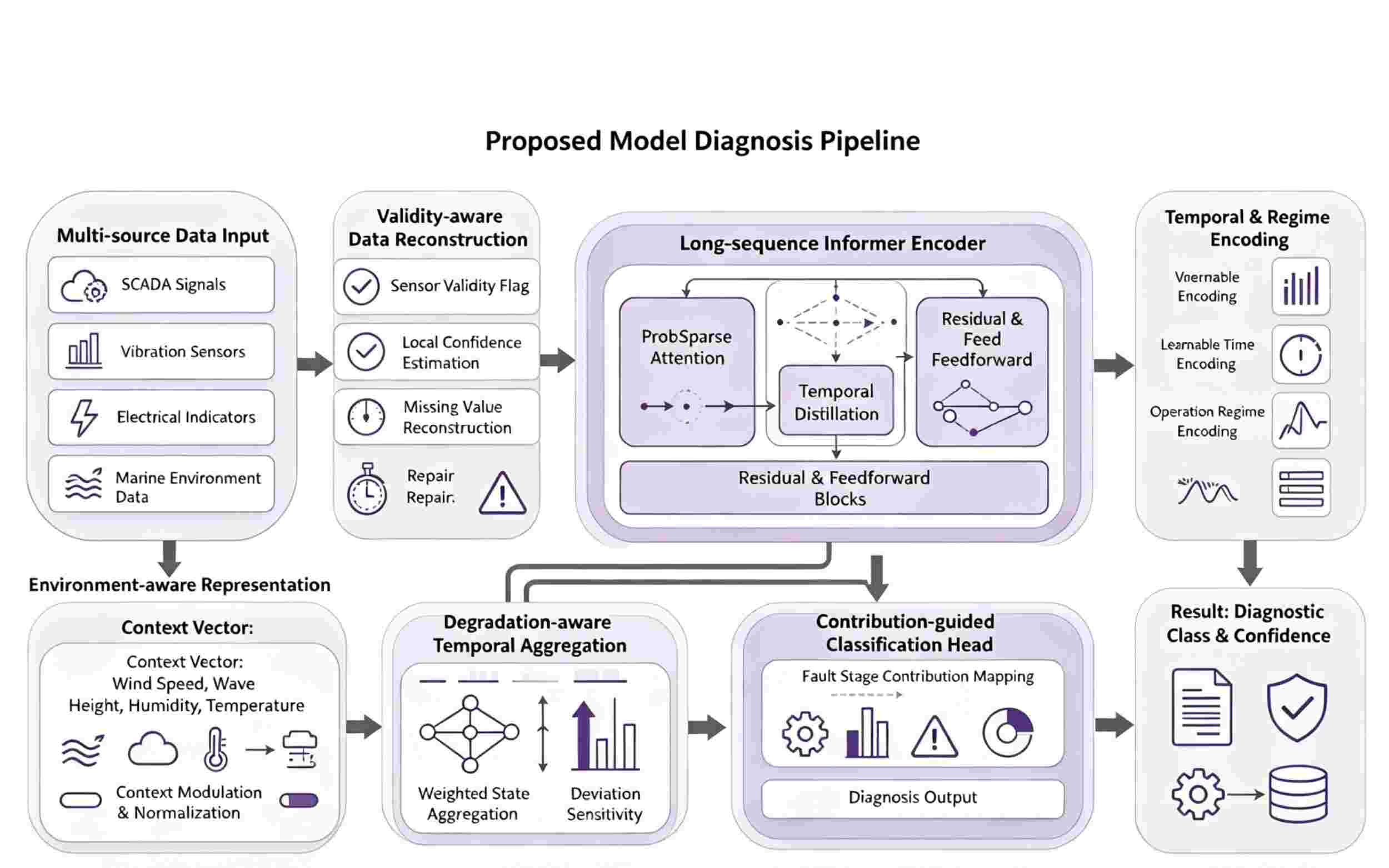
Offshore wind turbines are affected by numerous factors simultaneously: changes in wind speed, wave excitation, salt-spray corrosion, temperature drift and grid-side load fluctuations. Therefore, the fault signature is generally mild, delayed and may be misinterpreted for a normal environmental transient. Propose a long-sequence Informer model for problem identification based on maritime monitoring data in this paper. An environment-aware temporal representation that integrates electrical signals, vibration indicators, SCADA data, and observations of the marine environment. ProbSparse attention can learn long-range dependency information and reduce the amount of attention computation. To enhance the interpretability of diagnosis results for early-stage, transitional-stage, and severe-stage defects, a fault-stage contribution method will also be implemented. For testing, a multi-source monitoring dataset including 42,000 ten-minute records from offshore turbines has been created. It is separated into one normal class and five fault categories. The suggested model outperforms the LSTM, TCN, conventional Transformer, and CNN-GRU baselines in terms of overall accuracy (96.8%), macro-F1 score (95.9%), and average inference latency (18.6 ms per sequence). According to the findings, long-sequence sparse attention can enhance fault recognition reliability while still satisfying the demands of real-time offshore operation and maintenance.
Downloads
Published
How to Cite
Issue
Section
License
Copyright (c) 2023 Ladislav Drápal, Adéla Svoboda

This work is licensed under a Creative Commons Attribution-NonCommercial-ShareAlike 4.0 International License.