ConvLSTM-Based Pedestrian Flow Prediction for Intelligent Transportation Systems
DOI:
https://doi.org/10.64972/jaat.2023v1.285p7e:89-102Keywords:
ConvLSTM, Pedestrian Flow Prediction, Context-aware Modeling, Residual ForecastingAbstract
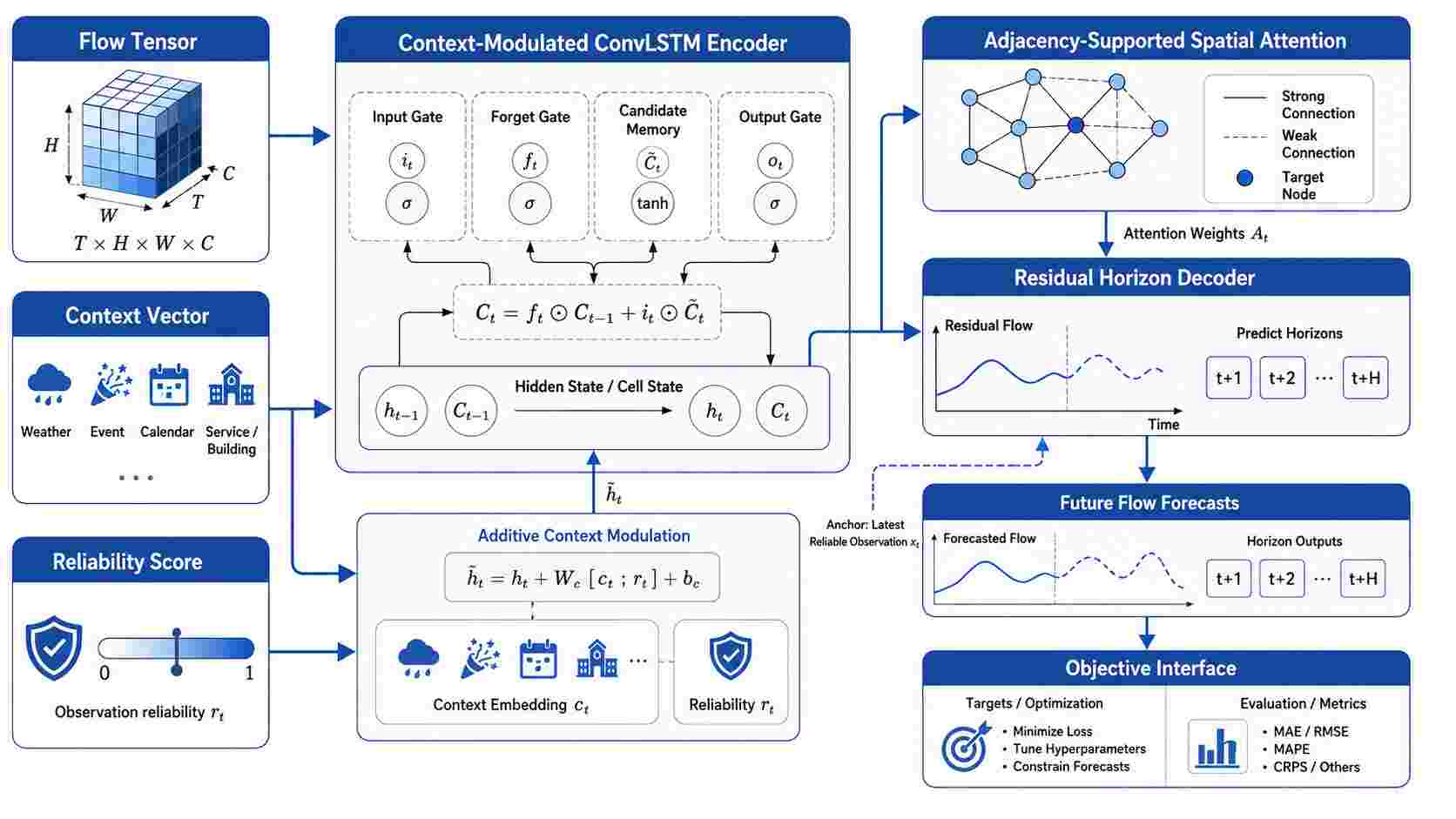
Prediction of pedestrian flow is necessary for intelligent transportation systems, and a short-term fluctuation in the number of people will affect station dispatching, route guidance, emergency response, public space safety, etc. Most existing time-series models treat pedestrian counts as independent sequences, and many deep models flatten facility regions, thus losing the spatial continuity among entrances, corridors, platforms, transfer channels and exits. Propose a context-aware residual ConvLSTM for pedestrian flow prediction at urban transportation hubs in this paper. The way it shows multiple sources of observation is as a spatial flow tensor, how it learns local crowd movement via convolutional recurrent gates, how it adds event and service context to memory update, and how it forecasts future flow through residual horizon increments. A direction-aware and volatility-adaptive objective function is used to penalize the wrong direction of movement and excessive oscillation separately from the magnitude error. Example experimental data from an ITS-style monitoring scenario show that the proposed model has a MAE of 15.2 pedestrians per minute, an RMSE of 23.9 pedestrians per minute, a MAPE of 8.7%, and a direction accuracy of 86.7%, which are all better than those of ARIMA, SVR, LSTM, GRU, GCN, STGCN and standard ConvLSTM baselines. Based on the ablation results, the primary sources of the improvement in accuracy are contextual memory injection and spatial convolution; residual decoding addresses the problem of long-horizon instability.
Downloads
Published
How to Cite
Issue
Section
License
Copyright (c) 2023 Norbert Paweł Konopka

This work is licensed under a Creative Commons Attribution-NonCommercial-ShareAlike 4.0 International License.