A New Technical Framework for Safe and Efficient Left Turns in Autonomous Driving
DOI:
https://doi.org/10.64972/jaat.2023v1.284p6e:76-88Keywords:
Autonomous Driving, Left-Turn Planning, Trajectory Prediction, Risk Allocation, Chance-Constrained Optimization, Motion Planning, Intersection SafetyAbstract
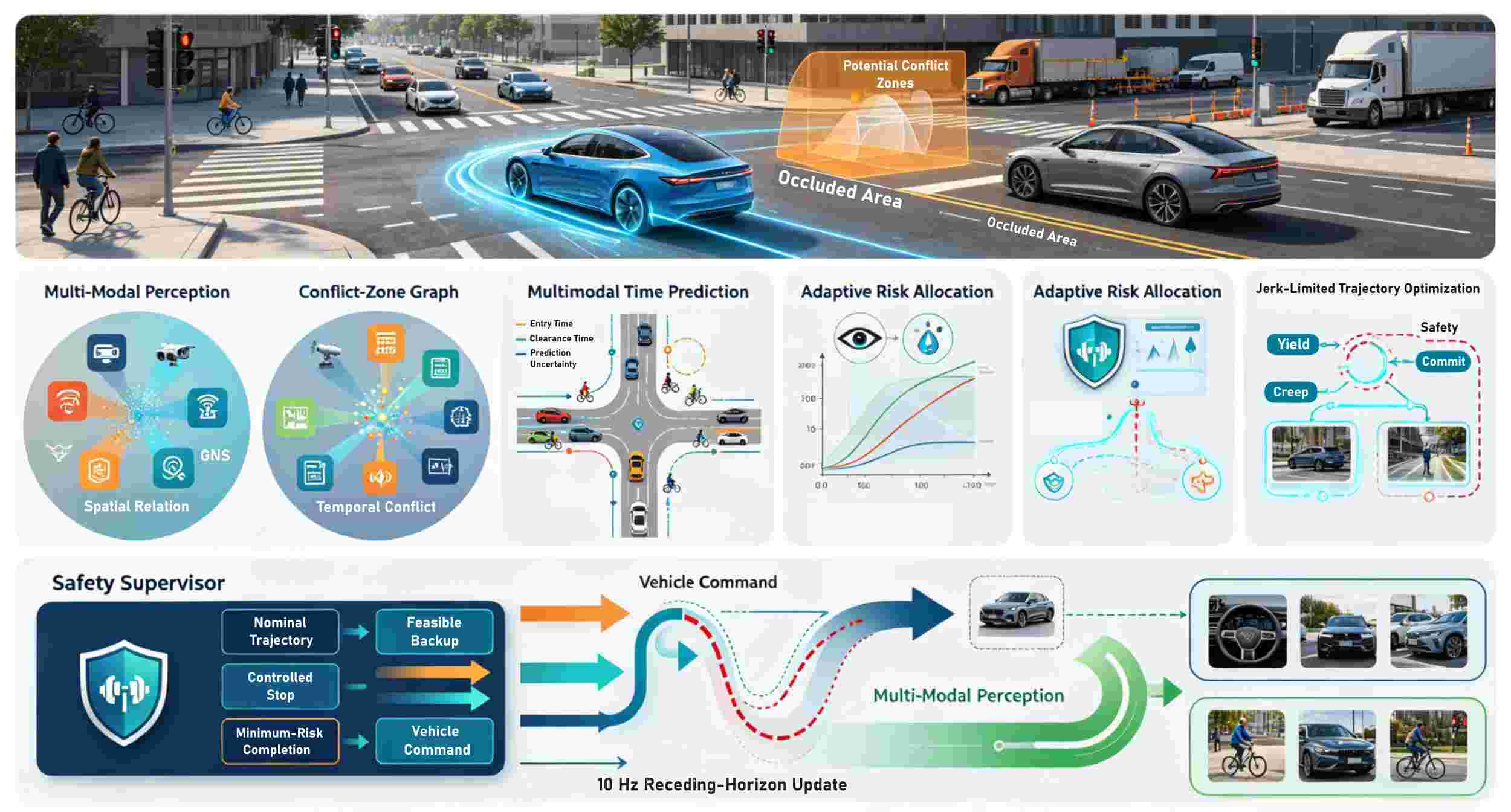
Unprotected left turns are still a difficult problem for autonomous driving because perception uncertainty, occlusion, and unpredictable road-user behaviour need to be handled in a short decision time. This paper proposes a risk-adaptive technical framework for integrating conflict-zone graph encoding, multimodal arrival-time prediction, dynamic risk allocation, chance-constrained gap selection and jerk-limited trajectory optimisation. The framework estimates the probability distribution of conflict-zone entry and clearance times, adjusts the admissible risk according to visibility, localisation uncertainty, road conditions and prediction calibration. 18,000 closed-loop simulation tests, 2,400 log-replay cases and 320 closed-course experiments were conducted for performance assessment. The proposed method had a 98.1% turn-completion rate and a 0.18% collision rate, and its collision rate was 0.27-0.71% for the four representative baselines. The median stop-line-to-clearance time was 7.6s, and the average intersection throughput reached 428 vehicles per hour per approach. The expected calibration error was 0.012, the median computational latency was 41ms, and 99.2% of the closed-course control cycles maintained a feasible backup trajectory. With combined sensing and behaviour disturbance, the collision-free survival rate after three seconds of continuous occlusion was 99.1%. As shown in the above results, adding probabilistic prediction and risk-constrained planning can improve the safety of left turns without adding much latency or other issues.
Downloads
Published
How to Cite
Issue
Section
License
Copyright (c) 2023 Patrycja Ostrowska, Sabina Walczak, Lidia Wójcikowa

This work is licensed under a Creative Commons Attribution-NonCommercial-ShareAlike 4.0 International License.