Multi-Agent Reinforcement Learning Framework for Intelligent Traffic Signal Optimization in Urban Transportation Systems
DOI:
https://doi.org/10.64972/jaat.2025v3.239p43e:589-603Keywords:
Multi-Agent Systems, Reinforcement Learning, Intelligent Transportation Systems, Traffic Signal Optimization, Urban MobilityAbstract
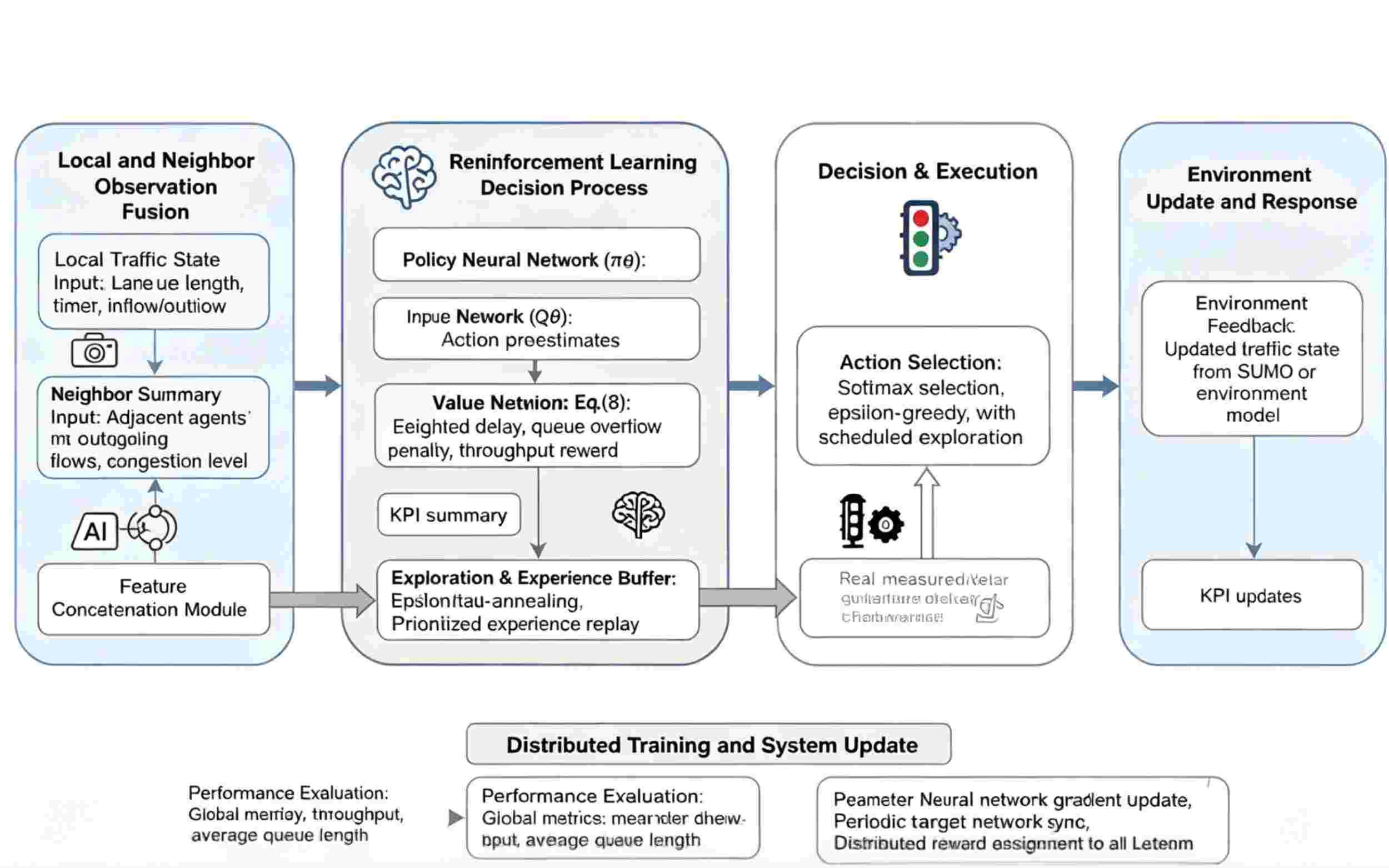
Efficient and dynamic traffic light control for intelligent transportation systems has become a pressing issue as cities have grown in recent years. A multi-agent reinforcement learning (MARL) system for dynamic signal optimization in extensive metropolitan road networks will be presented in this study. A novel approach for signal-timing plan optimization at connected intersections has been put forth that combines deep policy learning, distributed agent coordination, and real-time traffic-condition sensing. Construct a 25–49 intersection simulated city grid and conduct experiments with various inflow rates and realistic accident scenarios. In comparison to the fixed-time and actuated signal baselines, the results indicate that the MARL system has reduced the average vehicle delay by up to 30% and the average queue length by roughly 23%; network throughput has increased by approximately 15%. The approach exhibits good resilience to such issues, is comparatively steady in the face of heavy traffic and other disruptions, and continues to function normally for a considerable amount of time. According to the aforementioned study, multi-agent learning can use context-sensitive policy frameworks and robust communication capabilities to solve the issue of urban mobility's lack of scale. This research provides a foundation for the further use of distributed AI in intelligent traffic control.
Downloads
Published
How to Cite
Issue
Section
License
Copyright (c) 2025 Janusz Barák, Tobias Fiala, Josef Veselý

This work is licensed under a Creative Commons Attribution-NonCommercial-ShareAlike 4.0 International License.