Robust Adversarial Training for Network Traffic Classification: A ResNet-Based Approach with Protocol-Aware Perturbation
DOI:
https://doi.org/10.64972/jaat.2025v3.228p33e:447-460Keywords:
Cybersecurity, Adversarial Learning, Deep Neural Networks, Network Traffic Classification, Robustness AnalysisAbstract
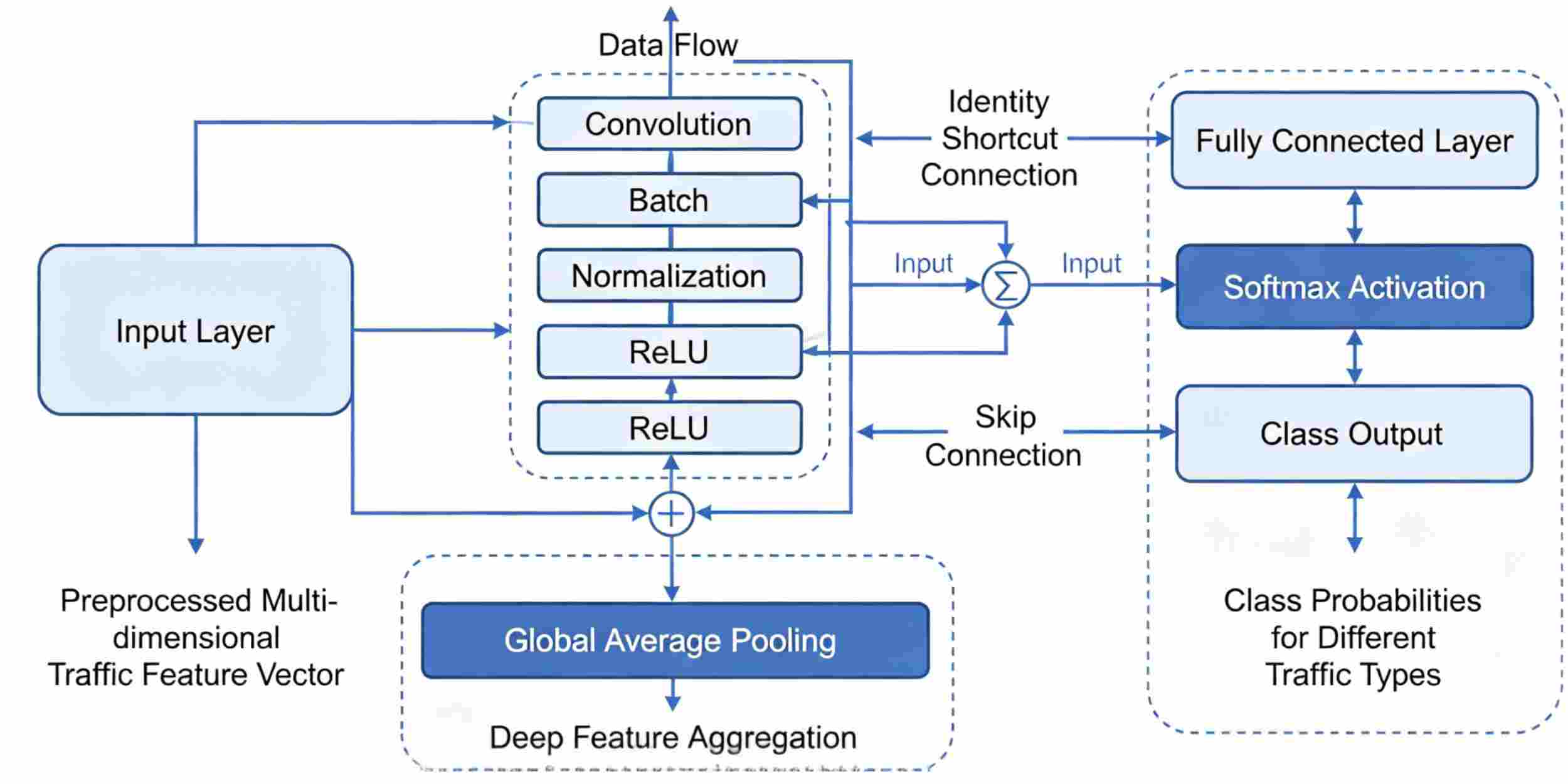
Network traffic classification is an important component of network security, but with the development of deep learning models, concerns about adversarial attacks have also emerged. The protocol-aware adversarial training framework based on the deep ResNet architecture addresses the aforementioned issues in this study. Improve network detection accuracy and adversarial robustness. In the adversarial sample generation phase, semantic preservation constraints were introduced, and model training was conducted using system-tuned parameters. Rigorous experiments were conducted on a representative real-world dataset, and the method produced the following results: The adversarially trained classifier achieved an accuracy of 98.2% on benign traffic, maintaining over 95% accuracy and higher F1 scores under strong FGSM, PGD, and CW attacks. Compared to previous strategies, a thorough robustness index and confusion matrix analysis have shown an approximate 70% drop in adversarial accuracy. Improving robustness requires optimal regularization and deeper networks. By fine-tuning adversarial ensembles and deep residual networks, the robustness of classifiers can be significantly improved. The widespread deployment of resilient network security solutions is possible. The limitations include higher computational demands and the challenge of countering fully adaptive attacks. These issues provide a reference for future research.
Downloads
Published
How to Cite
Issue
Section
License
Copyright (c) 2025 Mikołaj Kochan, Czesław Kamiński

This work is licensed under a Creative Commons Attribution-NonCommercial-ShareAlike 4.0 International License.