Defect Recognition Method for Automated Optical Inspection Systems Based on Generative Adversarial Networks
DOI:
https://doi.org/10.64972/jaat.2026v4.117Keywords:
Intelligent Manufacturing, Defect Recognition, Generative Adversarial Network, Automated Optical Inspection, Deep Learning, Data AugmentationAbstract
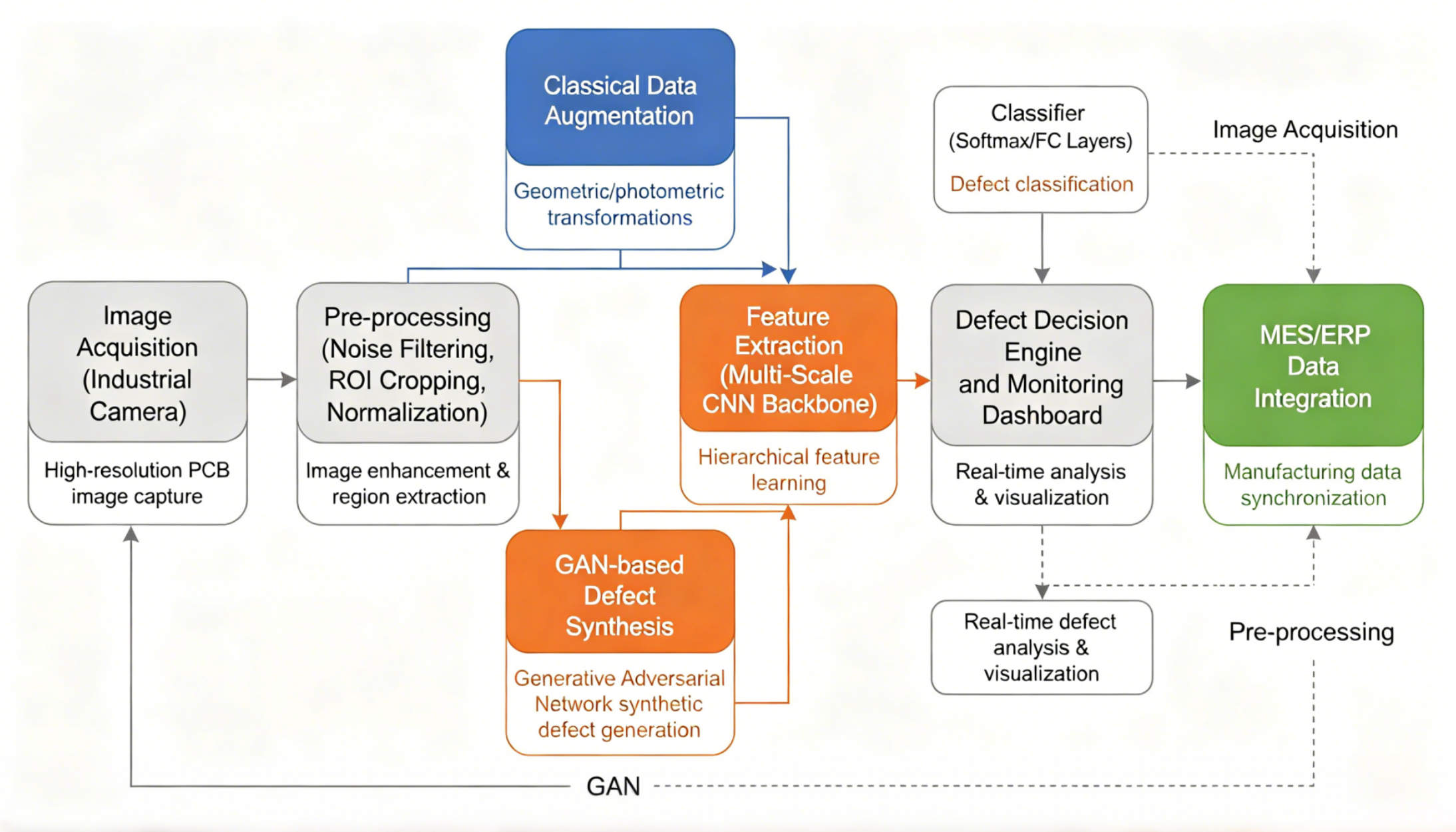
Optical Inspection Automation (AOI) has already been able to support the construction of large-scale precision electronic assembly production lines and is now receiving increasing attention. Traditional AOI solutions cannot handle visual noise, large defects, or variations in small defect sizes; moreover, they cannot adapt to product miniaturization and increased process complexity. An efficient defect recognition system based on Generative Adversarial Networks (GANs) is used to improve industrial image resource limitations, reduce class distribution imbalance, and handle complex environmental conditions. To generate more realistic defect images and improve the quality of any area of interest (AOI) module, the system integrates a class-conditional GAN. To determine the robustness, accuracy, and precision of the system on these real industrial application datasets. Compared to state-of-the-art deep learning model baselines and traditional visual methods, this study is able to improve the recall rate of rare defects while reducing false positives. This design does not require additional funding and can evolve over time. The solution can be retrained in real-time, directly compatible with existing production IT systems, and provide data support for process management. The above results indicate that generative models are very useful in industrial inspection systems. The adaptation of the AOI method is being expanded to be applied to more advanced safety and intelligent processes over time.
Downloads
Published
How to Cite
Issue
Section
License
Copyright (c) 2026 Michał Tomasz Dąbrowski

This work is licensed under a Creative Commons Attribution-NonCommercial-ShareAlike 4.0 International License.