Automated Classification and Fiber Recovery Process Redesign for Waste Textiles Based on Computer Vision Sorting Algorithms
DOI:
https://doi.org/10.64972/jaat.2026v4.113Keywords:
Machine Vision, Waste Textiles, Automated Sorting, Fiber Recovery, Deep Learning, Industrial AutomationAbstract
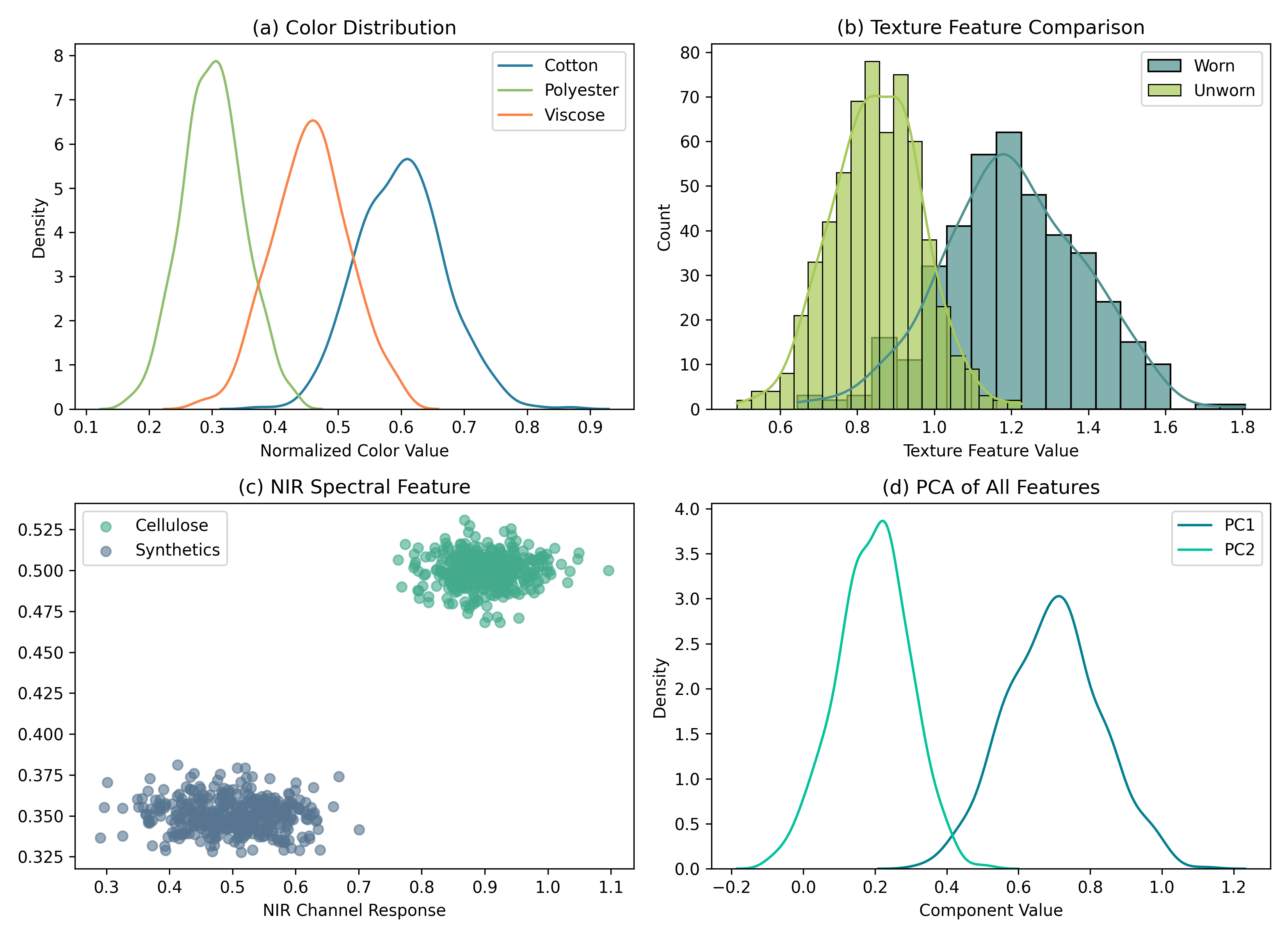
Due to the intensification of globalization in production and consumption, the continuous growth of post-industrial textile waste has become an environmental issue. To address the urgent need for efficient and accurate classification of used textiles, this paper will introduce a fully automated classification and fiber recovery system based on advanced computer vision technology. High-resolution color near-infrared (RGB-NIR) imaging, multi-stage feature extraction, and an embedded module classifier network optimized for large-scale industrial applications are components of the designed system. A rigorous experiment used a dataset containing over 19,000 textile samples, which included various types of fibers, to simulate real-world environmental pollution around the globe. Compared to traditional manual operations or mechanized processes, the intelligent sorting system has excelled with a classification accuracy of over 96% and a fiber recovery rate of over 80%. The volume of operations and the error rate of pollutants have significantly improved. The recycling process will become more efficient. This study provides an implementation method for an industrial framework, with broader application potential beyond textile materials. Thru this work, an effective technical system is established to promote the sustainable reuse value chain of low-carbon recycled resources and to advance the equation of green industrial standards.
Downloads
Published
How to Cite
Issue
Section
License
Copyright (c) 2026 Bartosz Dabrowski

This work is licensed under a Creative Commons Attribution-NonCommercial-ShareAlike 4.0 International License.