Context-Aware Cascade RCNN for Robust Pedestrian Detection in Complex Urban Environments
DOI:
https://doi.org/10.64972/jaat.2026v4.106Keywords:
Artificial Intelligence, Pedestrian Detection, Deep Learning, Context Modeling, Urban Environments, Autonomous DrivingAbstract
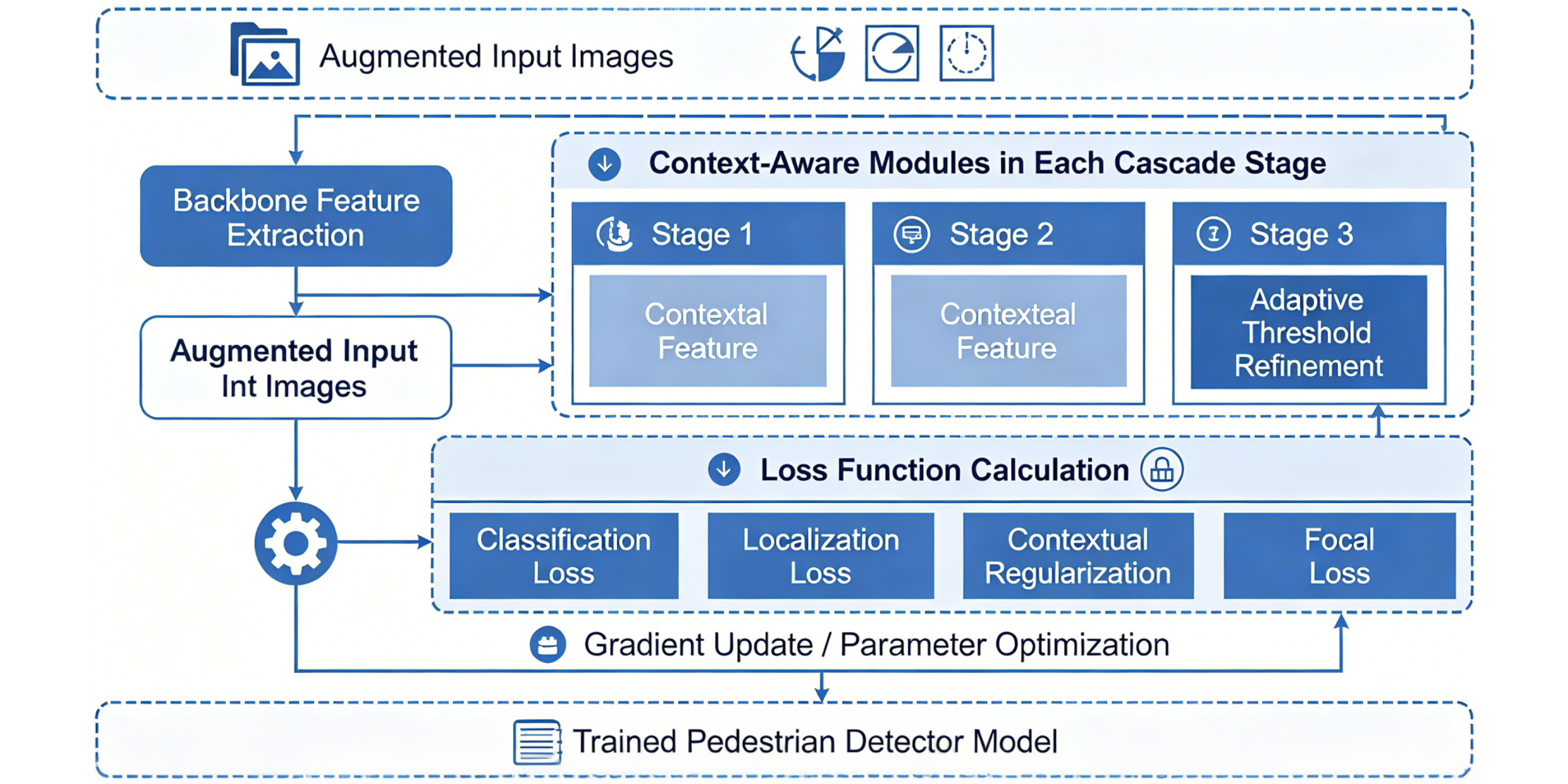
In bustling cities, autonomous pedestrian detection needs to consider changes in lighting conditions, multiple occlusions, and the simultaneous appearance of multiple objects. This paper proposes a context-aware cascaded RCNN architecture to improve the accuracy and robustness of heterogeneous urban environment detection. To accommodate local uncertainties and recognize multi-scale spatial dependencies, the framework includes a unique context aggregation module and a dynamic threshold adjustment mechanism. A large-scale dataset has been prepared for comprehensive experiments, including adverse weather, nighttime scenes, and congested traffic. The new method outperforms previous detectors in many cases. Under conditions with significant occlusion or environmental changes, it achieves higher average precision and recall rates. Not only is each module effective individually, but they are also very effective when combined. In real-world environments, on-site deployment demonstrated good inference speed and stability, and validated real-time operational conditions in various street settings. The aforementioned framework plays an important role in urban pedestrian detection tasks and provides new pathways for intelligent transportation and safety applications. It has good application value in urban surveillance and autonomous driving.
Downloads
Published
How to Cite
Issue
Section
License
Copyright (c) 2026 Hana Hájek, Adéla Svoboda

This work is licensed under a Creative Commons Attribution-NonCommercial-ShareAlike 4.0 International License.