UniFormerV2 for Fatigue Crack Growth Prediction from In Situ Microscopy Image Sequences
DOI:
https://doi.org/10.64972/dea.2024.v3i1.4587d:84-97Abstract
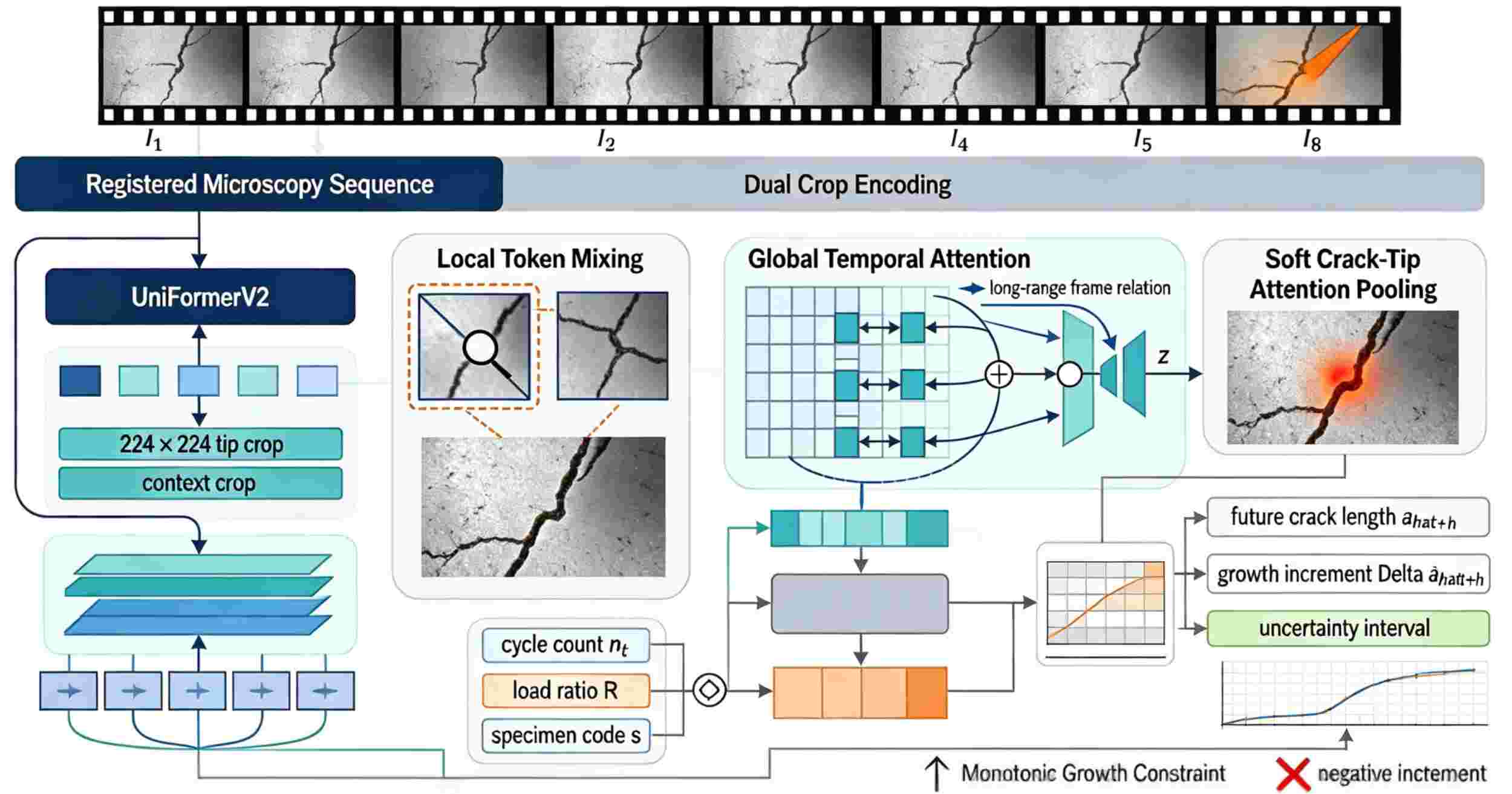
Accurate prediction of fatigue crack extension from in situ microscopy image sequences is essential to connect small-scale damage evolution with remaining-life assessment under cyclic loading. This paper proposes a crack-tip-aware UniFormerV2 model for forecasting fatigue crack growth based on registered microscopy frames and synchronous cycle metadata. The method builds eight-frame sequence windows, applies crack-tip-centered cropping, and combines local-global visual token mixing with cycle-aware positional encoding, soft crack-tip attention pooling, and uncertainty-weighted dual-task regression. A physics-guided monotonic regularizer was added to reduce physically unreasonable negative growth predictions while maintaining local acceleration behavior. A curated dataset of 18,420 microscopy frames and 1,536 labelled sequence windows from aluminum alloy, titanium alloy and dual-phase steel fatigue specimens was selected for the experiment. At the 10-window prediction horizon, the proposed model reduced the mean absolute crack-length error from 12.8 micrometers for CNN-LSTM and 9.4 micrometers for plain UniFormerV2 to 7.1 micrometers. The increment-rate R² reached 0.89, and the cumulative late-stage prediction lag was reduced by 31.4% compared with plain UniFormerV2. Ablation results show that crack-tip masking and monotonic regularization reduced the relative error by 14.6% and 9.3%, respectively. The results show that UniFormerV2 can provide stable visual forecasting for fatigue crack growth when temporal attention is restricted by fracture-process locality and physically plausible propagation behavior.
Downloads
Published
How to Cite
Issue
Section
License
Copyright (c) 2024 Navarro Domínguez, Ortiz Méndez

This work is licensed under a Creative Commons Attribution-NonCommercial-ShareAlike 4.0 International License.