Causal-Guided Fusion TiDE-GNN Screening Model for Perovskite Stability Prediction
DOI:
https://doi.org/10.64972/dea.2024.v3i1.4576d:72-83Abstract
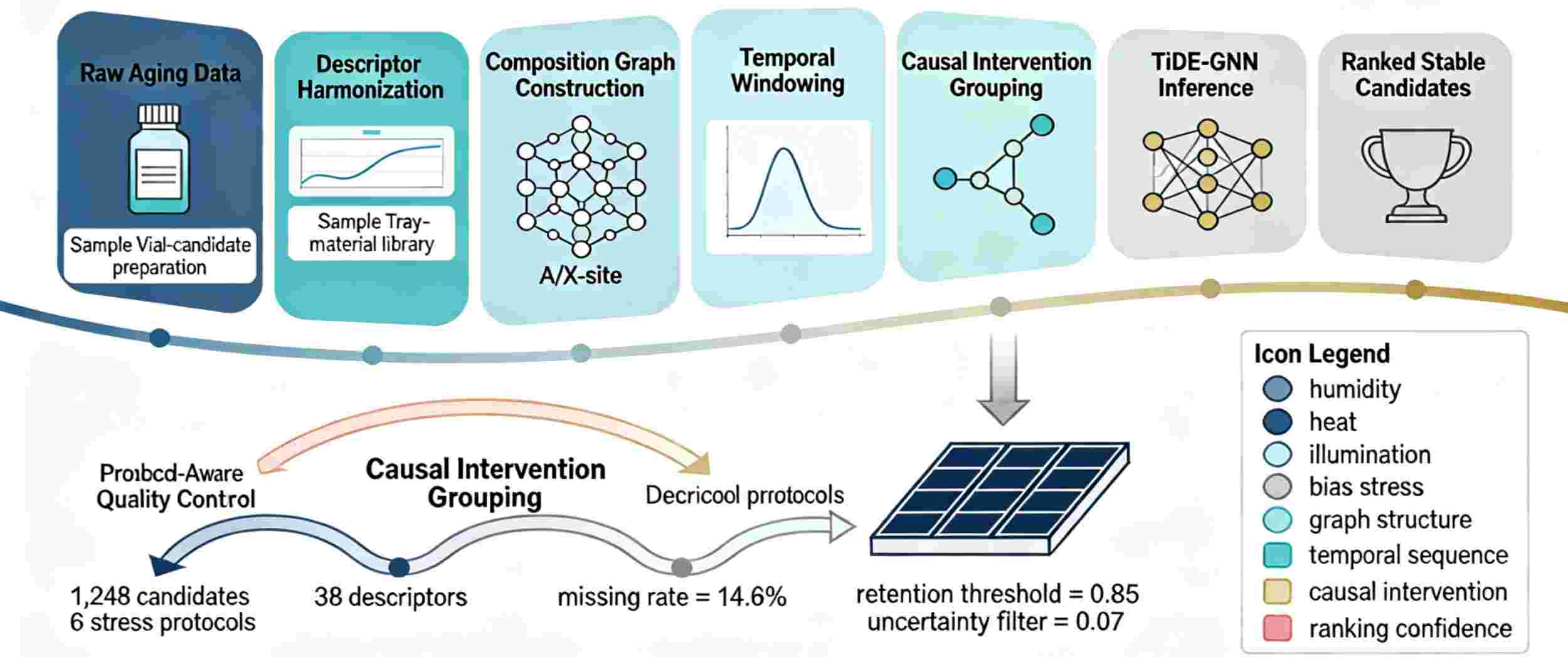
Stability screening of metal-halide perovskites remains difficult because accelerated-aging records combine compositional diversity, device interfaces, processing history and external stress protocols in incomplete time series. This study proposes a Causal-Guided Fusion TiDE-GNN screening model to rank perovskite candidates by long-term normalized retention rather than initial efficiency alone. The model represents each candidate as both a typed material graph and an aging sequence, uses a TiDE temporal encoder to capture degradation dynamics, applies graph message passing to encode compositional and interfacial interactions, and introduces a causal intervention embedding to stabilize fusion under humidity, thermal, illumination and bias-related protocol shifts. A curated benchmark containing heterogeneous accelerated-aging records was evaluated under protocol-aware splits. Compared with the strongest non-causal GNN baseline, the proposed model reduced RMSE by 16.4%, achieved an MAE of 0.043, improved Spearman rank correlation to 0.812, and increased top-10 enrichment to 3.6 under the uncertainty-filtered screening setting. Ablation analysis indicated that removing causal fusion increased RMSE from 0.061 to 0.072, while temporal-branch removal caused the largest deterioration in threshold-crossing accuracy. The results show that causal-guided temporal-graph fusion can provide a reproducible and interpretable route for prioritizing durable perovskite formulations before expensive long-duration tests.
Downloads
Published
How to Cite
Issue
Section
License
Copyright (c) 2024 Julia Makuch, Hanna Paluch, Zuzanna Serafin

This work is licensed under a Creative Commons Attribution-NonCommercial-ShareAlike 4.0 International License.