Oil Spill Thickness Estimation in Polarimetric SAR Imagery Using an Improved CoTNet-SE Model
DOI:
https://doi.org/10.64972/dea.2024.v3i1.4565d:57-71Abstract
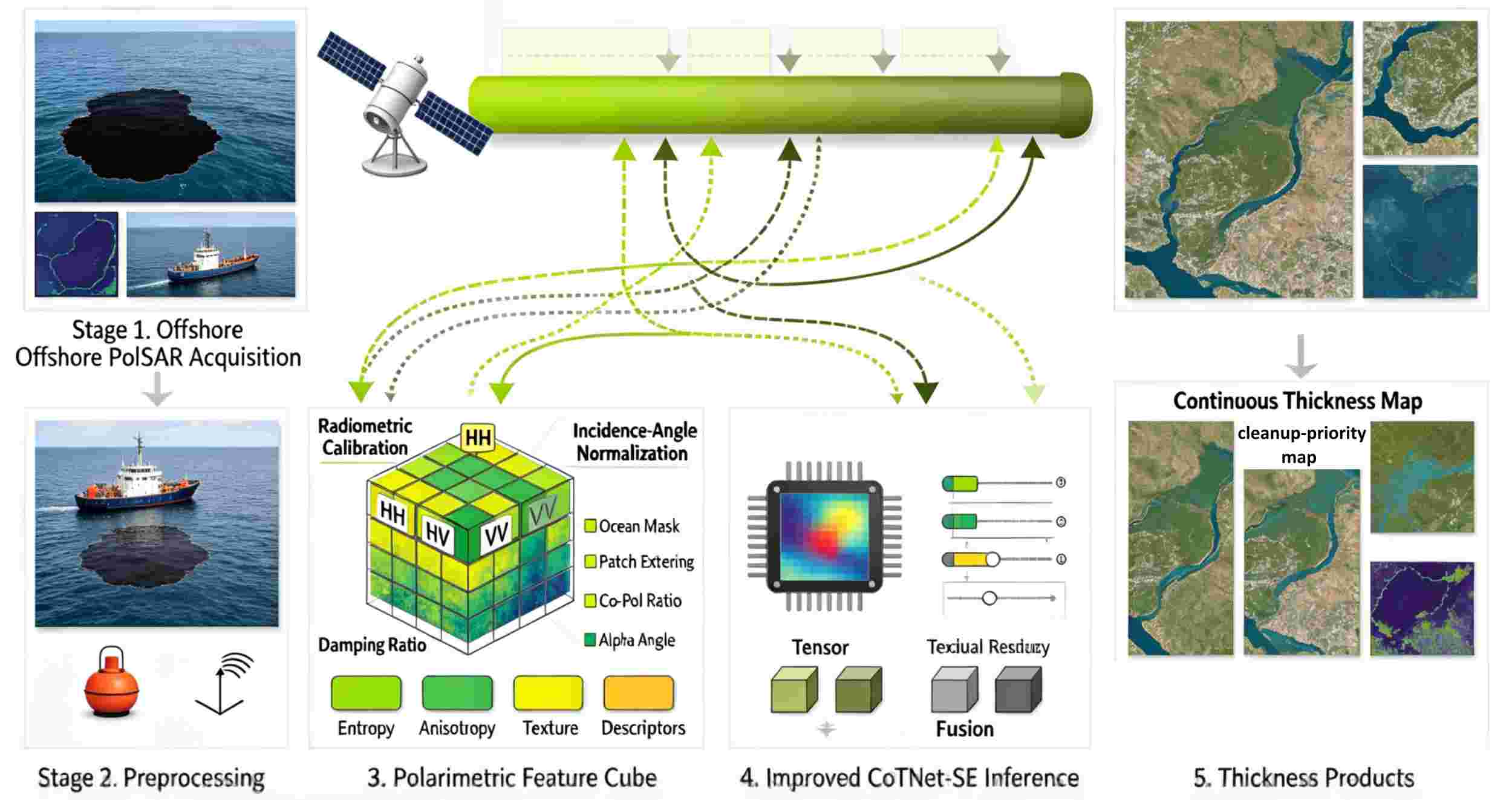
Reliable estimation of offshore oil spill thickness from polarimetric SAR imagery is required for emergency response planning, yet the backscatter response of thin, moderate, and thick slicks is often mixed with wind, incidence angle, look direction, and local sea-surface roughness effects. This paper proposes an improved Contextual Transformer Network with Squeeze-and-Excitation recalibration, called CoTNet-SE, for continuous thickness estimation from calibrated PolSAR patches. The method introduces polarimetric damping descriptors, contextual attention, channel-wise excitation, auxiliary grade supervision, and uncertainty-aware regression to jointly model weak slick texture, polarization-specific suppression, and spatially heterogeneous slick morphology. A controlled multi-scene benchmark of 6,240 labelled patches, four thickness grades, six wind-speed intervals, and three incidence-angle groups was selected for the experiment. Compared with the ResNet-50 baseline, the proposed model reduced the mean absolute error from 0.071 mm to 0.038 mm and the root mean square error from 0.104 mm to 0.056 mm, and increased the coefficient of determination from 0.781 to 0.913. Ablation experiments show that contextual attention reduced RMSE by 19.8%, while SE recalibration further reduced it by 11.3% in mixed sea-state conditions. The uncertainty head achieved 91.6% coverage within the predicted 90% interval. These results indicate that polarimetric channel recalibration and contextual dependency modelling provide an effective route for SAR-based oil spill thickness retrieval in engineering monitoring workflows.
Downloads
Published
How to Cite
Issue
Section
License
Copyright (c) 2024 Taner Başar, Salih Övünç

This work is licensed under a Creative Commons Attribution-NonCommercial-ShareAlike 4.0 International License.