KAN-Mamba with Physics-Informed Learning for Landfill Methane Leak Localization
DOI:
https://doi.org/10.64972/dea.2024.v3i1.4554d:43-56Abstract
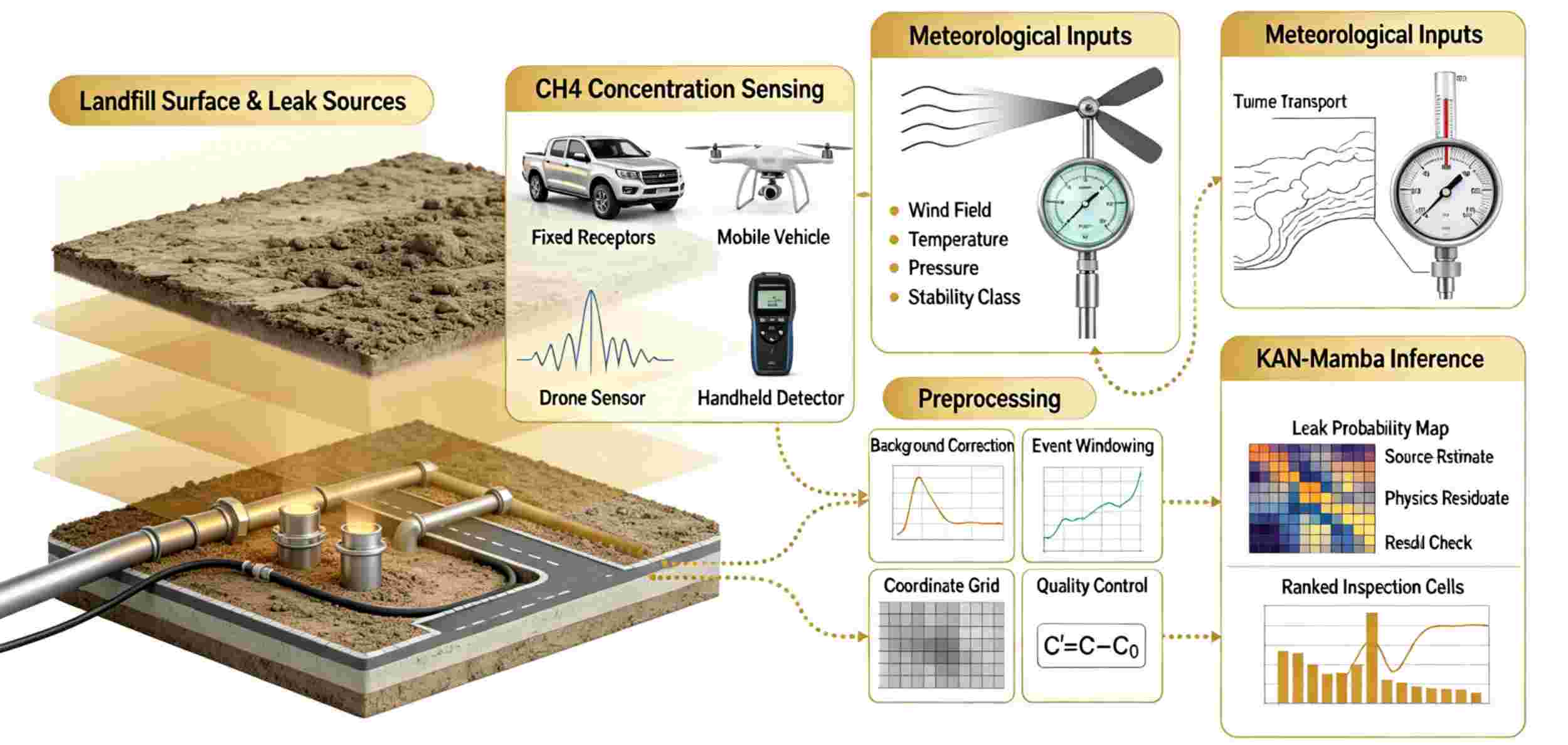
Landfill methane leakage is spatially sporadic, meteorologically sensitive, and difficult to pinpoint from sparse concentration measurements. This paper introduces a physics-informed KAN-Mamba model for high-resolution leak localization by combining Kolmogorov-Arnold Networks (KANs) to handle nonlinear source-to-receptor mapping, a selective state-space Mamba backbone for long-range temporal dependency, and differentiable plume constraints that penalize mass-balance and advection-diffusion inconsistencies. A simulated field campaign with 64 fixed sensors, two mobile transects, 46 leak events and 18 meteorological regimes was conducted to test the model against LSTM, Transformer, PINN and wind-conditioned graph neural network baselines. The median localization error of the proposed model was 6.8 m, the source-rate mean absolute error decreased to 0.031 kg h-1, and the event-level F1-score reached 0.941 under mixed wind stability; it exceeded the best baseline by 21.6% in distance error and 8.3% in recall. Based on the ablation experiment, the physics loss reduced false alarms near the downwind boundary by 34.7%, and the KAN layer improved the expected calibration error under weak wind from 0.113 to 0.061. Robustness tests further showed a recall of over 0.89 at 35% receptor dropout and only 2.6 m additional error under +/-10-degree wind perturbation. These results indicate that physically constrained sequence learning can convert sparse methane data into high-quality source maps for engineering inspection and landfill emission control.
Downloads
Published
How to Cite
Issue
Section
License
Copyright (c) 2024 Junsuke Moriya, Kyohei Seki, Mikiro Tokuda

This work is licensed under a Creative Commons Attribution-NonCommercial-ShareAlike 4.0 International License.