ConvNeXtV2-FPN Model with Cross-Domain Learning for Load Stability Prediction in Unmanned Forklifts
DOI:
https://doi.org/10.64972/dea.2026.v5i3.4546d:70-82Abstract
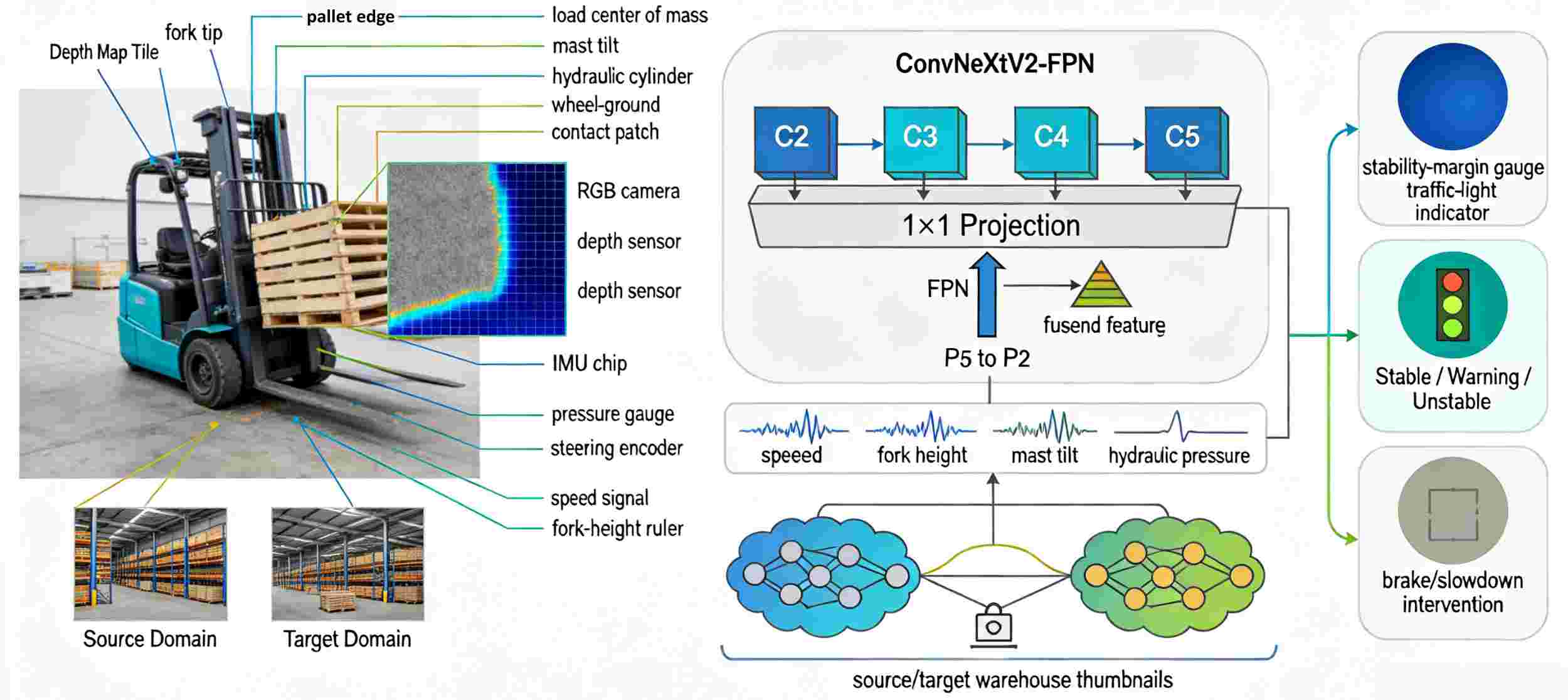
Load instability is still a practical problem for high-speed unmanned forklift operation because payload eccentricity, pallet deformation, floor friction, and motion commands jointly change the overturning margin. This paper proposes a ConvNeXtV2-FPN stability predictor with cross-domain learning to estimate the near-future load stability state from synchronized front-view images, depth cues, inertial signals and hydraulic pressure traces. Use a ConvNeXtV2 backbone for multi-scale visual-dynamic feature extraction; an FPN decoder will be employed to retain small load-boundary cues, a dynamic descriptor encoder will inject motion and pressure information, and a domain-alignment module will be used to reduce the gap between laboratory and warehouse scenes. On 38,640 labelled motion windows of the three payload classes, five motion patterns and four floor conditions were selected for experiments. Swin-T-FPN, ResNet50-FPN and a sensor-only temporal baseline were all outperformed by the proposed model in accuracy, unstable-event recall, mean absolute stability-margin error, and inference latency on an edge GPU. Under unseen warehouse domains, the cross-domain module reduced the false-alarm rate to 5.6% from 8.9%, improved unstable-event recall by 6.8 percentage points. Based on the above experiments, cross-domain feature alignment can enhance the predictive ability, threshold stability and operational portability of unmanned forklift load monitoring. The model was evaluated under domain-separated warehouse conditions using synchronized reference sensors, and the results show that the proposed method achieved 94.7% accuracy, 93.8% unstable-event recall, a 5.6% false-alarm rate, and a 0.039 mean absolute stability-margin error.
Downloads
Published
How to Cite
Issue
Section
License
Copyright (c) 2026 Karol Piekarski, Adrian Rosiński, Marcel Łukasz Kubiński, Oskar Wilk

This work is licensed under a Creative Commons Attribution-NonCommercial-ShareAlike 4.0 International License.