Reliability-Aware Physics-Informed Perceiver Resampler for Multimodal Defect Inspection of Prefabricated Components
DOI:
https://doi.org/10.64972/dea.2022.v1i3.4336d:65-79Keywords:
Prefabricated Components, Defect Detection, Physics-Informed Fusion, Perceiver Resampler, Multimodal InspectionAbstract
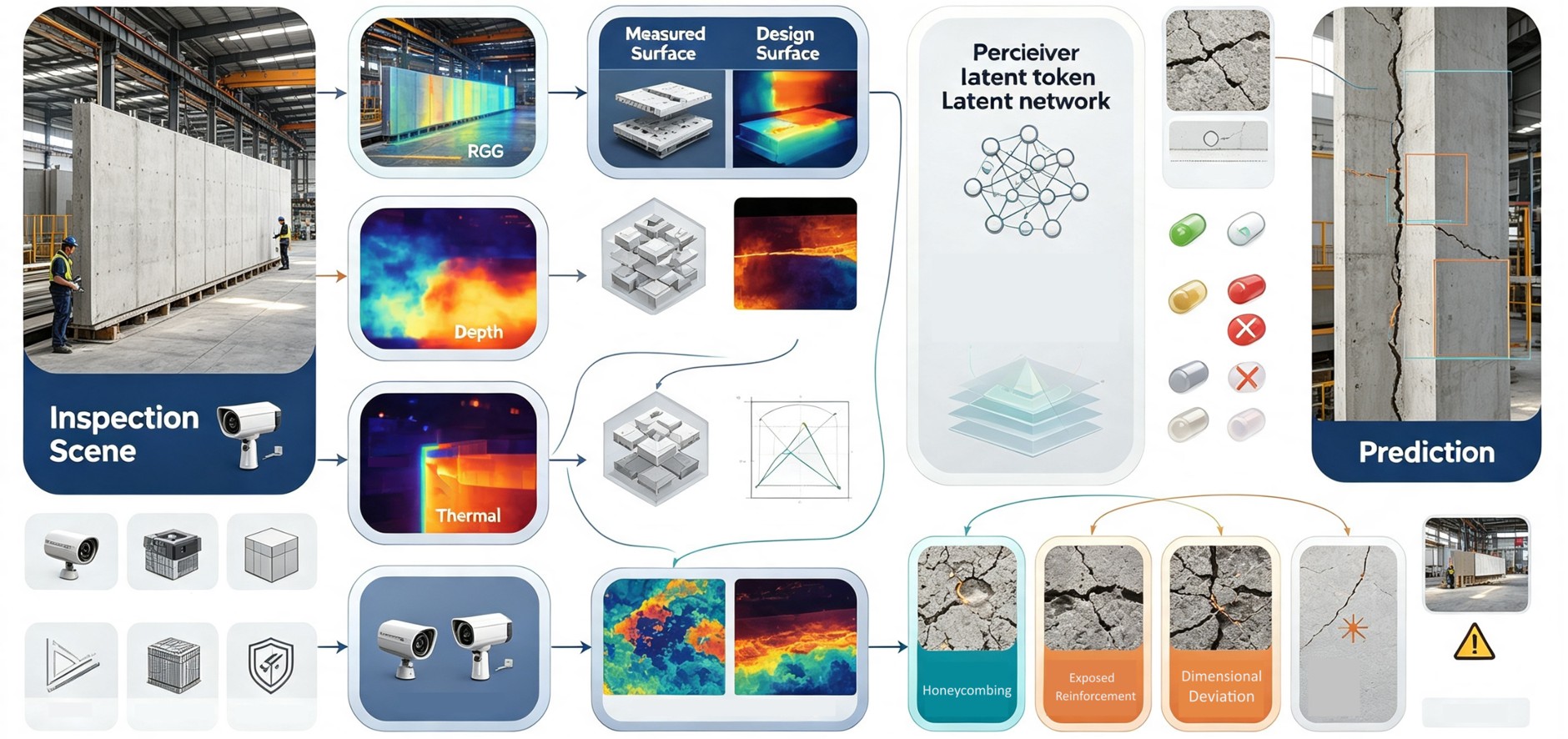
Automated inspection of prefabricated concrete components remains unreliable when cracks, honeycombing, spalling, exposed reinforcement, and dimensional deviations occur under variable illumination or resemble legitimate manufacturing features. This study proposes a reliability-aware, physics-informed Perceiver Resampler that fuses RGB texture with depth geometry, thermal diffusion residuals, and design-tolerance fields before fixed-length latent resampling. The principal methodological contribution is to use calibrated physical reliability to regulate token selection rather than append sensor channels without quality control. Reliability-weighted physical tokens, defect-adaptive latent queries, and a boundary-consistency decoder enable high-resolution multisensor observations to be processed with a stable computational budget. A replaceable experimental protocol is defined on 18,640 annotated component views collected from factory and construction-site scenes. Illustrative, non-final results show 91.8% mAP50, 84.6% mask mIoU, and 89.3% defect recall, exceeding a visual-only Perceiver baseline by 4.9, 5.7, and 6.8 percentage points, respectively. Under low illumination and partial depth loss, recall decreases by 3.7 percentage points, compared with 9.8 points for the baseline. The resampler processes a 2048 x 1536 multisensor sample in 28.4 ms with 3.1 GB peak memory. Component-level splitting, controlled sensor perturbations, module ablations, confidence calibration, and edge-device profiling are used to examine accuracy and operational reliability. The findings suggest that physical residuals are most effective when they regulate evidence selection. All reported values are illustrative placeholders and must be replaced with verified measurements before submission.
Downloads
Published
How to Cite
Issue
Section
License
Copyright (c) 2022 Dominik Szewczyk, Wiktoria Lech

This work is licensed under a Creative Commons Attribution-NonCommercial-ShareAlike 4.0 International License.