ConvNeXtV2-EMA for Multi-Robot Task Allocation on Dynamic Inspection Maps
DOI:
https://doi.org/10.64972/dea.2022.v1i3.4284d:41-52Keywords:
Dynamic Inspection Map, Multi-Robot Task Allocation, ConvNeXtV2 Encoder, Exponential Moving Average, Online ReplanningAbstract
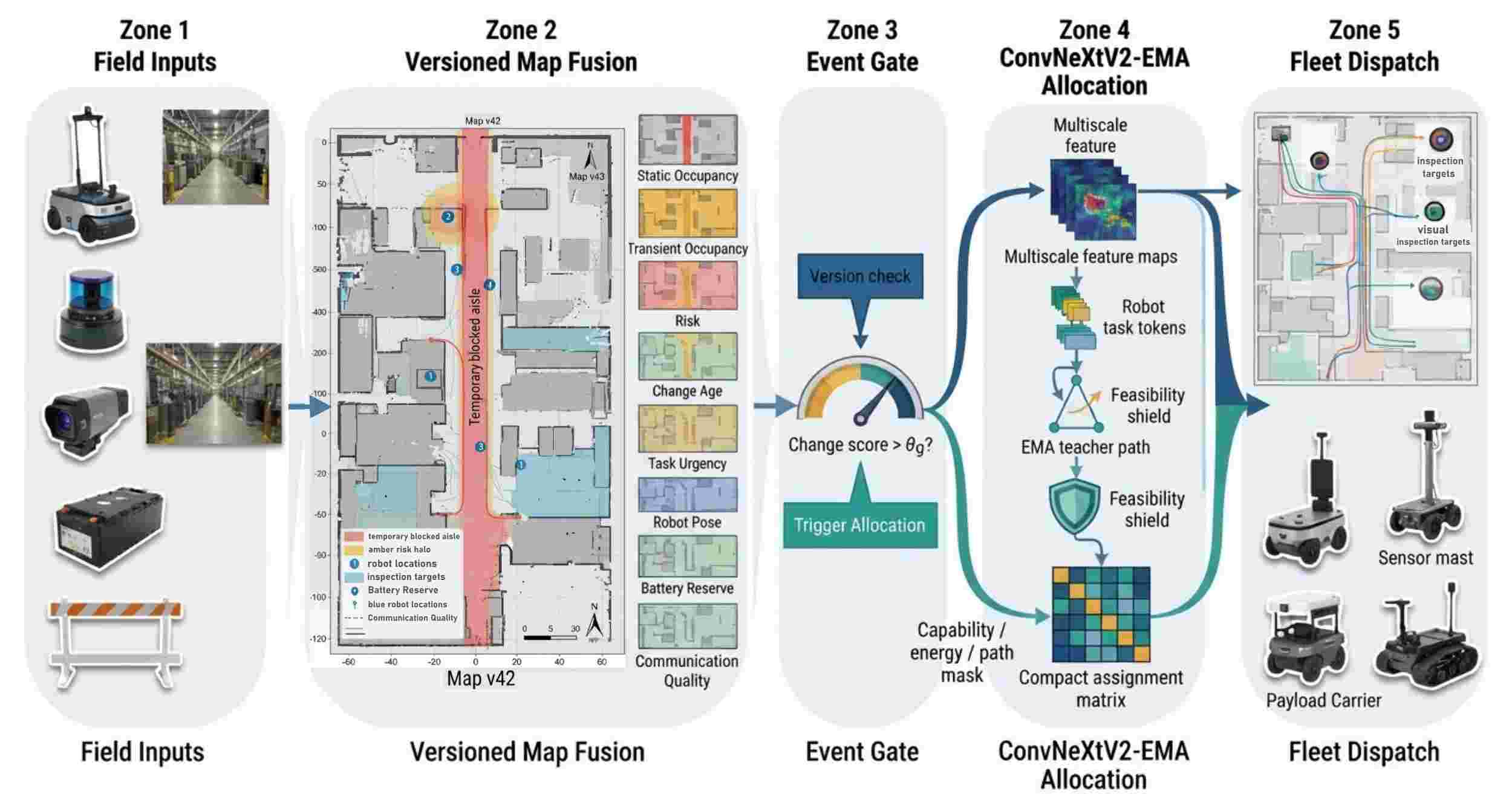
Dynamic inspection maps change when aisles are blocked, hazards occur or new assets are identified; thus, static multi-robot assignment is no longer feasible. This paper develops a ConvNeXtV2-EMA allocation model that converts occupancy, risk, task urgency and robot-state layers into a compact spatial representation and couples it with an exponential-moving-average teacher for stable online decisions. A map-event gate limits inference to consequential changes, and a feasibility mask and a differentiable bipartite decoder enforce capability, battery and collision constraints. Tests in 2,400 simulated episodes and 180 hardware runs of 4-20 heterogeneous robots show a 94.6% task completion rate, a 12.8% reduction in mission time, and a 17.3% decrease in travelled distance compared with the best graph-attention baseline. With fewer than 30 map changes per hour, the method still reaches 91.8% completion and has a 73ms allocation latency; the 95th-percentile workload imbalance is reduced to 0.137. The ablation experiment results attribute a 3.9 percentage point improvement to the multi-scale ConvNeXtV2 encoding and a 2.7 percentage point improvement to EMA stabilization. Based on the above results, Spatially Grounded Representation Learning and Temporally Smoothed Supervision can support responsive, feasible and balanced task allocation without solving a full combinatorial problem after each map update.
Downloads
Published
How to Cite
Issue
Section
License
Copyright (c) 2022 admin admin; Antoni Marciniak

This work is licensed under a Creative Commons Attribution-NonCommercial-ShareAlike 4.0 International License.