Efficient PatchMixer for Data-Driven Boundary-Aware Segmentation from Industrial Agricultural Image Streams
DOI:
https://doi.org/10.64972/dea.2022.v1i3.4273d:26-40Keywords:
Meat Marbling Segmentation; PatchMixer; Label-efficient Learning; Pseudo-label Filtering; Boundary-awareAbstract
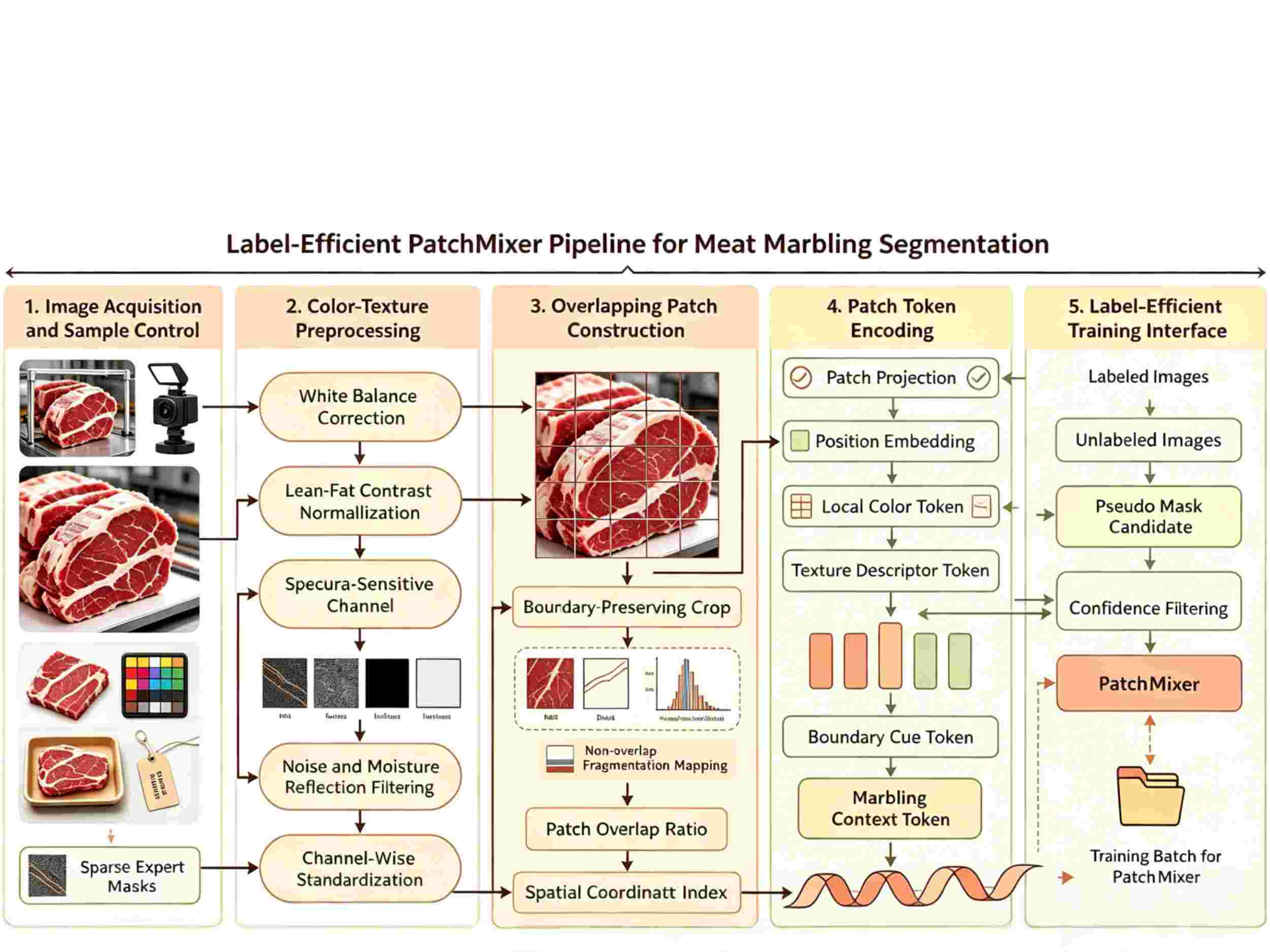
Segmentation of meat marbling is necessary to objectively evaluate the quality of meat in an industrial sorting process; otherwise, it will not be possible to determine the grade of the meat, observe visual uniformity, and feel tenderness. Manually annotating marbling spots is expensive, subjective, and susceptible to illumination, cut-surface conditions, and ambiguity in the fat-muscle border. This paper proposes a label-efficient patchmixer model for segmenting meat marbling. Create image patches from standardized meat-surface images, apply multi-scale patch mixing to achieve fine marbling texture and fat streaks, and implement confidence-guided training to minimize the need for dense pixel labels. The framework includes boundary-sensitive optimization, production-line applicability analysis, sparse annotation supervision, and pseudo-label confidence filtering. For the experiment, several label budgets and meat-image conditions are used. The suggested model is contrasted with semi-supervised versions and the traditional segmentation network and transformer-based baseline. The findings demonstrate that PatchMixer can preserve boundary quality for narrow fat streaks and increase segmentation accuracy with fewer labels. To determine likely regions for manual annotation of marbling masks with a confidence score, a model has been developed. According to the findings, label-efficient segmentation can lower annotation costs in real-world operations and facilitate extensive meat quality inspection.
Downloads
Published
How to Cite
Issue
Section
License
Copyright (c) 2022 Bogdan Radu, Mihnea Lupu

This work is licensed under a Creative Commons Attribution-NonCommercial-ShareAlike 4.0 International License.