Hydraulically Constrained CausalNex-GNN Framework for Data-Driven Urban Drainage Overflow Prediction from Radar and Manhole Sensor Streams
DOI:
https://doi.org/10.64972/dea.2022.v1i3.4251d:1-13Keywords:
Urban Drainage Overflow, Weather Radar, Manhole Sensing, Causal Graph Learning, Dynamic Graph Neural NetworkAbstract
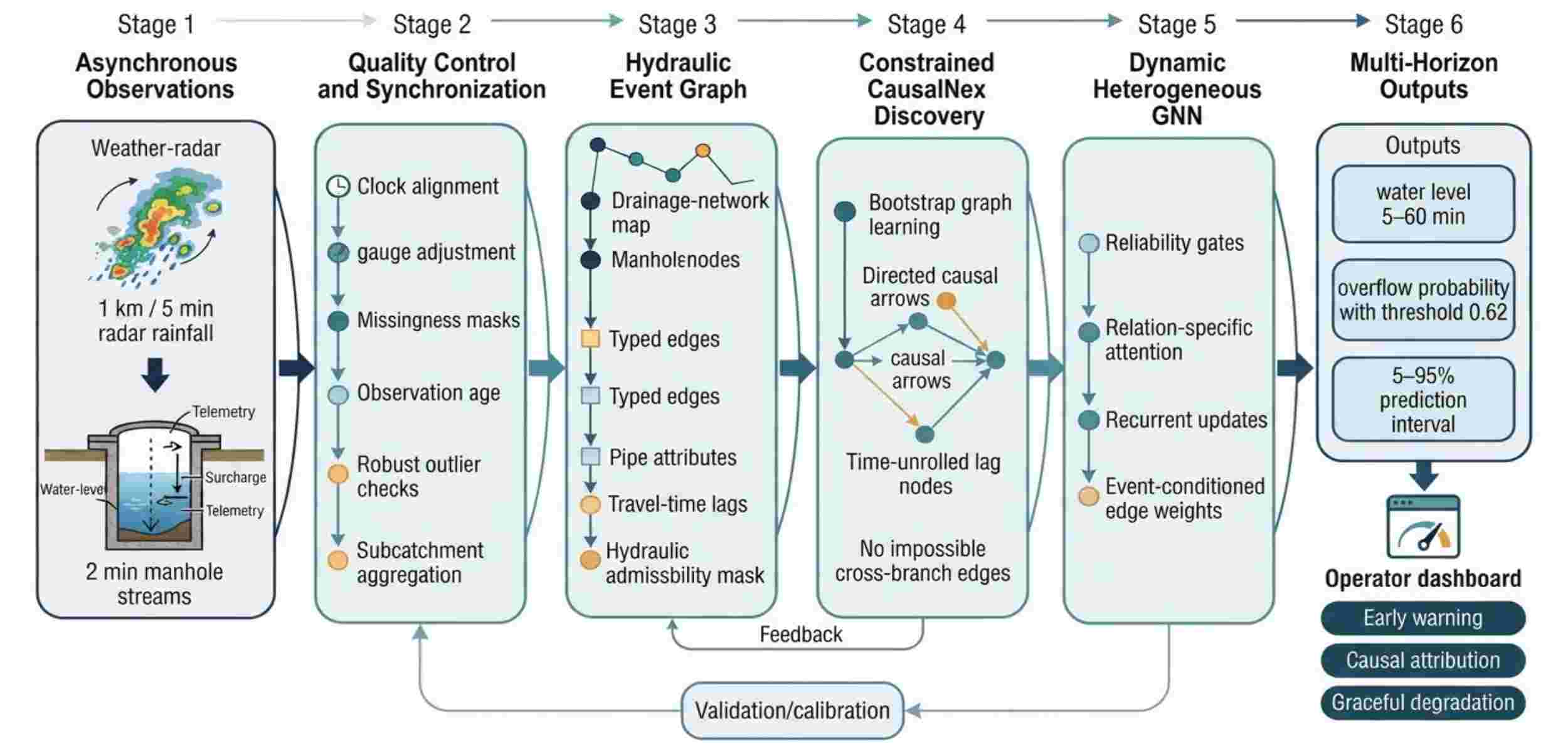
Short-horizon overflow warnings for urban drainage systems are unreliable if the speed of rainfall increase exceeds the range covered by sparse level sensors. This study develops an improved CausalNex-GNN model that integrates 1-km/5-min weather-radar rainfall data with 2-min water-level, flow and surcharge signals from instrumented manholes. CausalNex is used to learn a directed event graph under hydraulic ordering constraints; the graph initializes a dynamic heterogeneous message-passing network, a gated reliability layer suppresses corrupted observations, and a quantile head represents predictive uncertainty. The 186 storm events selected for the model's evaluation occurred in a 42.6-km² drainage area and included 1,284 manholes, of which 96 were instrumented. Among the six statistical, recurrent, graph-based and physics-guided baselines, the proposed model achieved an overflow F1 score of 0.891, an event recall of 0.918 and a 30-min lead-time mean absolute error of 0.118 m. These values are the relative gains of 8.4%, 6.9% and 18.6% over the strongest baseline, respectively. With a combined loss of 30% in manhole streams and 20% radar bias, F1 was still 0.824. Causal edge restrictions reduced the number of false alarms in hydraulically disconnected branches by 27.3% and achieved a calibrated 90% interval of 88.7%. According to the above results, Causal Structure and Topology-aware Fusion can generate accurate, interpretable, and degradation-tolerant overflow forecasts for operational drainage control.
Downloads
Published
How to Cite
Issue
Section
License
Copyright (c) 2022 Eustachy Długosz, Szymon Wierzbicki

This work is licensed under a Creative Commons Attribution-NonCommercial-ShareAlike 4.0 International License.