Adaptive-Resolution FastViT-EMA Model for Texture Estimation of Bakery Products
DOI:
https://doi.org/10.64972/dea.2025.v4i3.4245d:56-68Keywords:
Bakery Texture, Adaptive Resolution, FastViT, Exponential Moving Average, Non-Destructive Quality EstimationAbstract
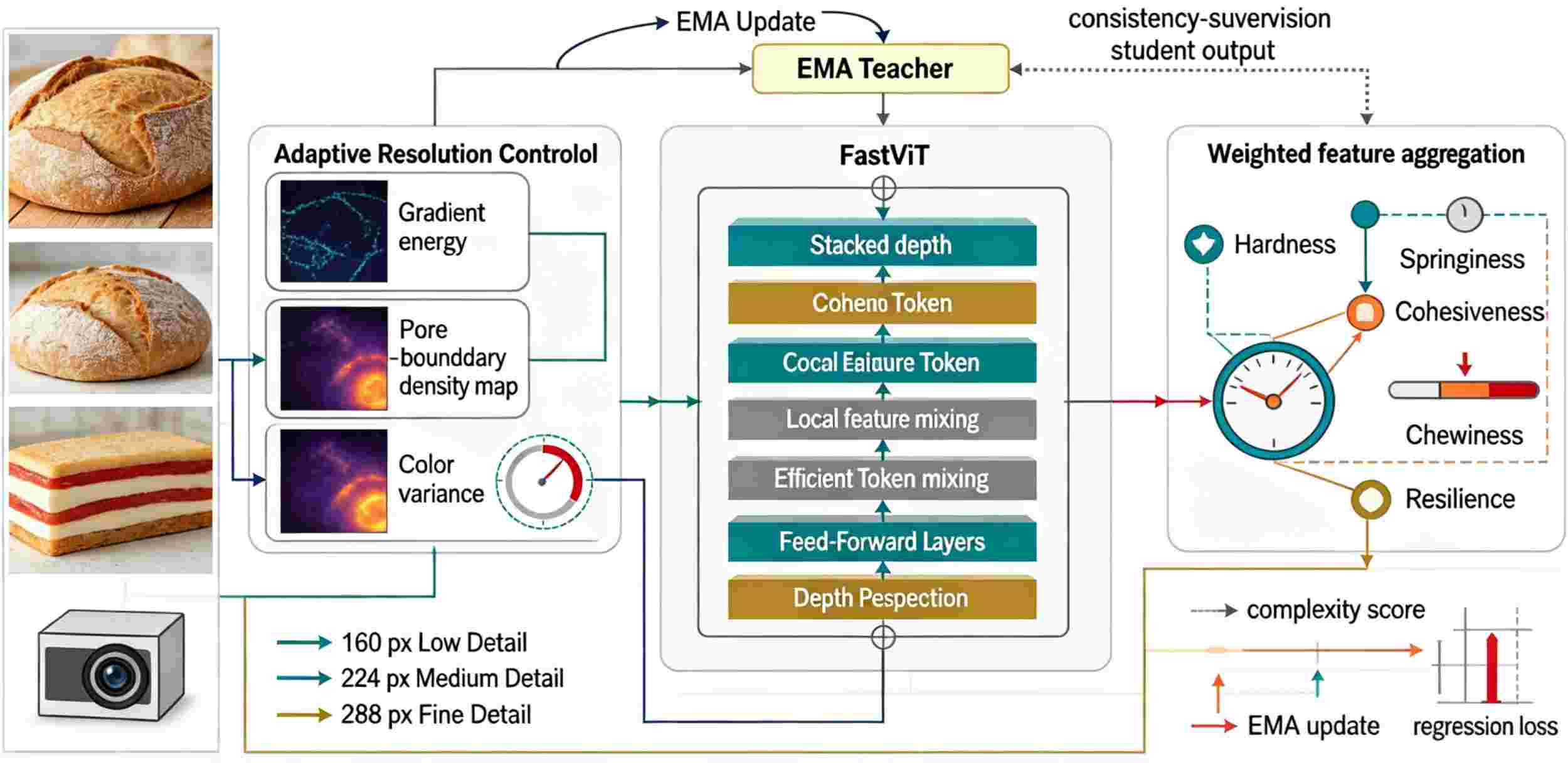
Texture estimation remains a practical bottleneck in bakery quality control because mechanical texture profile analysis is slow, destructive and unsuitable for continuous line-level inspection. This paper proposes an adaptive-resolution FastViT-EMA model for predicting multiple texture indices of food products and adjusts visual detail according to the complexity of crumbs, crusts and edges. A light-weight resolution controller, a FastViT backbone with convolutional token mixing, and an exponential moving average teacher are used to reduce instability caused by batch-to-batch variations in proofing and baking. Organize a controlled dataset of 1,260 samples of bread, cake, bun, biscuit and laminated pastry products that match the labels for texture profile analysis. Compared with the fixed-resolution FastViT baseline, the proposed model had a lower average RMSE of 0.246 and a higher mean R² of 0.918, and also reduced inference cost by 24.7% on the same hardware budget. Crumb-sensitive products showed the largest improvement; the reduction in hardness RMSE was 18.4% and the decrease in resilience error was 15.9%. Ablation analysis showed that adaptive resolution accounted for 0.031 R² and EMA stabilization added 0.018 R², and together they performed better in mixed illumination. Based on the above experiments, Texture can be predicted to an engineering level by including the scale selection step in the model rather than performing it in pre-processing.
Downloads
Published
How to Cite
Issue
Section
License
Copyright (c) 2025 Radek Jakub Kostecki

This work is licensed under a Creative Commons Attribution-NonCommercial-ShareAlike 4.0 International License.