Domain-Adaptive DeepONet-GRU Framework for Data-Driven Alarm Flood Reduction and Operator Decision Support from Industrial Process Streams
DOI:
https://doi.org/10.64972/dea.2022.v1i2.4227d:94-107Keywords:
Alarm Flood Reduction; Chemical Process Monitoring; Domain Adaptation; DeepONet-GRU; Alarm Rationalization; Operator Decision SupportAbstract
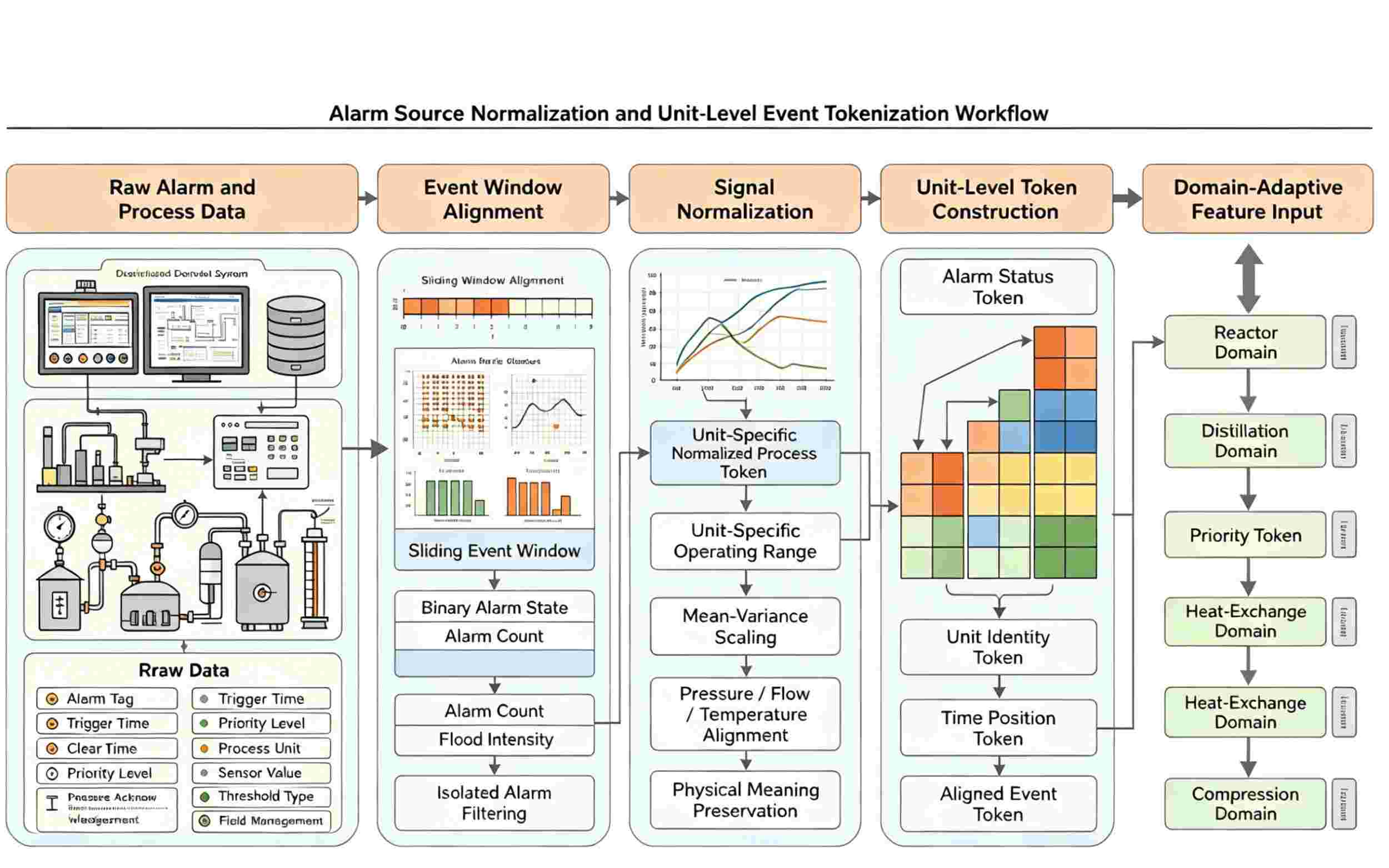
This paper proposes a domain-adaptive DeepONet-GRU framework for data-driven alarm flood reduction and operator decision support from heterogeneous industrial process sensor and alarm streams. The core methodological contributions center on three tightly integrated components that emphasizeWriting the abstract for the journal sequential modeling, cross-domain representation learning, and risk-aware decision support rather than process-specific heuristics. First, unit-level event tokenization combined with a domain-invariant plus unit-conditioned residual representation enables adversarial alignment across process units while preserving physically meaningful residual features that capture local dynamics. Second, a DeepONet branch-trunk operator mapping, conditioned on process context variables, learns a transferable alarm-response operator that generalizes flood-window patterns from source to target units without full retraining. Third, a GRU sequential memory module generates risk-constrained suppression scores, priority-recovery rankings, and concise operator explanation cues, thereby converting raw multi-source time-series into actionable, interpretable recommendations under strict safety constraints. Extensive experiments on industrial alarm and sensor streams demonstrate substantial practical gains: a 48.6 % reduction in nuisance alarms, missed critical alarms remaining below 1.9 %, 91.7 % priority recovery accuracy, and a 43.2 % reduction in operator cognitive load. Under cross-unit domain-shift and robustness evaluations the framework outperforms rule-based systems as well as LSTM, GRU, and Transformer baselines by more than 20 percent in both error and macro-F1 metrics, while sustaining inference latencies of 18.9 ms on a workstation and 54.2 ms on a CPU-edge device. By foregrounding domain-adaptive sequential representation learning and operator-centric decision support, the approach supplies an efficient, transferable solution for industrial time-series analytics and aligns directly with data-centric engineering objectives.
Downloads
Published
How to Cite
Issue
Section
License
Copyright (c) 2022 Povilas Ramanauskas, Saulius Laurinavičius, Ignas Čiobys

This work is licensed under a Creative Commons Attribution-NonCommercial-ShareAlike 4.0 International License.