SplitFed-MobileFormer with Privacy-Constrained Token Compression for Data-Driven Visual Perception in Heterogeneous Edge Camera Networks
DOI:
https://doi.org/10.64972/dea.2022.v1i2.4216d:81-93Keywords:
Edge Camera Network; Privacy-Preserving Visual Perception; SplitFed Learning; MobileFormerAbstract
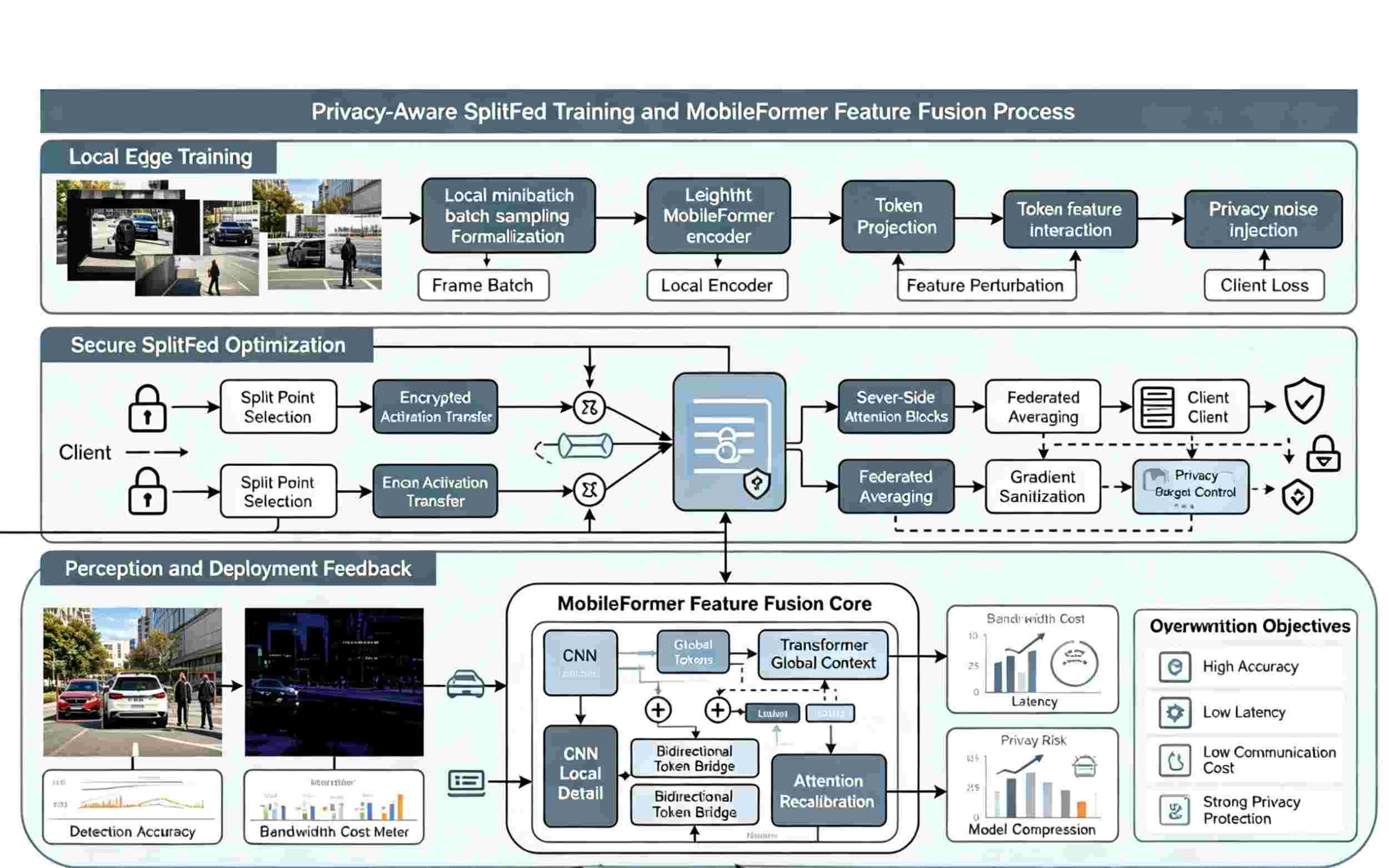
In smart cities, edge camera networks are typically used for traffic monitoring, factory inspections, and community and school security. However, centralized visual analysis has a high transmission cost and may contain sensitive information. A SplitFed-MobileFormer model for privacy-preserving visual perception in edge camera networks is presented in this study. The three are a lightweight MobileFormer backbone, federated aggregation, and split learning. For collaborative semantic learning, camera nodes only provide compact intermediate tokens while retaining the raw pictures and shallow representations. To lower the danger of feature inversion without sacrificing recognition speed, use a privacy-constrained optimization goal and a communication-aware feature compression approach. In comparison to a traditional split-learning baseline, experiments in a distributed multi-camera visual perception scenario demonstrate that the suggested model achieves 94.6% accuracy, 93.8% macro-F1, 21.7 ms average edge inference latency, and a 46.2% reduction in transmitted feature volume. The results show that SplitFed-MobileFormer can accomplish real-time, privacy-preserving visual intelligence on heterogeneous edge devices.
Downloads
Published
How to Cite
Issue
Section
License
Copyright (c) 2022 Zbigniew Kaczan

This work is licensed under a Creative Commons Attribution-NonCommercial-ShareAlike 4.0 International License.