Context-Conditioned Operator Learning for Robust Predictive Control in Environmental Data Systems
DOI:
https://doi.org/10.64972/dea.2022.v1i2.4205d:65-80Keywords:
Greenhouse Climate Control, Fourier Neural Operator, Long Short-Term Memory, Context Awareness, Predictive Control, Multivariate ForecastingAbstract
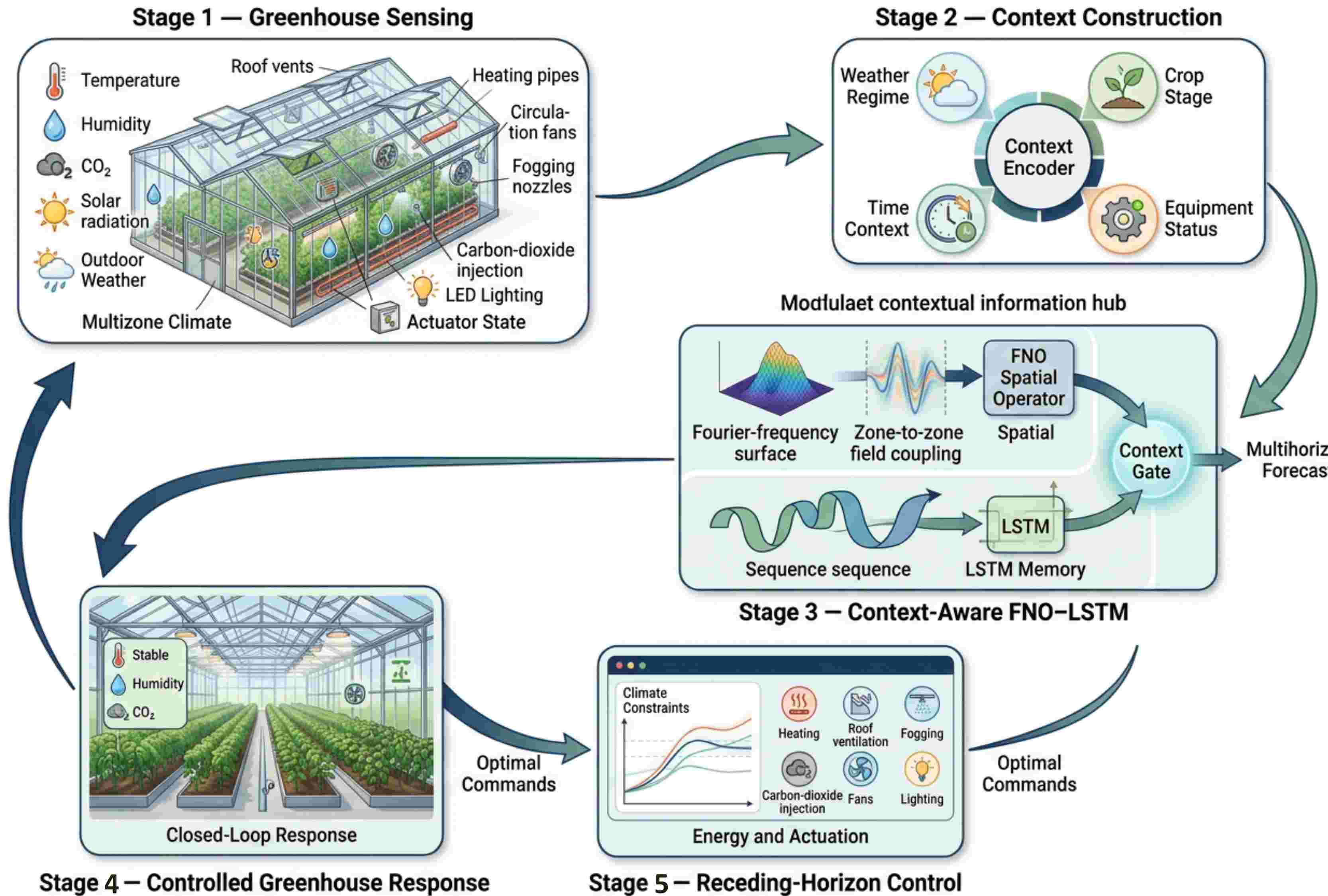
Greenhouse climate control requires forecasts that remain reliable when solar radiation, outdoor weather, crop development, and actuator operating modes alter the governing dynamics. Conventional recurrent networks compress spatial measurements into fixed vectors, whereas operator-learning models may overlook slow thermal and moisture storage. This paper develops a context-aware Fourier neural operator–long short-term memory (FNO–LSTM) model for multizone temperature, relative-humidity, and carbon-dioxide forecasting and receding-horizon control. A spectral branch learns nonlocal zone coupling, a recurrent branch preserves delayed responses, and a context gate conditions their fusion on crop stage, weather regime, time of day, and actuator availability. A control-oriented objective penalizes field error, transition inconsistency, condensation risk, and excessive actuation. In a replaceable 120-day, six-zone greenhouse experiment sampled every 5 min, the model achieved temperature MAE of 0.63 °C, humidity MAE of 3.1 percentage points, and carbon-dioxide MAE of 41 ppm at a 60-min horizon. Relative to an LSTM controller, it reduced temperature error by 46.6%, energy use by 12.8%, and actuator reversals by 21.4%, while maintaining 98.6% climate-constraint satisfaction. The results indicate that explicit spatial operators and context-conditioned temporal memory provide a practical basis for accurate, stable, and computationally feasible greenhouse climate control.
Downloads
Published
How to Cite
Issue
Section
License
Copyright (c) 2022 Dajana Dujmović

This work is licensed under a Creative Commons Attribution-NonCommercial-ShareAlike 4.0 International License.