Dynamic Hypergraph Transformer with Regime-Conditioned Incidence for Multi-Horizon Efficiency Forecasting from Renewable Sensor Streams
DOI:
https://doi.org/10.64972/dea.2022.v1i2.4194d:46-64Keywords:
Hypergraph Transformer, Electrolyzer Efficiency, Renewable Energy, Dynamic Topology, Multi-Horizon Forecasting, Green HydrogenAbstract
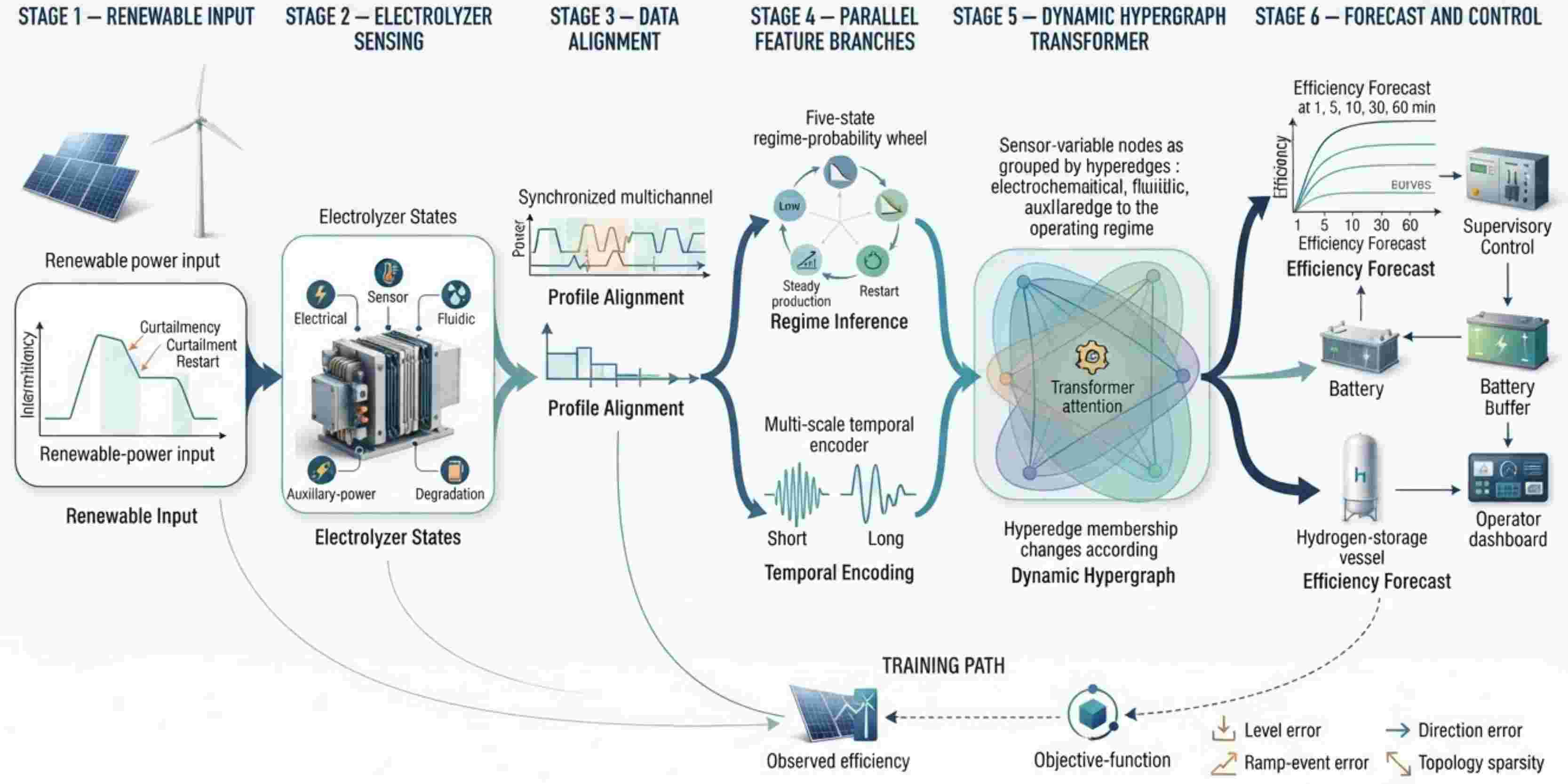
Electrolyzer efficiency varies nonlinearly when photovoltaic and wind power are supplied through ramps, intermittency, curtailment, and restart events. Pairwise temporal models do not explicitly represent the simultaneous coupling among electrical loading, stack temperature, pressure, gas purity, water circulation, and accumulated degradation. This paper proposes a dynamic Hypergraph Transformer for multi-horizon efficiency prediction under renewable-energy input profiles. Its central novelty is a differentiable, regime-conditioned incidence mechanism that encodes time-varying higher-order process groups rather than relying on dense pairwise attention or a fixed graph. A regime-aware topology generator forms hyperedges that connect variables sharing electrochemical, thermal, fluidic, and operating-state dependence. Hyperedge attention then propagates higher-order interactions, while a ramp-sensitive temporal encoder preserves rapid input changes and a gated residual decoder limits long-horizon drift. The prediction target is lower-heating-value system efficiency, defined as hydrogen LHV output divided by total electrical input, including auxiliary demand. The study uses a replaceable illustrative dataset containing 312,480 ten-second records from a 250-kW proton-exchange-membrane electrolyzer, divided chronologically into training, validation, and test subsets. In the illustrative test results, the proposed model obtains an efficiency mean absolute error of 0.86 percentage points, root-mean-square error of 1.21 points, mean absolute percentage error of 1.24%, and ramp-direction accuracy of 91.6% for a 30-min horizon. Its mean absolute error is 34.8% lower than that of a dense Transformer, while inference latency falls from 9.4 to 6.1 ms per sample. Ablation results attribute the largest ramp-event error increase to removal of dynamic topology. These findings indicate that higher-order regime-dependent coupling is useful for supervisory efficiency prediction and renewable-to-hydrogen energy management. All reported experimental values are illustrative and must be replaced by verified measurements before submission.
Downloads
Published
How to Cite
Issue
Section
License
Copyright (c) 2022 Satoshi Hasegawa, Fumiya Matsui, Atsushi Kimura

This work is licensed under a Creative Commons Attribution-NonCommercial-ShareAlike 4.0 International License.