Few-Shot Graph Attention with DLinear Decomposition for Infrastructure Sensor Data Degradation Forecasting
DOI:
https://doi.org/10.64972/dea.2022.v1i2.4183d:31-45Keywords:
Road Marking, Degradation Assessment, Few-Shot Learning, DLinear, Graph Attention Network, Infrastructure MaintenanceAbstract
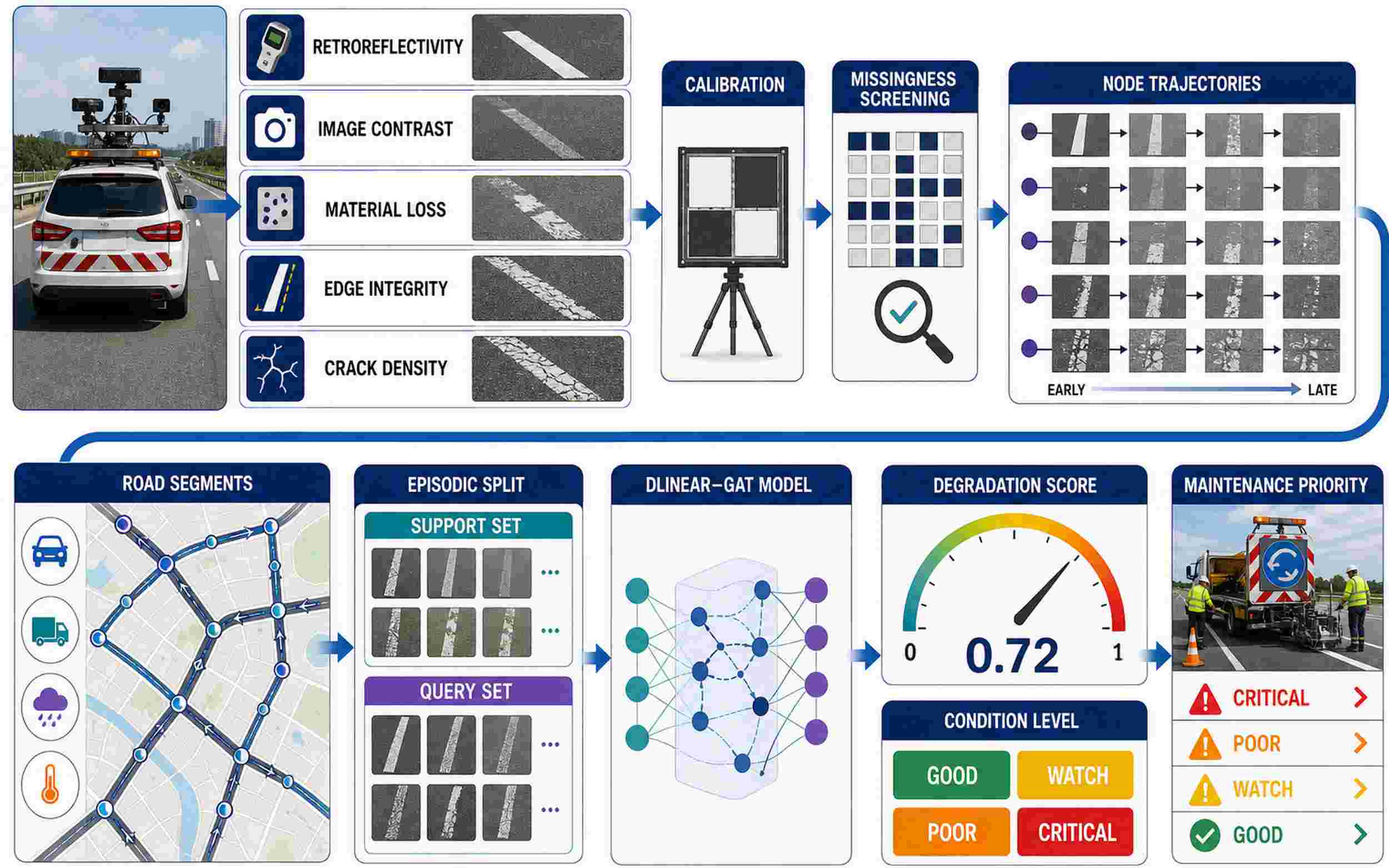
Reliable road-marking condition assessment is difficult when deterioration evolves over time, adjacent segments share traffic and environmental exposure, and only a few labeled inspections are available in a new road district. This paper develops a few-shot DLinear–GAT model that estimates a continuous degradation score and four operational condition levels from sparse inspection sequences. The method decomposes each multivariate trajectory into trend and residual components, applies separate linear temporal projections, and propagates the resulting states through a graph attention network built from segment adjacency, traffic similarity, and maintenance connectivity. An episodic support–query adapter then calibrates the predictor for unseen districts without full retraining. On a replaceable illustrative dataset containing 2,640 segment inspections from 220 road segments, the proposed model obtains a normalized-score MAE of 0.041, RMSE of 0.058, and four-class macro-F1 of 0.876 with five labeled support segments per target district. It reduces MAE by 20.6% relative to the strongest tested baseline and preserves an MAE below 0.070 at a 12-month horizon. Ablation results show that temporal decomposition, graph attention, and episodic adaptation contribute complementary error reductions. These findings support a practical assessment workflow in which limited inspection labels are combined with network structure to identify rapidly deteriorating markings and allocate verification effort. All numerical results are illustrative placeholders and must be replaced by verified experiments before submission.
Downloads
Published
How to Cite
Issue
Section
License
Copyright (c) 2022 Shu-feng Kao, Chia-cheng Lo

This work is licensed under a Creative Commons Attribution-NonCommercial-ShareAlike 4.0 International License.