Physics-Informed Sequential Learning with KAN-Mamba for Quality Prediction in Agricultural Cold-Chain Data
DOI:
https://doi.org/10.64972/dea.2026.v5i2.4169d:114-126Keywords:
Fresh-Cut Vegetables, Enzymatic Browning, Physics-Informed Learning, KAN-Mamba, Quality PredictionAbstract
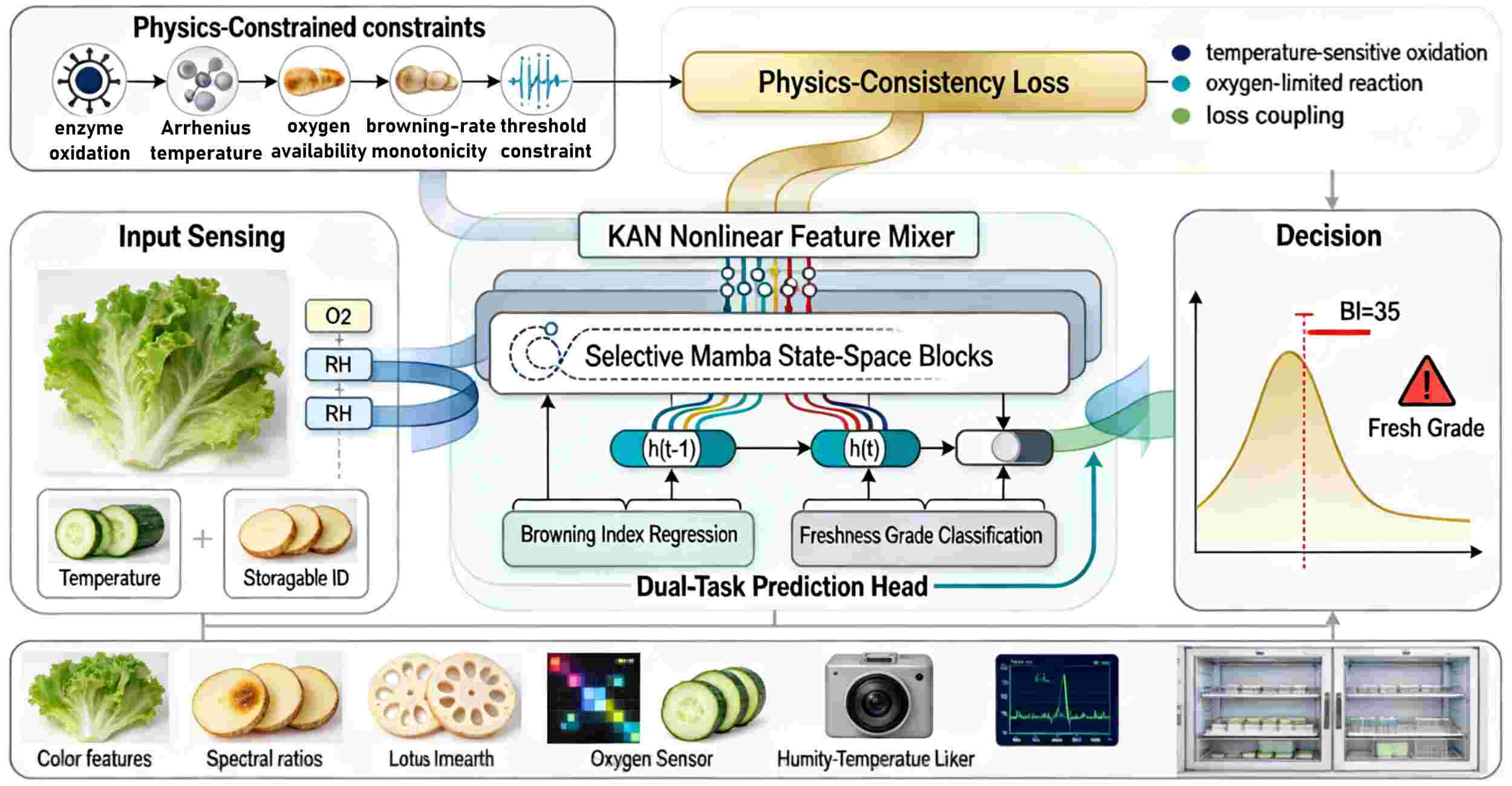
Fresh-cut vegetables are easily damaged by enzymatic browning after cutting because cell compartmentalisation is disrupted, oxygen diffusion accelerates, and moisture migration changes at the exposed tissue surface. Develop a physics-informed KAN-Mamba model for browning prediction in fresh-cut lettuce, potato, lotus root and cucumber under cold-storage conditions in this study. The model uses Kolmogorov-Arnold network layers for nonlinear multimodal feature mixing, selective Mamba state-space blocks for long-term storage memory, and a soft reaction-consistency constraint based on temperature-sensitive oxidation and browning-rate monotonicity. The input features are RGB colour indices, hyperspectral band ratios, headspace oxygen, relative humidity, storage temperature, vegetable identity and elapsed storage time. In a 72-hour experiment with 1,920 time-stamped records, the proposed model achieved an RMSE of 3.18, an MAE of 2.41, a freshness-grade accuracy of 93.6%, and a high-browning warning recall of 91.7%, and outperformed the conventional machine-learning and sequence-model baselines.
Downloads
Published
How to Cite
Issue
Section
License
Copyright (c) 2026 Iliana Trifunović, Radojka Filipović, Tihomira Gojković

This work is licensed under a Creative Commons Attribution-NonCommercial-ShareAlike 4.0 International License.