Edge-Semantic Perceiver IO for Firmware Backdoor Detection Using Binary Function Call Graphs
DOI:
https://doi.org/10.64972/dea.2022.v1i2.4132d:16-30Keywords:
Firmware Backdoor Detection, Binary Function Call Graph, Perceiver IO, Edge Semantics, Latent Attention, Cross-Architecture GeneralizationAbstract
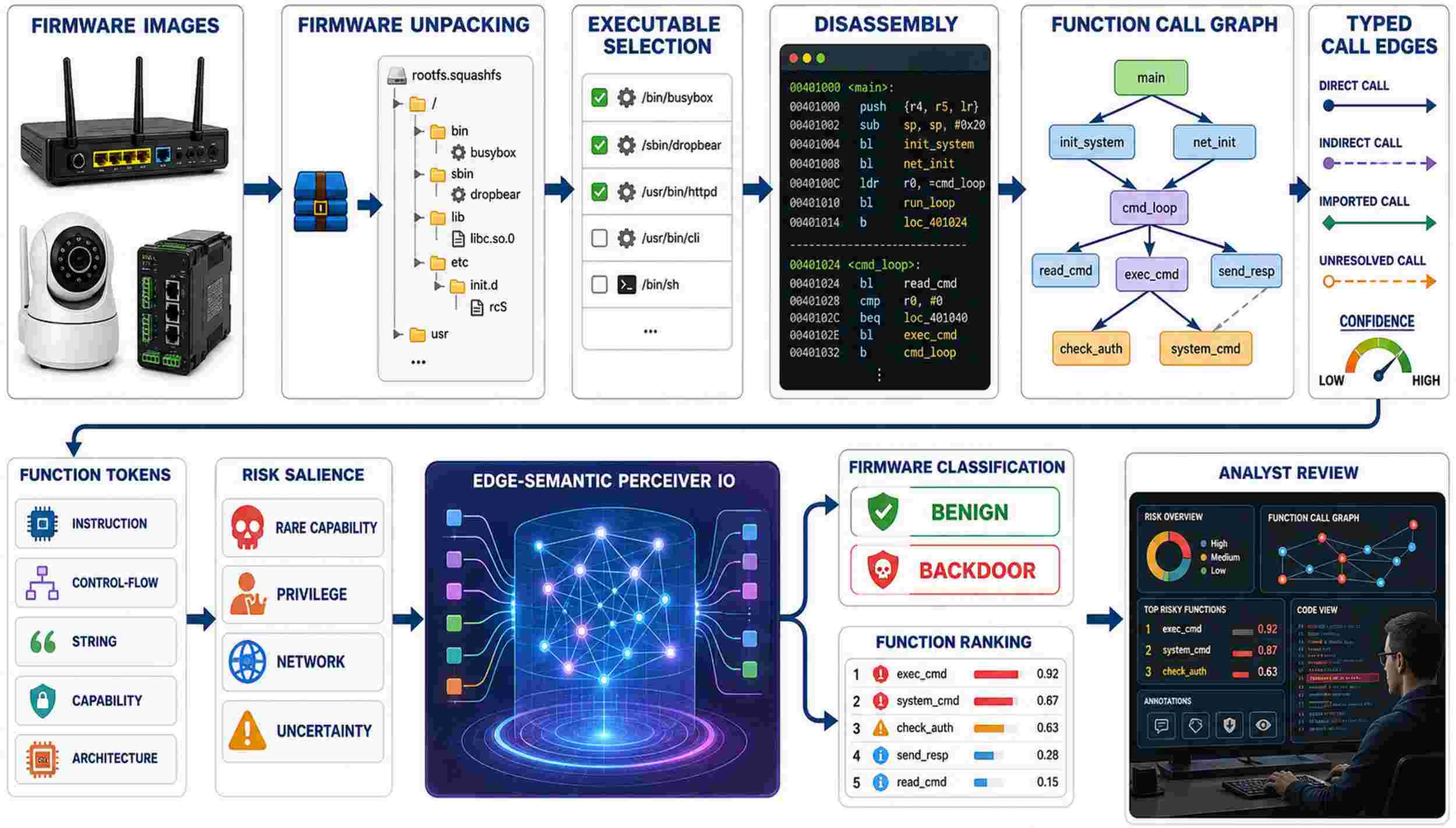
Firmware backdoors are difficult to detect after compilation because malicious behavior may be confined to a small set of functions and remain hidden after extensive changes to instruction layout. This paper proposes ESPI-FBD, an edge-semantic Perceiver IO framework that analyzes binary function call graphs while avoiding quadratic interaction among all recovered functions. The method integrates architecture-normalized function descriptors, typed directional call-relation biases, salience-seeded latent vectors, latent self-attention, and separate output queries for firmware classification and suspicious-function ranking. A product-disjoint evaluation protocol is specified for a multi-architecture firmware corpus and covers detection, localization, cross-architecture transfer, robustness, calibration, latency, and memory. The framework is designed to preserve sparse malicious evidence in a bounded latent workspace and to return an analyst-oriented review queue in addition to an image-level decision. The numerical values currently reported are illustrative placeholders that define the intended evaluation and must be replaced with audited experimental outputs before submission.
Downloads
Published
How to Cite
Issue
Section
License
Copyright (c) 2022 Takács Ádám, Juhász Imre

This work is licensed under a Creative Commons Attribution-NonCommercial-ShareAlike 4.0 International License.