Collision Avoidance at Crowded Intersections Based on Model Predictive Control Algorithms
DOI:
https://doi.org/10.64972/dea.2022.v1i1.4116d:69-83Keywords:
Model Predictive Control, Collision Avoidance, Crowded Intersections, Adaptive Risk Allocation, Interaction PredictionAbstract
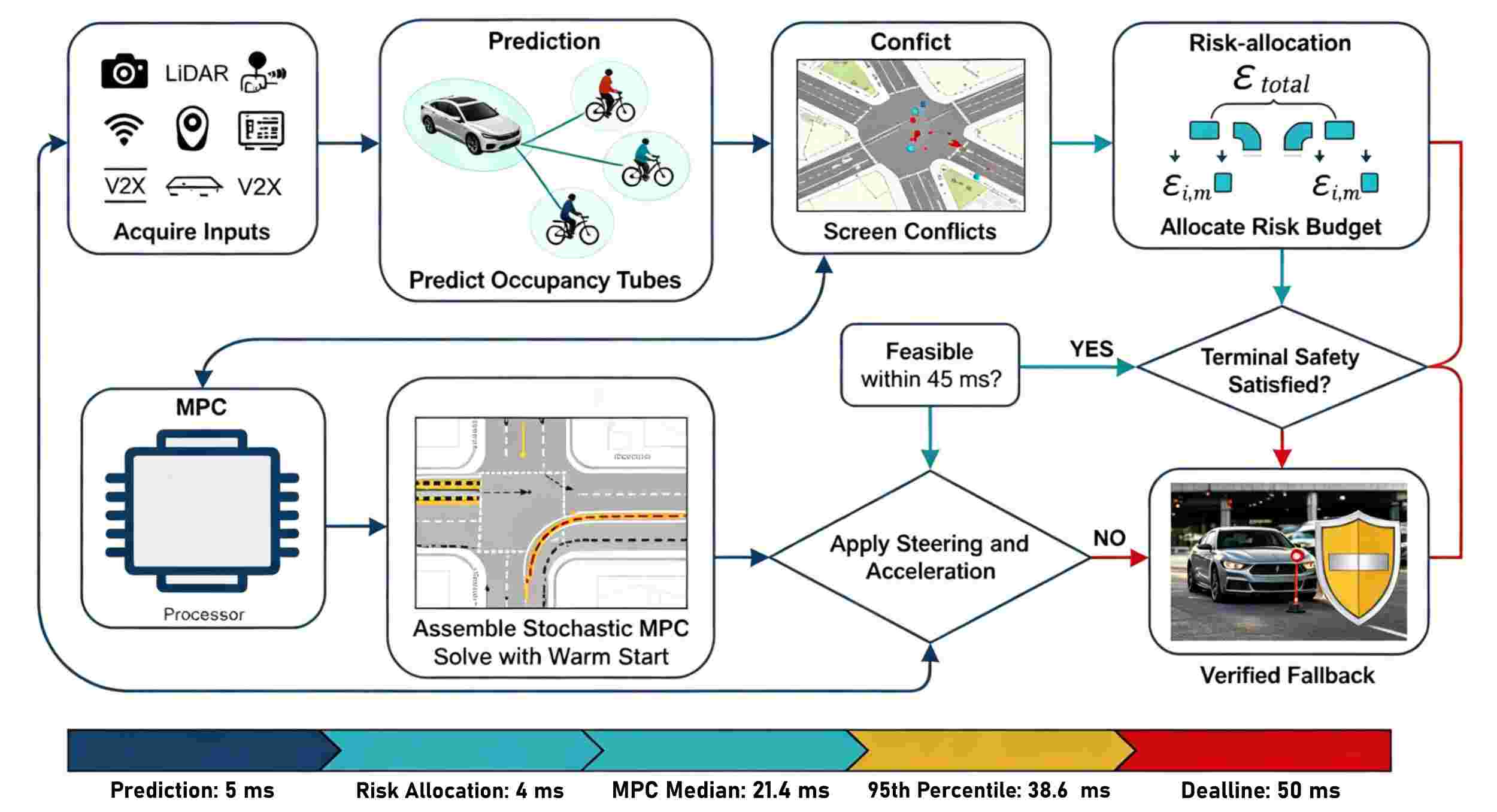
At busy intersections, there is a high risk of accidents because many people are in the way and it is difficult to see what others intend to do. A Stochastic Model Predictive Control Algorithm with Adaptive Risk Allocation for Real-time Collision Avoidance is Proposed in this paper. Multimodal motion prediction is converted into class-dependent occupancy tubes, and at each control step, a finite risk budget is reallocated based on the severity of conflict, age of observation, and road-user vulnerability. The optimisation aims to balance the four factors of progress, tracking accuracy, control smoothness and probabilistic separation, subject to vehicle dynamics, road boundaries, actuator limits and a terminal safe-set condition. A total of 12,000 random encounters were conducted at a densely packed four-leg intersection, and the results were compared with those of time-to-collision braking, artificial-potential-field planning, deterministic tracking MPC, and fixed-risk stochastic MPC. At the high demand of 1,800 vehicles per hour, the proposed controller reduced the collision rate from 4.8% for deterministic MPC to 0.6%, increased the fifth-percentile clearance from 0.74m to 1.28m, and limited mean delay to 8.7s. The median and 95th-percentile solution times for an automotive-grade processor were 21.4ms and 38.6ms, and it met the 50ms control period requirement. Based on the above results, urgent-weighted risk redistribution can maintain the safety level without a large increase in the constraint-induced stop rate.
Downloads
Published
How to Cite
Issue
Section
License
Copyright (c) 2022 Akira Takahashi, Sakura Yamamoto

This work is licensed under a Creative Commons Attribution-NonCommercial-ShareAlike 4.0 International License.