Roadside Acoustic Array Data-Driven S4D-Transformer Model for Performance Evaluation of Noise Barriers
DOI:
https://doi.org/10.64972/dea.2026.v5i3.3961d:1-14Keywords:
Roadside Acoustic Array, Noise Barrier Evaluation, S4D-Transformer, Insertion Loss, Spectral AttenuationAbstract
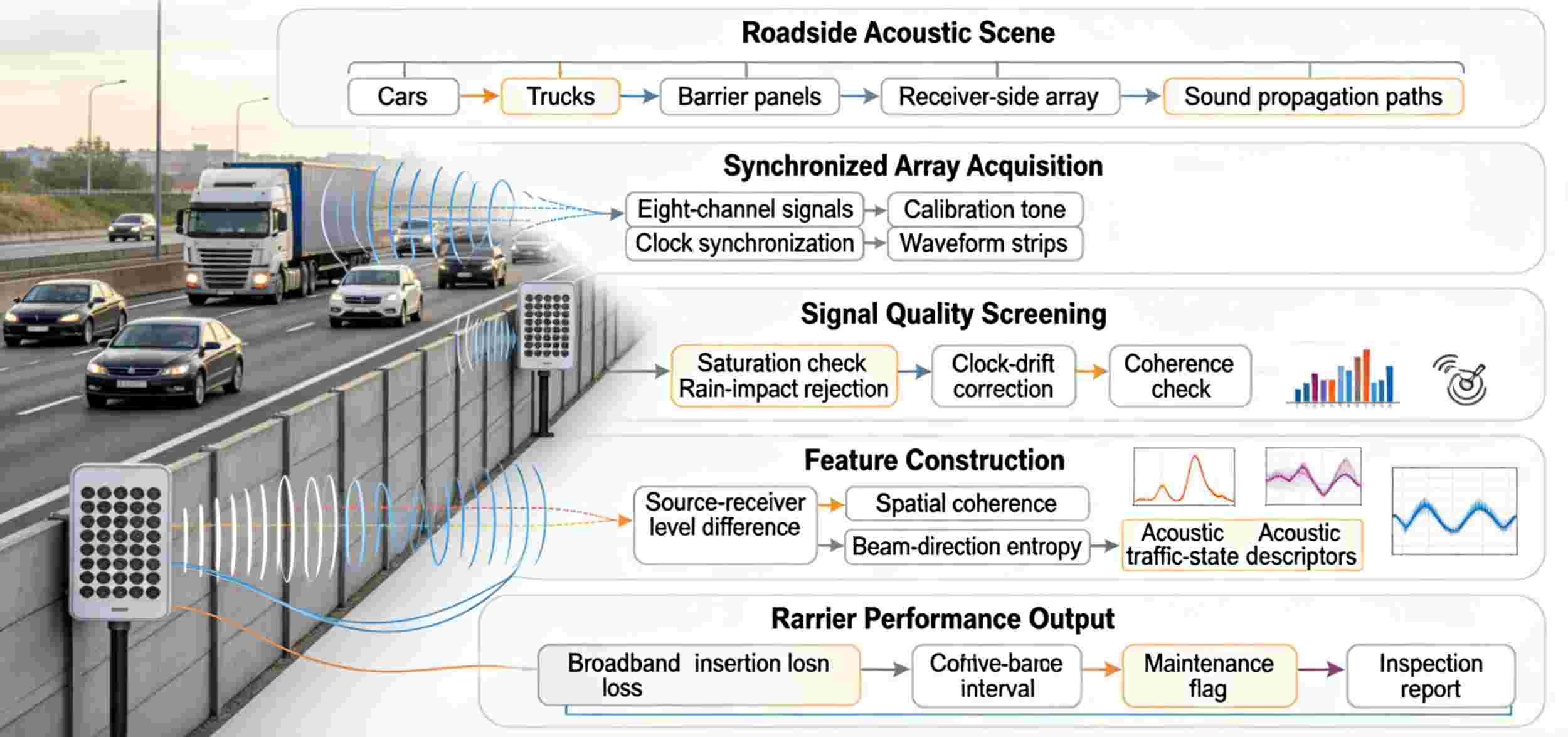
Most roadside noise barriers are still assessed through short-term manual surveys, so their actual noise-reduction performance under changing traffic composition, source height, pavement state, wind condition and receiver-side propagation environment remains insufficiently characterized. This paper proposes an S4D-Transformer model for data-driven performance evaluation using synchronous roadside acoustic-array recordings collected on the source side and protected receiver side of a full-scale barrier. First, multiple acoustic signals are converted into standardised time-frequency descriptors, spatial-coherence indicators, beam-direction features and traffic-state variables. A diagonal-structured state-space block is then employed to retain long-range acoustic memory across monitoring windows, and a transformer fusion layer estimates broadband insertion loss, spectral attenuation and rating confidence. A 28-day field dataset of 1,344 ten-minute windows and 7.8 million valid array frames was used for training and testing. The mean absolute insertion-loss error of the proposed model was 0.84 dB, the root-mean-square error was 1.12 dB, and the Pearson correlation coefficient with reference measurements was 0.946. Compared with CNN-LSTM, vanilla Transformer and pure S4D baselines, it reduced the mid-frequency error by 18.6%-31.4% and maintained 95% of the window-level uncertainty intervals within 2.7 dB. According to the above results, roadside acoustic arrays can perform non-intrusive, frequency-resolved and continuous barrier-performance diagnosis for operation and maintenance in complex urban corridors with minimal disturbance to normal traffic flow.
Downloads
Published
How to Cite
Issue
Section
License
Copyright (c) 2026 Sultan Al-Dhaheri, Khamis Al-Zahrani, Hazaa Al-Mansoori

This work is licensed under a Creative Commons Attribution-NonCommercial-ShareAlike 4.0 International License.