Koopman Neural Operator Model for Wake Interaction Prediction in Wind Farms Based on SCADA Data
DOI:
https://doi.org/10.64972/dea.2023.v2i4.3795d:54-65Keywords:
Wind Farm SCADA, Wake Interaction, Koopman Neural Operator, Power Loss Prediction, Wind Energy ForecastingAbstract
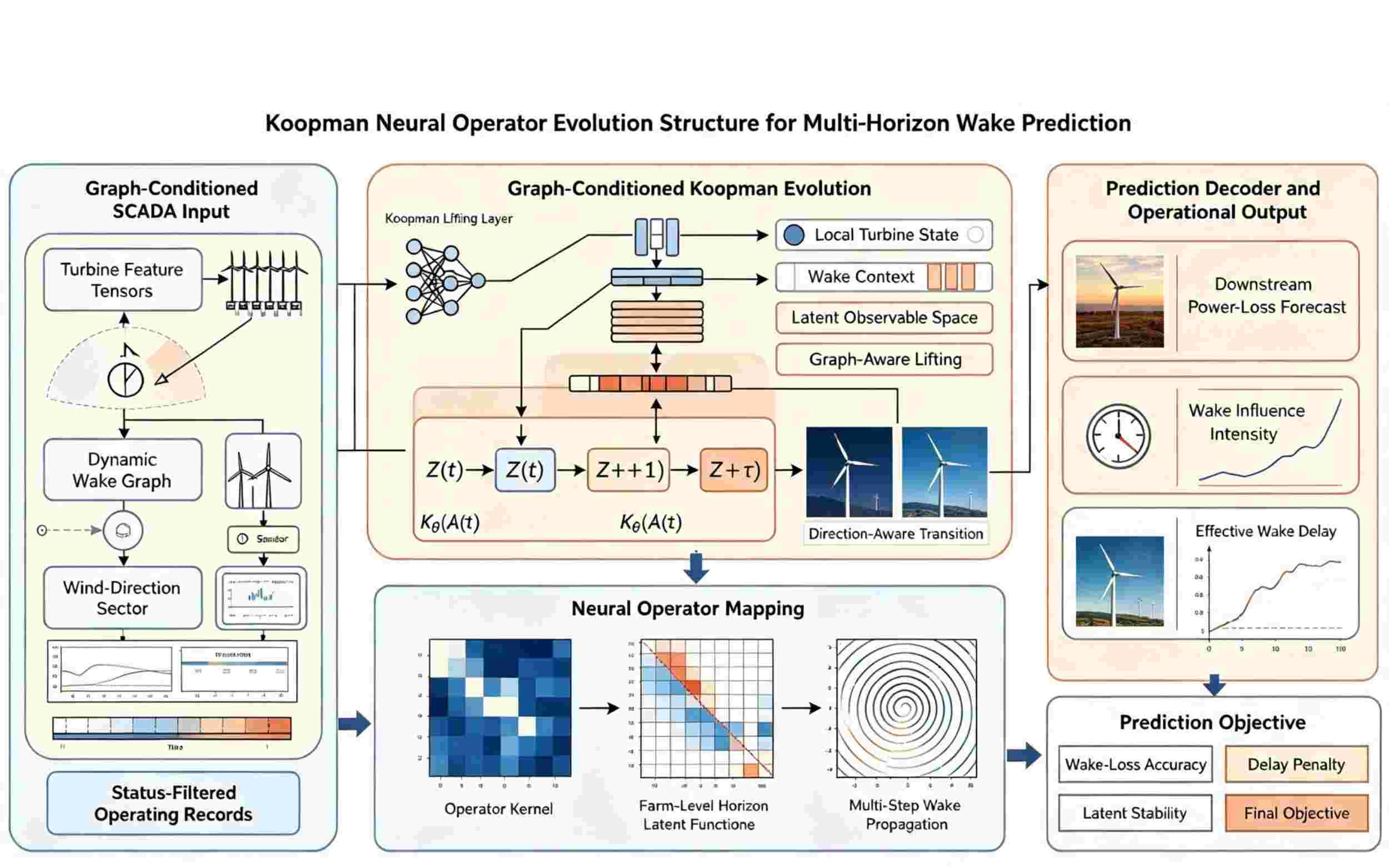
Use SCADA data to propose a Koopman neural operator model for wake interaction prediction in wind farms. Wind direction, wind speed, active power, rotor speed, pitch angle, yaw deviation, ambient temperature, generator temperature, turbine status, and downstream power-loss residuals are arranged into farm-level SCADA windows, with each turbine being considered a dynamic node. Koopman lifting is used to transform the non-linear turbine interaction into a latent evolution process with enhanced dynamical stability, and direction-conditioned wake graphs are built based on the turbine arrangement and inflow sector. Then, farm-level latent states are mapped to multi-horizon downstream power-loss, wake-intensity, and delay predictions using a compact neural operator. Improved power-loss RMSE, wake-intensity F1, delay-error control, cross-sector transfer, and online inference latency are demonstrated using simulated trials of an irregular 42-turbine wind farm. The model is neither a direct flow-measurement or automatic-control system, but rather a SCADA-based monitoring layer for wind-farm operators.
Downloads
Published
How to Cite
Issue
Section
License
Copyright (c) 2023 Irena Harasimowa, Maja Karpińska, Paulina Lis

This work is licensed under a Creative Commons Attribution-NonCommercial-ShareAlike 4.0 International License.