Boundary-Refined DeepLabV3+ for Crop Disease Detection in Greenhouse Vegetable Images
DOI:
https://doi.org/10.64972/dea.2026.v5i2.2997d:87-100Keywords:
Semantic Segmentation, DeepLabV3+, Boundary Refinement, Greenhouse Vegetables, Crop Disease DetectionAbstract
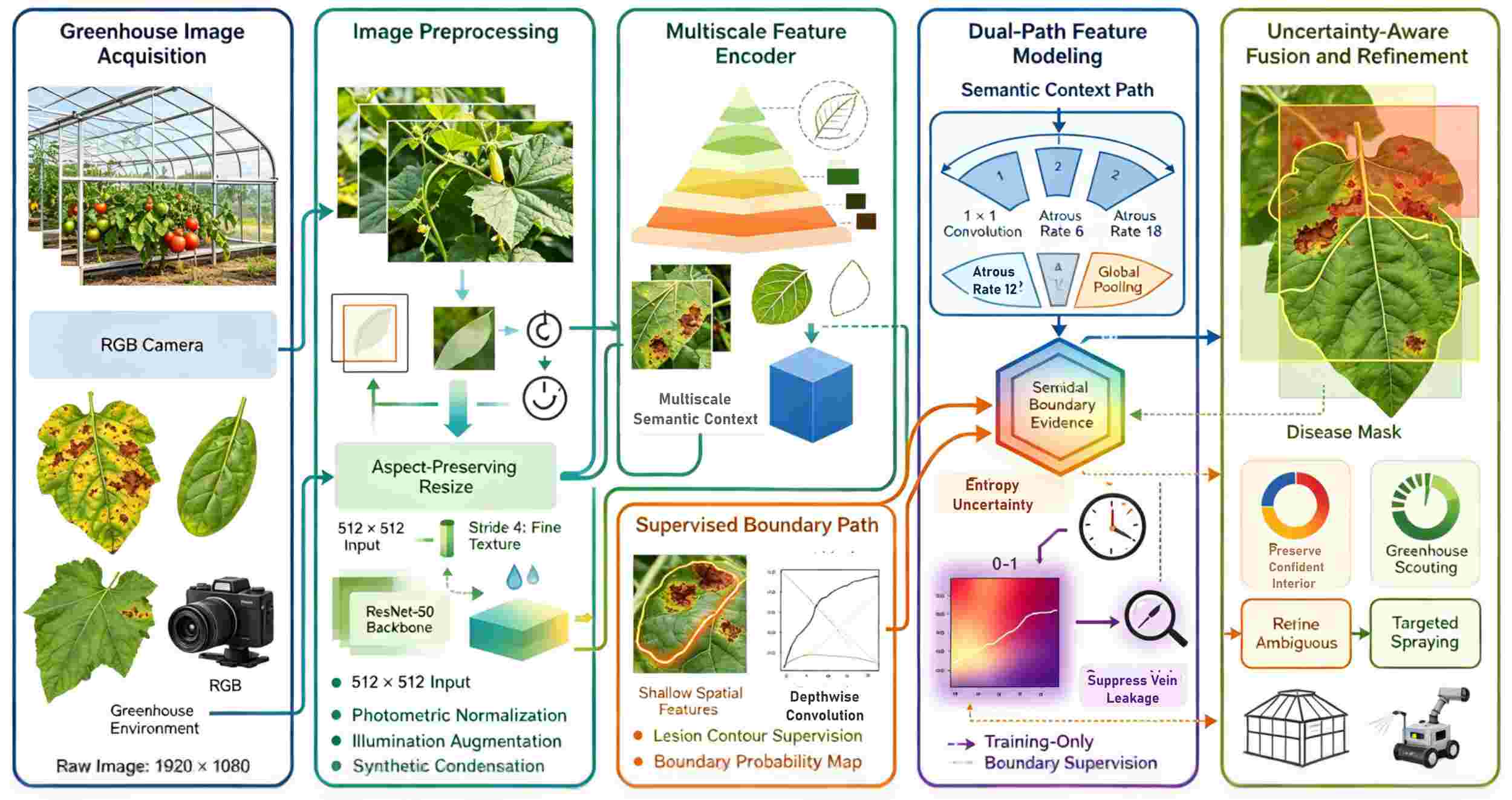
Accurate pixel-level delineation of crop disease in greenhouse images is challenging due to weak lesion margins, scale variations, leaf-vein interference, specular highlights and partial occlusion. This paper introduces a boundary-refined DeepLabV3+ model that keeps the encoder-decoder efficiency of the original framework and adds a boundary supervision branch, uncertainty-aware cross-scale fusion, and an adaptive refinement gate. The network is tested on a set of 6,840 curated greenhouse images that include leaves of tomatoes, cucumbers, peppers and eggplants, as well as 8 disease categories and healthy tissue. Under a fixed split by greenhouse compartment, the proposed model has achieved a mean intersection over union of 89.7%, a mean F1 score of 94.8%, and a boundary F1 of 86.9% at a two-pixel tolerance. The corresponding values are 3.8, 2.4 and 7.6 percentage points higher than those of the standard DeepLabV3+. The mean Intersection over Union (IoU) under low-illumination and condensation-blur conditions are 3.1 and 2.7, respectively. Ablation studies show that boundary supervision is responsible for most of the contour improvement, and uncertainty-aware fusion reduces false lesion expansion along veins. The model has 31.6 million parameters and, after mixed-precision optimisation, runs at 18.7 frames per second on an embedded graphics chip. Based on the above results, explicit boundary reasoning can improve the precision of disease-area estimation without sacrificing the efficiency required in practice; it is thus suitable for greenhouse scouting, targeted spraying and longitudinal severity assessment.
Downloads
Published
How to Cite
Issue
Section
License
Copyright (c) 2026 Milorad Vlahović, Gojko Vasiljev

This work is licensed under a Creative Commons Attribution-NonCommercial-ShareAlike 4.0 International License.